Archive
Tariffs are Good for Inflation
The news of the day today – at least, from the standpoint of someone interested in inflation and inflation markets – was President Trump’s announcement of a new tariff on Canadian lumber. The new tariff, which is a response to Canada’s “alleged” subsidization of sales of lumber to the US (“alleged,” even though it is common knowledge that this occurs and has occurred for many years), ran from 3% to 24% on specific companies where the US had information on the precise subsidy they were receiving, and 20% on other Canadian lumber companies.
In related news, lumber is an important input to homebuilding. Several home price indicators were out today: the FHA House Price Index for new purchases was up 6.43% y/y, the highest level in a while (see chart, source Bloomberg).

The Case-Shiller home price index, which is a better index than the FHA index, showed the same thing (see chart, source Bloomberg). The first bump in home price growth, in 2012 and 2013, was due to a rebound to the sharp drop in home prices during the credit crisis. But this latest turn higher cannot be due to the same factor, since home prices have nearly regained all the ground that they lost in 2007-2012.

Those price increases are in the prices of existing homes, of course, but I wanted to illustrate that, even without new increases in materials costs, housing costs were continuing to rise faster than incomes and faster than prices generally. But now, the price of new homes will also rise due to this tariff (unless the market is slack and so builders have to absorb the cost increase, which seems unlikely to happen). Thus, any ebbing in core inflation that we may have been expecting as home price inflation leveled off may be delayed somewhat longer.
But the tariff hike is symptomatic of a policy that provokes deeper concern among market participants. As I’ve pointed out previously, de-globalization (aka protectionism) is a significant threat to inflation not just in the United States, but around the world. While I am not worried that most of Trump’s proposals would result in a “reflationary trade” due to strong growth – I am not convinced we have solved the demographic and productivity challenges that keep growth from being strong by prior standards, and anyway growth doesn’t cause inflation – I am very concerned that arresting globalization will. This isn’t all Trump’s fault; he is also a symptom of a sense among workers around the world that globalization may have gone too far, and with no one around who can eloquently extol the virtues of free trade, tensions were likely to rise no matter who occupied the White House. But he is certainly accelerating the process.
Not only do inflation markets understand this, it is right now one of the most-significant things affecting levels in inflation markets. Consider the chart below, which compares 10-year breakeven inflation (the difference between 10-year Treasuries and 10-year TIPS) to the frequency of “Border Adjustment Tax” as a search term in news stories on Google.

The market clearly anticipated the Trumpflation issue, but as the concern about BAT declined so did breakevens. Until today, when 10-year breakevens jumped 5-6bps on the Canadian tariff story.
At roughly 2%, breakevens appear to be discounting an expectation that the Fed will fail to achieve its price inflation target of 2% on PCE (which would be about 2.25% on CPI), and also excluding the value of any “tail outcomes” from protectionist battles. When growth flags, I expect breakevens will as well – and they are of course not as cheap as they were last year (by some 60-70bps). But from a purely clinical perspective, it is still hard to see how TIPS can be perceived as terribly rich here, at least relative to nominal Treasury bonds.
Profits and Health Care: A Beneficial Connection
I usually try to avoid political commentary in this space, because it has become so personal to so many people. If I point out that a particular program of the “left” is smart, or cleverly put together, then half of my readership is annoyed; if I point out the same about the right, then half of my readership is angry. It doesn’t really make sense to waste article space except on those occasions when a policy has a clear effect on inflation over time, such as when the structure of the ACA made it clear that it would put upward pressure on inflation (as I pointed out in 2013) or in response to someone else’s flawed analysis of a policy, as I did last year when I tackled the San Francisco Fed for their weak argument about how the ACA would hold down inflation because the government would demand lower prices. Actually, there is no policy I have written about more than the ACA over the years – but again, this was economic commentary and not political commentary.
This article will be short, but different in that I am writing it to express frustration with the absolute lack of intellectual clarity on the part of the Republicans in making a particular argument that immediately impacts the debate over health care but also extends far into other policies. And, because the argument is simple, direct, and has tremendous empirical support, I couldn’t restrain myself. I expect this article will not be picked up and syndicated in its usual channels since it isn’t directly about economics or markets, but it needed to be said.
I’ve been stewing about this topic since Tuesday (March 14th), when I happened to catch part of the daily White House press briefing. Press Secretary Sean Spicer was asked a question about the President’s health care proposal, and tap danced away from the question:
Q Thanks, Sean. You mentioned the call with the CEO of Anthem Health. Can you tell me what this proposal of the President means for health insurance companies? Will their profits go up or down under the President’s proposal?
SPICER: Well, I don’t think that’s been the focus of the President’s proposal. It’s not about them, it’s about patients. But I think what it means for them is that they finally get to create more choice and more plans and allow people to choose a plan that fits them. Right now, they don’t have that choice. And, frankly, in more and more markets, companies like Anthem, UnitedHealth, Signa are pulling out — Aetna — because they don’t have the choice and because of the government mandate. I think what we want to do is allow competition and choice to exist so that they can offer more options for the American people.
Q But will those companies make more money under the President’s plan or less?
SPICER: I don’t know the answer to that. That’s not been the focus of what we’re doing now. And at the end of the day, right now they’re pulling out of market after market, leaving the American people with fewer and fewer choices. So right now it’s not a question of — from the last I checked, I think many of them were doing pretty well, but it’s the American people and its patients that are losing under the current system. So I think that there’s a way you can do a little of both.
Spicer’s response was the usual drivel that the Republicans have adopted when they run in fear from any question that includes the word “profits.” To summarize, the question was basically, “you’re doing this to throw a sop to fat-cat insurance companies, aren’t you?” and the answer was “we don’t think about that. No idea. Profits? Who said anything about profits? It’s about patients and choice. And, if anyone gets more profits, it wasn’t on purpose and we didn’t have anything to do with it.”
But this was actually a softball question, and the answer ought to have been something like this:
Q But will those companies make more money under the President’s plan or less?
BIZARRO SPICER: Well, I hope so. After all, the insurance companies want every person in America to have health care – which is the same thing that we want – because the more people they sell their product to, the more money they can make. The insurance companies want to sell insurance to every person in the U.S. The insurance companies also want costs to be lower, and constantly strive to lower the cost of care, because the lower that costs are, the more profit they can make in the short run. But they don’t want lower costs at the expense of health – clearly, the best outcome for their profits is that most people covered by insurance are healthy and so don’t require the insurance they’ve paid for. So, if we just get out of the way and let companies strive for better profits, we are likely to get more coverage, lower costs, and a healthier population, and that is the goal of the President’s plan.
The reason we don’t already have these things is that laws we have previously passed don’t allow insurance companies to offer certain plans, to certain people, which both sides want but which politicians think are “unfair” for one reason or another. Trying to create a certain preconceived Utopian outcome while limiting profits of insurance companies is what caused this mess in the first place.
If you want to beautify gardens in this city, does it make sense to limit the amount of money that gardeners can make? If you did, you would find fewer gardens got tended, and gardeners would not strive to make improvements that they didn’t get paid for. We can see this clearly with gardeners. Why is it so hard to understand with the companies that tend to the nation’s health? Next question.
For some reason, Republicans think that saying “profits are good” is the same thing as saying “greed is good” and leads to caricatures of conservatives as cigar-smoking industrialists. But while at some level it is the desire for a better material outcome – which I suppose is greed, but aren’t there degrees of greed? – that drives the desire for profit, we cannot dismiss the power of self-interest as a motive force that has the effect of improving societal outcomes. “It is not from the benevolence of the butcher, the brewer, or the baker that we expect our dinner, but from their regard to their own interest,” after all.
Of course, Republicans must also remember that profit without competition is a different animal. If an insurance company creates an innovation that lowers medical care costs, but does not face competitive pressure, then the benefit of the innovation accrues to the company alone. There is no pressure in such circumstances for the company to lower the price to the customer. But consider what happened to air fares after the deregulation of 1978, or to the cost of telephone service when the AT&T monopoly was broken up in 1984, as competition was allowed and even encouraged. Competition, and the more brutal the better, is what causes companies to strive for an edge through innovation, and it’s also what causes the benefit of that edge to eventually be accrued by the end customer. The government didn’t invent cell phones. Motorola did, in order to try and gain an edge against AT&T,[1] but until the telephone monopoly was broken up there were no commercial versions of the cell phone. The first cell phones cost $10,000 in 1983, about $25,000 in today’s dollars, but now they are ubiquitous and cost about 2% as much in real terms. But this didn’t happen because of a government program to drive down the cost of cell phones. It was the profit motive, combined with competition. All that government did was create the conditions that allowed innovation and competition to happen. And wouldn’t we like health care to be as ubiquitous and cheap as cell phones are?
This is not a hard thing to get right. It isn’t hard for people to understand. But for some reason, it seems incredibly hard for politicians to believe.
Note that nothing I have written here should be construed as an opinion about the President’s health care plan, which I have not read. My remarks are only meant to reflect on the utter inability of Republicans to properly convey the reasons that a different approach – one where the government’s involvement is lessened, rather than increased – would make more sense.
[1] The first cell phone call was made by the inventor, Martin Cooper at Motorola, who called his competition with it: the head of the cellular program at AT&T. According to him, he said “Joel, I’m calling you from a cellular phone, a real cellular phone, a handheld, portable, real cellular phone” and he said it got really quiet on the other end of the line.
Can’t Blame Trump for Everything
So much has happened since the Presidential election – and almost none of it very obvious.
The plunge in equities on Donald Trump’s victory was foreseeable. The bounce was also foreseeable. The fact that the bounce completely reversed the selloff and took the market to within a whisker of new all-time highs was not, in my mind, an easy prediction. I understand that Mr. Trump intends to lower corporate tax rates (and he should, since it is human beings – owners, customers, and employees – that end up paying those taxes; taxing a company is just a way to hide the fact that more taxes are being layered on those human beings). And I understand that lowering the corporate tax rate, if it happens, is generally positive for corporate entities and the people who own them. I’m even willing to concede that, since Mr. Trump is – no matter what his faults – certainly more capitalism-friendly than his opponent, his election might be generally positive for equity values.
But the problem is that equities are already, to put it generously, “fully valued” for very good outcomes with Shiller multiples that are near the highest ever recorded.
I think that investors tend to misunderstand the role that valuation plays when investing in public equities. Consider what has happened to the economy over the last eight years under President Obama: if you had known in 2008 that growth would be anemic, debt would balloon, government regulation would increase dramatically, taxes would increase, and a new universal medical entitlement would be lashed to the backs of the American taxpayer/consumer/investor, would you have invested heavily in equities? Yet all stocks did was triple. The reason they did so was that they started from fairly low multiples and went to extremely high multiples. This was not unrelated to the fact that the Fed took trillions of dollars of safe securities out of the market, forcing investors (through the “Portfolio Balance Channel”) into risky securities. By analogy, might stocks decline over the next four years even if the business climate is more agreeable? You betcha – and, starting from these levels, that’s not terribly unlikely.
I am less surprised with the selloff in global bond markets, and not really surprised much at all with the rally in inflation breakevens. As I’ve said for a long time, fixed-income is so horribly mispriced that you should only hold bonds if you must hold bonds, and then you should only hold TIPS given how cheap they were. Because of their sharp outperformance, 10-year TIPS are now only about 40-50bps cheap compared to nominal bonds (as opposed to 110 or so earlier this year), and so it’s a much closer call. They are not relatively as cheap as they were, but they are absolutely less expensive as real rates have risen. 10-year real rates at 0.37% aren’t anything to write home about, but that is the highest yield since March.
Some analysis I have seen attributes the large increase in market-based measures of inflation expectations on Mr. Trump’s victory. For example, 10-year breakevens have risen 20bps, from about 1.70% to about 1.90%, since Mr. Trump sealed the win (see chart, source Bloomberg).

I think we have to be careful about blaming/crediting Mr. Trump for everything. While breakevens rose in the aftermath of the election, you can see that they were rising steadily before the election as well, when everyone thought Hillary Clinton was a sure thing. Moreover, breakevens didn’t just rise in the US, but globally. That’s a very strange reaction if it is simply due to the victory of one political party in the US over another. It is not unreasonable to think that some rise in global inflation might happen, if Trump is bad for global trade…but that’s a pretty big reach, and something that wouldn’t happen for some time in any event.
In my view, the rise in global inflation markets is easy to explain without resorting to Trump. As the previous chart illustrates, it has been happening for a while already. And it has been happening because global inflation itself is rising (although a lot of that at the moment is optics, since the prior collapse of energy prices is starting to fall out of the year-over-year figures).
The bond market and the inflation market are acting, actually, like the Great Unwind was kicked off by the election of Donald Trump. We all know what the Great Unwind is, right? It’s when the imbalances created and nurtured by global central banks and fiscal authorities over the last couple of decades – but especially in the last eight years – are unwound and conditions return to normal. But if pushing those imbalances had a soothing, narcotic effect on markets, we all suspect that removing them will be the opposite. Higher rates and inflation and more volatility are the obvious outcomes.
Equity investors don’t seem to fear the Great Unwind, even though stock multiples are one of the clearest beneficiaries of government largesse over the last eight years. As mentioned above, I can see the argument for better business conditions, even though margins are still very wide. But I’m skeptical that better business conditions can overcome the headwinds posed by higher rates and inflation. Still, that’s what equity investors are believing at the moment.
*
A couple of administrative announcements about upcoming (free!) webinars:
On Thursday, November 17th (aka CPI Day), I will be doing a live webinar at 9:00ET talking about the CPI report and putting it in context. You can register for that webinar, and the ensuing Q&A session, here. After the presentation, a recording will be available on TalkMarkets.
On consecutive Mondays spanning November 28, December 5, and December 12, at 11:00ET, I will be doing a series of one-hour educational seminars on inflation. The first is “How Inflation Works;” the second is “Inflation and Asset Classes;” and the third is “Inflation-aware Investing.” These webinars will also have live Q&A. After each session, a recording will be available on Investing.com.
Each of these webinars is financially sponsored by Enduring Investments.
How Obama Helped Trump Win the White House
At this writing, Presidential Candidate Donald Trump is trailing Hillary Clinton in most assessments of the political map. While it is much closer than the 6-point spread in the national polling indicates (if all of the “toss-up” states on Real Clear Politics flip to Trump, rather than to Clinton as they now lean, then Trump scores a fairly easy victory), the winner-take-all betting markets put Clinton’s chance of victory near 90%. To be fair, though, let’s remember that the betting markets had the Brexit vote failing with similar certainty, even though the polls were similarly close.[1]
The October surprises, which by now are no surprise, have had essentially no effect. The jaded and cynical US public yawned at tales of Trump’s peccadilloes and the shocking, shocking tale that Clinton may have padded her pockets by selling influence while in office. And so…it’s over?
Well, not so fast. While the public now dismisses as normal behavior the sorts of things that we would fire an employee for (or divorce a spouse for) if they happened to people around us, and seems content to elect a flawed candidate regardless of the outcome on November 8th, there is something that they do care about, and deeply: their own money.
It is incredible to me, since I am just as cynical as the rest of the electorate, that when the Affordable Care Act was passed the open enrollment date was systematically placed just a few days before Election Day. That was either great confidence (“this is going to be great! They’ll love us and vote for us!”), great hubris (“it doesn’t matter whether this works, the sheeple will vote for us anyway”) or great carelessness (“oh, rats, didn’t think of that”). Because we now know that over the next several days, millions and millions of Americans will receive letters explaining to them that their existing plan will be outrageously more expensive in 2017 – in some cases, premiums will double – or may not be available at all.
I suspect that a taxpayer in North Carolina, who sees his premium jump 40%, is going to suddenly take notice of the Presidential election and wonder which candidate is more likely to solve that problem. Now, before you write your hate mail to me, let me note and acknowledge a few facts:
- I am not voting for either of the two major party candidates. I’m no Trump stooge. I think they’re both awful candidates. This article is just a commentary on what I think will happen, not cheerleading for an outcome I want to happen.
- Some voters will not see any change in their premiums because their subsidies will rise an equivalent amount to the premium. But,
- Most people who are squarely in the middle class will not get these subsidies. On the calculator at https://www.healthcare.gov, I can see that a family of four in New Jersey, earning $45,000, should not expect to be eligible for a premium tax credit or other savings. According to the Pew Research Center, a family of four with a $45,000 pre-tax income is in the lowest 25% of New Jersey residents arranged by income.
- Furthermore, someone who continues to get a subsidy is not likely to be as motivated to go out and vote for a continuation of the status quo as a person who is seeing a 40% rise is motivated to go out and vote for change. So, this is likely to cause a major change in the degree of motivation for one party compared with the other.
- Many voters will, instead, get a letter that their existing plan will no longer be offered, and this too will cause angst and anger.
- Voters who are covered by an employer plan are not immune just because the “employer pays.” When an employer’s cost for employee insurance rises 40%, that employer will either lay off workers, make them cover more of their own premium costs, or hold down other costs…such as salary increases.
Simply put, unless you are living under a rock you are aware of these dramatic changes in insurance costs and coverage. If you’re one of the few lucky ones to be subsidized (and even more if you’re lucky to have a cheap plan that you wouldn’t have had to get at all before the ACA passed), then you’re probably going to like the current regime. You may even be grateful, and go out to vote your thanks. But this is a small (and expensive!) minority of the electorate. The vast majority is going to see painful and drastic changes in the health care landscape. And they’re going to see it right about now. Again, what is really amazing to me is that the program designers made November 1st the notification deadline for re-enrollment letters.
Aside from the effect on the election, which I think might be dramatic, we need to also think about the effect on the economy. The good news is that while medical care inflation is likely to keep rising, the large jump this year is possibly a one-off effect because the ACA is removing subsidies of insurance companies that previously caused insurance to look cheaper than it really was. But that won’t help this year’s politicians.
The large rise in premiums, incidentally, is also going to have a depressing effect on economic growth next year because it hits the middle of the income distribution the hardest. If Bill Gates sees his insurance costs go up 40%, it’s no big deal. But if Fred the plumber from Poughkeepsie sees his insurance costs go up 40%, he’s going to be buying less of something else that is discretionary. Cars, clothes, meals out perhaps?
The election is mere days away. If Trump wins, despite his every effort to make himself unelectable, he will have one person to thank most profusely: President Obama.
[1] Remember that the betting markets work like options – as time to maturity goes to zero, gamma at the strike price goes to infinity. That is, with no time left the value of the Clinton option – which, since it’s a binary option, is the same as its delta – goes from 100% if she wins by 1 vote in a state that puts her 1 electoral vote over Trump, to 0% if she loses by 1 vote in that same state. Six months ago, one vote would have no effect on option price; but if we are around the strike as we are now even small changes can have large effects on price.
Greece: We Get It
“When in the Course of human events it becomes necessary for one people to dissolve the political bands which have connected them with another and to assume among the powers of the earth, the separate and equal station to which the Laws of Nature and of Nature’s God entitle them, a decent respect to the opinions of mankind requires that they should declare the causes which impel them to the separation.
“We hold these truths to be self-evident, that all men are created equal, that they are endowed by their Creator with certain unalienable Rights, that among these are Life, Liberty and the pursuit of Happiness. — That to secure these rights, Governments are instituted among Men, deriving their just powers from the consent of the governed, — That whenever any Form of Government becomes destructive of these ends, it is the Right of the People to alter or to abolish it, and to institute new Government, laying its foundation on such principles and organizing its powers in such form, as to them shall seem most likely to effect their Safety and Happiness.”
Greece has voted ‘no.’ It should not surprise us that this has happened. The only surprise is that it took this long for “one people to dissolve the political bands which have connected them with another.”
Make Hay While the Sun Doesn’t Shine
Today new Fed Chairman Janet Yellen jumped on the bandwagon in blaming the recent growth slowdown on the weather.
Here’s what I have to say about the news and the weather.
First, although it’s becoming quite passé to point this out, the weather should account for a slowdown in economic activity – but, since economists were aware of the weather (presumably), it is less clear that it should account for a surprise in the amount of slowdown we are seeing. The chart below (source: Bloomberg) shows the Citibank economic surprise index, which measures how much recent data have exceeded (positive) or fallen short (negative) of expectations. It is not a measure of growth, per se, but merely of the direction in which economists are missing. I have plotted both the US index and the Eurozone index.
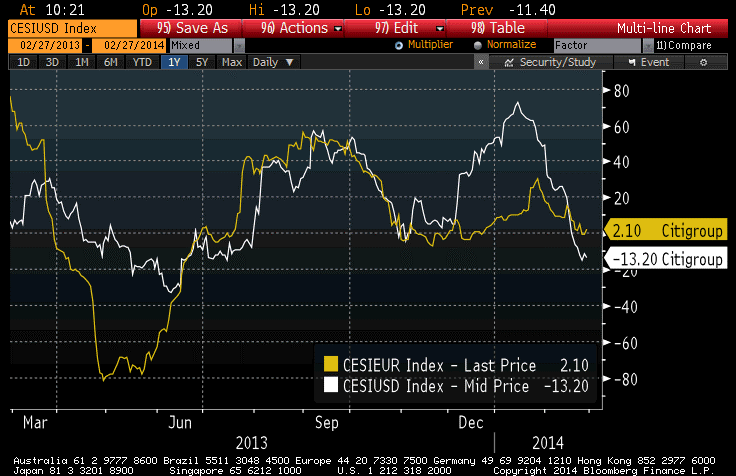
Obviously, economists were far too pessimistic about the numbers in December and January (reflecting data from October to December, and data kept exceeding their estimates. But now they are over-exuberant. So it isn’t that the numbers are falling short; it’s that they’re falling short of where economists (who can presumably recognize snow) thought they would be incorporating the known weather drags. That could simply mean the weather had a worse impact on real people than the bow-tied set thought it would. Or it could mean data is weaker than it ought to be.
Second point: just because the weather was bad should not be taken as carte blanche for the economy to collapse. If the economy was really as strong as equity investors seem to think, should weather be able to derail it so easily? Yes, weather makes it harder to detect the natural rhythm of what is going on, but it wasn’t as if that was easy to begin with. The danger is, as I suggested a week and a half ago, when all news can only be neutral or good. That’s a bad sign for once the weather normalizes again and it gets impossible to shrug off bad news as easily.
Third point: was the weather as bad in Europe? Because, as you can see from the chart above, economists have also been missing on the optimistic side for European figures. To be sure, they’ve been missing by less, and the numbers surprised less on the positive side over the last couple of months, but I don’t know that the Polar Vortex ought to be affecting Italy as seriously as it is affecting Chicago.
All of which is simply to say that the weather isn’t going to be bad forever, so … make hay while the sun doesn’t shine, I guess. Stocks are flat on the year, the hard way (but commodities are +6.5%, measured by the DJ-UBS index; according to our valuation estimates, that should be the normal case over the next few years rather than the rarity it has been over the last few).
It is interesting, too, that as bad as the weather effect has been on the construction industry and sales it hasn’t really impacted the price dynamics at all. The chart below (source: Bloomberg) shows Existing Home Sales in white, and the year/year change in median sales prices of existing single-family homes. Sales are 14% off their highs (seasonally-adjusted, which you should take with a grain of salt due to the unseasonal weather, but notice that the decline started in August when the snow was appreciably lighter), yet prices are still rising at nearly 11% year/year.

Now, a housing bull will say that these are the opposite faces of the same coin. They would say, “because there is so little inventory available – according to the NAR, only 1.9mm homes are for sale, which is higher than last winter but otherwise the lowest since 2002 – prices are rising and fewer are being sold because of the shortage of supply.” This is certainly possible, although I wonder at where all of the ‘shadow supply’ and bank REO property got off to so quickly, especially since the pace of existing home sales (and new home sales) remain at such low fractions of the pace prior to 2007 (existing home sales is currently 64% of the peak rate in 2005; new home sales are at 34% of the 2005 peak). How do you get rid of inventory without selling it?
The housing market continues to be a conundrum, but without a doubt prices are rising. And, also without a doubt, rising home prices are beginning to push rents higher. More economists are raising their forecasts for core inflation looking forward over the next year. Of course, readers of this column know that this is old news here. Speaking of which, Enduring Investments’ Quarterly Inflation Outlook for Q1 has been published. Institutional investors and others interested in our services can register for this private report on our website by filling out the contact form and requesting access to the blog.
Finally, I want to make one observation about the complete impotence of the Republicans to respond to the Democrats’ push for a higher minimum wage. It is terribly distressing to see such bad economics from one party (in this case, the Democrats) and such utter lack of common sense responses to bad economics from the other party (in this case, the Republicans). Here is the only question that needs to be answered: if raising the minimum wage has only salutatory effects on the economy and on the working class, then why not raise it to $1000/hour? Why not $10,000 per hour? Surely, if raising the minimum wage is good, then raising it more can’t be bad. Republicans should be amending the bill to make the minimum wage $10,000/hour.
The obvious answer is that if the minimum wage was $10,000/hour, no one would hire anybody – and we all know that, and even Democrats know that, and we all know why: because there is almost no one in the country who can produce enough goods or services to be worth $10,000/hour. If you are hiring people, you have to decide whether you will get enough out of them to afford their labor and still stay in business. The answer is obvious at $10,000. But it’s the same question at $10: can this group of workers produce enough so that I can afford to pay them all $10? If not, they will not be earning $10/hour but $0/hour (or at least some of them will be). We know exactly what would happen with a $10,000/hour minimum wage, and it’s easy to demonstrate it. But the Republicans are absolutely inarticulate on this point, and on most points, and that is why they keep losing arguments where they have the stronger position.
Housekeeping Note: earlier this week I published an article on the Mt. Gox/bitcoin fiasco. If you didn’t see the note (it didn’t get out on all of the syndication channels), you can find it here.
More on Health Care: Agreeing on the Questions
Since I wrote a blog post in early December on “The Effect of the Affordable Care Act on Medical Care Inflation,” in which I lamented that “I haven’t seen anything of note written about the probable effect of the implementation of the Affordable Care Act on Medical Care CPI,” several things have come to my attention. This is a great example of one reason that I write these articles: to scare up other viewpoints to compare and contrast with my own views.
In this case, the question is not a trivial one. Personally, I approach the issue from the perspective of an inflation wonk,[1] but the ham-handed rollout of the ACA has recently spawned greater introspection on the question for purely political reasons. This is awkward territory, because articles like that by Administration hack Jason Furman in Monday’s Wall Street Journal do not further the search for actual truth about the topic. And this is a topic on which we should really care about a number of questions: how the ACA is affecting prices, how it is affecting health care utilization and availability, how it is affecting long-term economic growth, and so on. I will point out that none of these are questions that can be answered definitively today. My piece mentioned above speculated on possible effects, but we simply will not know for sure for a long time.
So, when Furman makes statements like “The 7.9 million private jobs added since the ACA became law are themselves enough to disprove claims that the ACA would cause the sky to fall,” we should immediately be skeptical. It should be considered laughably implausible to suggest that Obamacare had a huge and distinguishable effect before it was even implemented. Not to mention that it is very bad science to take a few near-term data points, stretching only for a couple of years in a huge and ponderous part of the economy, to extrapolate trends (this is the error that Greenspan made in the 1990s when he heralded the rise in productivity growth that was eventually all revised away when the real data was in). Furman also conflates declines in the rate of increase of spending with decelerating inflation – but changes in health care spending include price changes (inflation) as well as changes in utilization. I will talk more about that in a minute, but suffice to say that the Furman piece is pure politics. (A good analysis of similar logical fallacies made by a well-known health care economist that Furman cites is available here by Forbes.)
I want to point you to another piece (which also has flaws and biases but is much more subtle about it), but before I do let’s look at a long-term chart of medical care inflation and the spread of medical care inflation to headline inflation. One year is far too short a period to compare these two things, not least because one-time effects like pharmaceuticals losing patent protection or sequester-induced spending restraints can muddy the waters in the short run. The chart below (source: Enduring Investments) shows the rolling ten-year rise in medical care inflation and, in red, the difference between that and rolling ten-year headline inflation.
 You can see from this picture that the decline in medical care inflation, and the tightening of the spread between medical care inflation and headline inflation, is nothing particularly new. Averaging through all of the year-to-year wiggles, the spread of medical care has been pretty stable since the turn of the century (which, since this is a 10-year average, means it has been pretty stable for a couple of decades). Maybe what we are seeing is actually the anticipation of HillaryCare? (Note: that is sarcasm.)
Now, the tightening relative to overall inflation is a little exaggerated in that picture, because for the last decade or so headline inflation has been somewhat above core inflation due to the persistent rise in energy prices throughout the ‘00s. So the chart below (source: Enduring Investments) shows the spread of medical care inflation over core inflation, which demonstrates even more stability and even less reason to think that something big and long-term has really changed. At least, not that we would already know about.
 The other piece I mentioned, which is more worth reading (hat tip Dr. L) is “Health Care Spending – A Giant Slain or Sleeping?” in the New England Journal of Medicine. The authors here include David Cutler, whom Forbes suspected was tainting his views with politics (see link above), so we need to be somewhat cautious about the conclusions but in any event they are much more nuanced than in the Furman article and the article makes a number of good points. And, at the least, the authors distinguish between spending on health care and inflation in health care. A few snippets, and my remarks:
- “Estimates suggest that about half the annual increase in U.S. health care spending has resulted from new technology. The role of technology itself partly reflects other underlying forces, including income and insurance. Richer countries can afford to devote more money to expensive innovations.” This is an interesting observation that we ought to think carefully about when professing a desire to “bend the cost curve.” If we are reining in inflation, that’s a good thing. But is it a good thing to rein in innovation in health care? I don’t think so.
- The authors, though, clearly question the value of technological innovation. “The future of technological innovation is, of course, unknown. But most forecasts do not call for a large increase in the number of costly new treatments… some observers are concerned that a wave of costly new biologic agents (for which generic substitutes are scarce) will soon flood the market.” Heaven forbid that we get new treatments! “The use of cardiac procedures has slowed as well.” This is a good thing?
- “Health spending has clearly been associated with health improvements, but analysts differ on whether the benefits justify the cost.” Personally, it makes me uncomfortable to leave this question in the hands of the analysts. If the benefits don’t justify the cost, and the market was free, then no one will pay for those improvements. It’s only with a highly regulated market – replete with “analysts” doing their cost/benefit analysis on health care improvements – that this even comes up.
- Some of the statistical argument is a little weak. “The recent reduction in health care spending appears to have been correlated with slower employment growth in the health care field; this suggests that such changes may continue.” I’m not sure that the causality runs that way. Surely tighter limits on what health care workers can earn might cause slower employment growth? That’s at least as plausible as the direction they are arguing.
That sounds very critical, but I point these things out mainly to make them obvious. Overall, the paper does a very good job of discussing the possible causes of the recent slowdown in health care inflation (although they focus inordinately on “the first 9 months of 2013”, a period during which we know the sequester impacted health care prices), give plenty of credit to reforms instituted far before ACA implementation, correctly distinguish between utilization and prices, and highlight some of the promising trends in health care costs – and yes, there are some! The authors are clearly supportive of the ACA, which I am not, but by and large they raise the salient questions.
It matters less if we instantly agree on the solution than that we agree on the questions.
[1] Actually, a little more than a generic inflation wonk in this case; I’ve also written about, presented on (and you can listen to my presentation while you walk through the slides) and consulted on the topic of hedging health care inflation, for example in post-employment benefit plans.
RE-BLOG: My Two Cents On Nonsense
Note: The following blog post originally appeared on March 13, 2012 and is part of a continuing year-end ‘best of’ series, calling up old posts that some readers may have not seen before. I have removed some of the references to then-current market movements and otherwise cut the article down to the interesting bits. You can read the original post here.
I had not planned to write tonight, but there was too much that happened today, and too much that is likely to be misunderstood and misinterpreted. Not, necessarily, that what follows will help that situation, but I felt a need to add my two cents (which, don’t forget, is two cents more than you paid for it, so you’re two cents ahead no matter what).
…
And this takes us to the final, and most interesting, event of the day. It began when JP Morgan trumpeted a nickel increase in its dividend and a $15bln stock buyback. My first reaction was that this is not a phenomenon you tend to see in bear markets or early in bull markets, but rather in mature bull markets. Firms have a marked tendency to buy stock back when it’s expensive, not when it’s cheap, and an even more marked tendency to announce a buyback when they want a stock price supported. An announcement of a buyback program is not a promise to buy, and often no stock is actually bought. It is only an announcement of an intention to buy, which the firm need not honor. And this is a bank. Anyone with even a passing knowledge of Basel III knows that banks are going to be raising Tier 1 capital – especially in Europe, but in the U.S. as well – for a while. There is no way that banks, whether or not they feel overcapitalized by 2000s standards or not, are actually going to be buying back large chunks of stock. So my second thought was “wow, are they actually going to scare up the stock so that they can sell more? That can’t be legal.”
Moments later, we found out what the real point was. It seems the Fed had completed the stress tests and informed all of the banks a couple of days ago (it’s unclear when), and were going to make a public announcement on Thursday.
Sidebar: This is why people think that Wall Street is run by a bunch of crooks. The moment that banks had this information, they were in possession of material nonpublic information that should have been immediately released if the banks were going to prepare any offering in their own securities. Whether the Fed says they can or can’t, the information must be released. And here is one positive checkmark for JPM: they announced that the Fed had approved their buyback and dividend plans in the context of passing the stress test. But thanks a lot, Fed, for putting banks in the awkward position of having to choose between ticking off the Fed, or ticking off the SEC. And great job, bank managements, for mostly choosing to keep a secret that makes you look like a member of an elite club/secret cabal, rather than choosing to release the information. Good job, JPM. (But I’m not done with you yet).
So, the Fed decided that they needed to immediately release the stress tests results, early. Well, not immediately; they decided to wait until 4:30ET, after the markets closed to retail investors, because golly it would be too much to ask to let people get the information when the markets were open. Sidebar: this is why people think the Fed is run by a bunch of crooks who are in bed with the Wall Street crooks. Who is running the PR at the Fed?
Bank of America bravely followed JP Morgan through the breach to announce that they, too, had passed the stress tests. US Bank announced a share buyback, dividend hike, and a passing stress test grade. (Quick quiz, with the answer to be given later: are the banks announcing share buybacks likely to be the strong banks or the weak banks with respect to the stress test? Write down your answer and we’ll come back to it.) Volume on the exchange spiked, with better than 50% of the day’s volume coming in the last hour of trading, and almost 30% in the last 7 minutes before the bell.
The stress test results were released, and four financials failed: Ally Financial, SunTrust, MetLife, and Citigroup. Well, good luck raising capital now, Citi. (Important Disclosure: I am expressing no opinion on any of these individual equities or any of the other securities of these companies. I neither own, nor intend to buy, nor sell, any of their securities in the near future. My negative opinion on banks generally is well-known, but I do not have any position, positive or negative, on the banking sector, nor do I plan to make such a sector bet in the near future).
Now, initially the press coverage listed three of the four firms that failed, but not MetLife, so I was forced to go skimming through the “CCAR” report to find the fourth one. If I hadn’t done that, I almost certainly would not have noticed Figure 7, which is reproduced below for your easy reference.
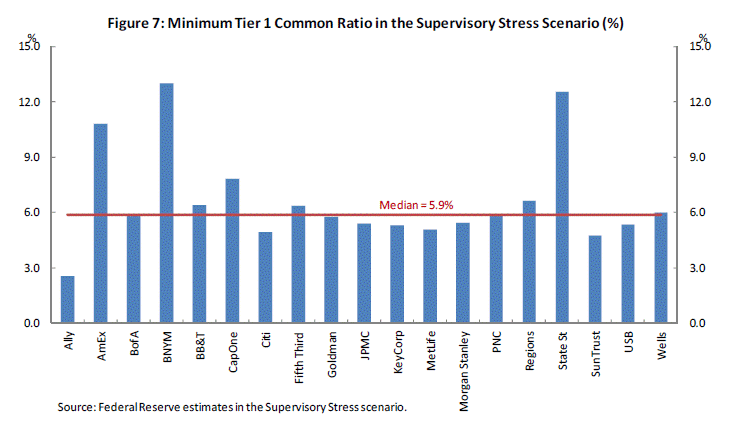
You can see the four banks which failed are the shortest bars on this chart, so you can easily pick out Ally, Sun Trust, Citi, and with a straightedge you can conclude that MetLife is the fourth. But then it’s a really close race for fifth-worst with KeyCorp, US Bank, Morgan Stanley, and… JP Morgan. It must be great to be JP Morgan. When you wonder why they drew the line where they did, you might imagine the counterfactual situation where JP Morgan came out on the other side of the line. JP Morgan, which was the Fed before there was a Fed, and will probably be the Fed after the Fed is gone. JP Morgan, which the Fed called on multiple times during the crisis to save the world (for example, by serving as a lending conduit to entities which the Fed could not directly lend to). I wonder what the odds are that JP Morgan would be allowed to fail? I’m going to speculate: zero. And that’s why the line is where it is.
Now, it is interesting to see which banks scored very highly. They’re banks that don’t have exposure to as many of the blow-up areas that were tested by the Fed (which is not to say they aren’t exposed to blow-ups: just that they’re not the ones that the Fed tested).
By the way, don’t let anyone tell you “well, this was a really severe test, and so these banks are actually in really good shape.” Yes, this test is much more stringent than the cotton-candy version the European regulators put their banks through last year, but it only measures expected reactions to broad macroeconomic events, and not the interaction of the entire system under such a stressful scenario. That reaction is non-linear, and it is very difficult to model. Moreover, we can’t model the unknown: a rogue trader, a $65billion Ponzi scheme, a tsunami and nuclear meltdown in Japan, a terrorist attack in New York. As Roseanne Roseannadanna used to say, “It’s always something.”
When all is said and done, are we better off that the Fed did these stress tests? I suppose the answer is yes, if only because it means the regulators actually took some interest in looking at these businesses and their risks. But if it creates a false sense of comfort, or reverses the trend towards greater capital cushions, then probably not. Time will tell.
I am about ranted out for today, and there are no important economic releases tomorrow. It will be interesting to see how the spin machines work on Citigroup and JP Morgan, which are after all separated by only a thin line on Figure 7, but by a huge gulf in reputation.
———
You can follow me @inflation_guy, or subscribe to receive these articles by email here.
Just Waiting for the Shaking to Stop
Obama started backing off the “absolute default” tactic by today saying “This week, if we don’t start making some real progress both in the House and the Senate, and if Republicans aren’t willing to set aside some of their partisan concerns in order to do what is right for the country [ed. note: our guys are always the patriots and the other guys are always the partisans, right?], then we stand a good chance of defaulting.” So, it’s no longer a sure thing, and the hurdle he has laid out is “good progress” rather than a hard stop.
As I have said before, there should be no default even if there is no agreement reached in our day. There simply is no reason to default unless the Administration decides it is politically opportune to do so. Last week, White House spokesman Jay Carney said “prioritization is default,” meaning that the government would somehow be defaulting by choosing to pay debtholders before others, but that’s simply wrong. Servicing the bonds is most assuredly not a default no matter what else you do. Carney might mean “prioritization is a bad political situation for us,” and he might mean “not paying some vendors would be, if we were a private company, grounds for being forced into bankruptcy,” but the US Govt isn’t a private company and there is no way to force it into default if it services its debt. And it is interesting that the President is now walking back his threats that a default was inevitable if no agreement is in place by the time the debt ceiling is reached.
I am not so sanguine that the current developing deal in the Senate is going to end the impasse. Although Senate Republicans seem willing to give the Administration all that it wants, and probably to apologize as well, the House Republicans already tried their version of a complete surrender and it was roundly rejected by the Administration (and why shouldn’t it be rejected? With the government shut down and the constant threat of default in the air, stocks are +1.7% this month. Toy with us some more, please!). By the time this crisis is over, the Republicans will probably be offering to repeal the 22nd Amendment and let Obama serve another term!
If, in fact, the standoff is resolved, it remains to be seen how quickly all of the economic data releases get back on line once the government is back at work. In any case, some of the data from this month will be suspect because the regular collection procedures will not be followed. For example, even if CPI is released on Thursday (or delayed and released before the end of the month), it will not be based on a full month’s regular survey of prices since for the last week or two no one has been collecting prices. This will be corrected in the next release (since what the price collectors are surveying is the level of prices, not the change in prices), but it may lead to near-term confusion due to the indeterminate effects. Other releases suffer from similar problems of greater or lesser order, but considering how important CPI is right now this is a prime concern.
It is a prime concern right now firstly because the artificial inflation trough induced by the original sequester has passed and inflation will be rising going forward, and secondly (and more importantly) because we will soon have a new Federal Reserve Chairman in Janet Yellen who will have to confront the issue very quickly and either burnish or reject her dovish credentials. So far, it seems clear to most of us that Yellen is a committed dove although a story that circulated in late September tried to argue that since she had been an advocate of a formal inflation target it means she is actually a hawk.
Favoring an annual inflation target has almost no implications for interpreting whether a monetary policy maker is a hawk or a dove. In fact, of the various targeting regimes proposed the non-correcting annual target is the most dovish proposal. That’s because there is no penalty for missing the target. With this sort of target, if you have 2% inflation followed by 20% inflation followed by 2% inflation, you’re back on target and the central bank need do nothing further. But, of course, prices are much higher than if you’d experienced 2%, 2%, and 2%. Other proposals, such as the long-term price-level proposal, force the central bank to steer to a particular compounded inflation level, which means that a big miss to the upside must be “paid back” by a subsequent miss to the downside. Now that is a much more hawkish proposal, because it defends long-term inflation levels rather than declaring a toothless goal. (You can read more about inflation targeting in my article here from 2010). Yellen is among those who thinks it’s important to convince everyone there is a goal, because “grounded inflation expectations” (even if they’re not rationally grounded but rather grounded because you tricked consumers into thinking you really have a target) help to restrain inflation. And on this point there is really not much evidence.
But it also misses the point in the extant environment. If Yellen desires to limit inflation, merely stating that she wants inflation to stay around 2% isn’t a policy action, or even a policy preference. It’s merely an expression of her preference for possible states of the universe. My children do approximately the same thing, with the same effect, when they say “I wish we could have a horse/travel to the Caribbean/build an indoor pool.” Yeah, and I wish I had a Jaguar, too.
Wishing doesn’t make it so. If Bernanke/Yellen want to limit inflation to 2%, merely talking about it is insufficient. What Yellen needs to do is to take action now. (Actually, they needed to take action two years ago, but it’s like James Carville famously said: “the best time to plant a tree was twenty years ago. The second-best time is right now.”) To the extent that Yellen is not urging action to reduce the Fed’s balance sheet and restrain future money growth it means that either she doesn’t really care about 2% inflation, at least in the near-term, or she doesn’t understand what causes inflation. I suppose I hope it is the latter cause, since that would be consistent with Bernanke’s position: he probably cares about limiting inflation but doesn’t understand that letting the balance sheet grow without bound is among the worst things he can do to limit inflation in the medium-term.
No Default in Our Day
I suppose it should not be surprising that there is a great deal of misinformation and misunderstanding about the debt limit and government default. A lot of people and especially folks in the media don’t understand these issues because they have never confronted them, and the warring parties seem to believe they have an incentive to get the media telling their story by whatever means necessary, even if that means spreading disinformation.
Some of this is confusion among non-financial people about what “default” actually means. An individual defaults when he or she fails to pay bills within a reasonable time after they come due. If the default is serious enough, a creditor can force the defaulting party into bankruptcy and attach assets.
This isn’t what it means to default as a sovereign country, however. A sovereign default is when a nation fails to pay interest or principal on its debt when due. And that’s all. If the U.S. fails to pay its soldiers, that is not default. It’s a bad move, perhaps, but it is not default. If the government doesn’t pay you, you can sue…but even if you win, there is no Chapter 7 or Chapter 11 bankruptcy for the U.S. government so you cannot attach assets. So this distinction is key: if the U.S. services the debt, there is no default. This is the case whether or not the debt limit increases or not.
It is much more surprising to read James Baker, who among other things has been Treasury Secretary, equating the debt limit increase with solvency. Mr. Baker was interviewed for Peggy Noonan’s column this week in the Wall Street Journal and said, speaking of the President, “He has to get the debt limit raised to avoid default.”
We can walk this through and show why there need not be a default in the case where the debt limit is not raised.
While the government at some point ceases to spend, since it doesn’t have Congressional authorization to do so, it still continues to collect revenue. The U.S. takes in a little less than $3 trillion per year in revenues, and if you think those taxes don’t need to be paid while the government is shut down I invite you to try. Against that revenue, interest payments on Treasury bonds are on the order of $300bln (I don’t have the exact figure). Principal repayments aren’t relevant for this calculation, because as bonds mature the Treasury can re-issue the same nominal amount of bonds. So all the Treasury needs to do in order to avoid default is to pay the interest. They probably also want to pay the $1.6 trillion in Social Security and Medicare payments, and maybe a fair amount of the $700bln in defense and homeland security spending although a lot of that is procurement. But there’s plenty more than is needed to avoid a default.
Incidentally, in theory the Treasury could take in more money by issuing Treasuries with above-market coupons. Perhaps there is a statute that requires the Treasury to always pay the minimum coupon possible, although I am not aware of it. But if there isn’t such a statute, then the Treasury could raise more money by doing the following: when a $10bln TBill issue comes due, the Treasury immediately re-issues a $10bln, 10-year, 10% bond at a price of around 165% of par. Voila, an extra $6.5bln for the coffers. What is limited by statute, as far as I know, is the face amount of bonds that may be issued, not the amount of money that can be taken in.
Now, the Treasury claims that it is unable to pay selected obligations. According to them, it is not operationally possible – the check run is either on, or it is off. All, or nothing. This represents either ridiculous incompetence, or an outright lie. Seriously? The Treasury has no way to cut a single check if it wants to? How about this: take a big stack of blanks and, instead of running them through the printer, fill them out by hand and have the Secretary sign ’em. Painful? Absolutely. But it is inconceivable that it isn’t possible to run only some checks. The Secretary should speak to his I.T. guys.
We should keep in mind that the Secretary is the President’s former Chief of Staff, and probably knows a lot more about the politics of appearing to be unable to pay than he does the actual capabilities of the machinery.
Does any of this make default impossible? Of course not. There is always the possibility that politics or petulance cause the President to simply refuse to order the Secretary to prioritize interest payments on the debt. It would most likely cause dramatic long-term costs for the government and precipitate a real crisis, and I wonder if it might even be impeachable (the 14th Amendment does not seem to me to give the President the power to raise the debt ceiling and pay anything he wants, but it certainly seems to give him the power to cut checks in order to defend the “validity of the public debt of the United States authorized by law, including debts incurred for payments of pensions.”) But there is no financial reason that failure to raise the debt ceiling should result in an actual default.
