Archive
Inflation in One Easy Lesson
For Christmas, my daughter gave me the pamphlet “Inflation in One Easy Lesson,” by Harry Scherman. (Yes, I am that typecast that my daughter gives me inflation memorabilia for Christmas!) It was written during World War II, and distributed by the Council for Democracy. It is so delightfully simple and direct, and makes the main point so obvious, that I want to share it. It also happens to be, given the current war against Iran, somewhat timely. Here is the cover:

I scanned the whole pamphlet into a pdf, after ascertaining with some confidence that the pamphlet is no longer under copyright as there is no sign the copyright was renewed after the initial period of protection. If you believe yourself to hold a copyright on this material, please contact me at inflationguy@enduringinvestments.com and I will remove the post.
Here is the 22-page pamphlet. Frankly the pictures are wonderful by themselves, even without the text!
Modeling Shortfall Risk versus Inflation – What a Good Hedge Looks Like
When people ask me about hedging inflation, they aren’t always asking what they think they’re asking. There are two approaches to addressing inflation in your portfolio so that the portfolio grows in real terms. One of the approaches is to try to simply outrun inflation: “If inflation averages 3%, and I have an investment that averages 5%, I’ve succeeded.” This mode of thinking derives, I think, from the fact that all of our education has been in nominal space and in most financial modeling problems inflation is just assumed rather than modeled as a random variable. It turns out to be a lot harder than it sounds to find an asset class or collection of asset classes that dependably beat inflation over moderate (10+ year) periods, because there is significant (inverse) correlation between inflation and the performance of many asset classes. Most obvious here are stocks and bonds, so if you build a 60-40 portfolio that “should” return 5% over the long term and figure that will beat inflation, you’ll be right…as long as inflation stays low. If inflation goes up, you won’t only lose purchasing power but you’ll lose actual nominal value, since equities and bonds both tend to decline when inflation goes up. Let’s put that aside for a second but I will come back to it.
The other approach to addressing inflation is to try to hedge inflation: exceed inflation by a little bit, but all the time, so that your returns go up when inflation goes up and your returns go down when inflation goes down, but you always are experiencing some positive real return.
The difference between the first approach and the second approach can be summarized by thinking about shortfall risk. As an investor, you care about the upside (in real terms) but most of us are risk-averse meaning that we care more about the downside. Ask most people whether they’d risk a 25% loss in their portfolio purchasing power to have a similar risk of gaining 25%, and they will experience a strong preference to avoid that coin flip. Risk aversion isn’t linear, so investors treat small gains and losses differently from large gains and losses, and of course it matters whether you’re barely covering your goals or easily exceeding them so that you’re ‘playing with house money.’ Many things, in other words, affect risk preferences. But the bottom line is that if you are trying to ‘hedge’ inflation, you care about your shortfall risk over some horizon. What is the probability that you underperform inflation – that is, lose value in real terms – by some given amount between now and a stated horizon?
Now we are going to get a little mathy, but for those who aren’t so mathy I will try to explain in English as well.
If you want to evaluate the probability of asset B underperforming asset A by some given amount over some period, of course you need an estimate of the expected returns of A and B, or how they’re expected to drift relative to one another. That determines your jumping off point. Let’s suppose that A and B have the same expected return. The next thing that determines the frequency and severity of a shortfall of B versus A is the volatility of the spread between them, which is driven by (a) how correlated A and B are, and (b) how volatile each of them is. If they are highly correlated but B is far more volatile than A, you can have a large shortfall if B just has a bad day. If they aren’t very correlated, then when B happens to zig lower as A zags higher, you’ll get a shortfall even if they have similar volatilities. Essentially, we are valuing a spread or Margrabe option and like any option, we need a volatility parameter. In this case, it’s the volatility of the spread we care about, so we can evaluate “what’s the likelihood that the B-A spread is negative.”
If “SA” is the value of an inflation index (or an indexed token like USDi), and “SB” is the value of the hedging asset, then if distributions of A and B are approximately normal,[1] the option value is
C = SA N(d1) – SB N(d2), where

and

and, crucially, is the volatility of the ratio of A to B, which is a formula that will be familiar to travelers in traditional finance and depends on the individual asset volatilities and the correlation () between them:

For this ‘shortfall’ option to be as small as possible, assets A and B should have small volatilities () and a high correlation () between them.
In plain English terms: imagine two drunk guys walking down the boardwalk. What determines how far away they are from each other at any given time? Assuming no drift, it will depend on how much they’re weaving (volatility) and how much they’re weaving in the same pattern (correlation). If they’re holding hands (imposing high correlation), they’ll never get too far away from each other. And if neither one is very drunk (low volatility) they also won’t stray very far from each other. On the other hand, if both are wildly drunk and they don’t know each other, the spread between them will be wildly variable.
We aren’t trying to evaluate the spread between drunks, though. Let’s take this thought process and apply it to the inflation-hedging problem with an example. Suppose you are considering which of two assets is a better ‘hedge’ for inflation: the “INFL” ETF, or a mystery fund – let’s call it “EUSIT.”[2] Here is relevant data for these two assets, and for CPI. These are 3-year returns, volatilities, and month/month correlations, ending November 2025:

Using this data, we can see that the spread volatility (the result of the last formula listed above) for INFL versus CPI is 15.2%, while the spread volatility for EUSIT vs CPI is 1.1%. The Mystery Private Fund is the drunk holding hands with the other drunk, with neither of them that drunk; but INFL is really smashed (14.9% vol) and tending to zig when the CPI drunk zags (negative correlation).
Let’s extend this out one year, assume that INFL, EUSIT, and CPI all have the same expected returns, volatilities, and correlations. Practical question: What is the probability that your investment in INFL or EUSIT underperforms inflation?
For INFL: based on prior returns, it is expected to outperform CPI by 8.99% (11.97% – 2.98%). With a spread volatility of 15.2%, underperforming inflation (a spread of 0% or less) would mean an outcome that is 0.59 standard deviations below the mean. The probability of a draw from a normal distribution being 0.59 standard deviations below the mean is about 33.5%, which means that if you hedge your inflation exposure with INFL, you’ll underperform inflation about one year in three. Your chances of underperforming inflation by 10% or more in a given year is about 18%.
For EUSIT: based on prior returns, it is expected to outperform CPI by 3.15% (6.13% – 2.98%). With a spread volatility of 1.1%, underperforming inflation (a spread of 0% or less) would mean an outcome that is 2.86 standard deviations below the mean. The probability of a draw from a normal distribution being 2.86 standard deviations below the mean is about 0.66%, which means that if you hedge your inflation exposure with EUSIT, you’ll underperform inflation for a full year about once every 151 years. Your chances of underperforming inflation by 10%…even by 5% for that matter…is essentially zero.
Put a star by this paragraph: the assumptions here are key and I am making no claims about either of these strategies having those same characteristics going forward. This is only to illustrate the point that if you want an inflation hedge, meaning that you want to minimize shortfall risk, then it is very important to look at the volatility and correlation to CPI of your intended hedge. Having a better return is important, but less important than you think it is: at a 5-year horizon, the INFL ETF would be expected to outperform inflation (if we think 12% and 3% are decent long-term projections too) by about 60% compounded, but the spread standard deviation is now 15.2% times the square root of 5 years, so you’re only about 1.76 standard deviations above zero and thus you still have an 8% chance of underperforming inflation at the 5-year horizon! On the other hand, your chance of outperforming inflation by a huge amount, if you use the Mystery Fund, is also very small while that possibility exists if you use INFL. That’s what a hedge does: you give up the possibility of big outperformance to ‘buy back’ the chance of underperformance. If you are risk averse, that is a good trade because you’re giving up the less-salient part of your gains (big outperformance) to protect against the more-salient part (big underperformance).
So getting back to answering the question that we started with: what does a good inflation hedge look like?
- It has highly positive correlation to inflation at whatever horizon you’re focused on
- It has low volatility
- It outperforms, or at least doesn’t underperform, inflation over time
To this, I’ll add a fourth characteristic. It’s almost humorous, because hedges that fit those three characteristics are themselves quite rare. But the fourth one I would add is that it has convexity to higher inflation; that is, it does better at an increasing rate, the higher inflation gets. An inflation option, in other words.
Most of us should be happy with three! But at least now you’ll know how to evaluate whether you’re really getting a hedge, or something that will hopefully perform so well that you won’t care that it isn’t a hedge.
[1] I also conveniently wave away some complexities like the relative growth rates and the time value of money to make the math clearer with respect to volatility and correlation, which is my point here.
[2] Mystery fund is a private 3(c)1 fund available to verified accredited investors via a subscription agreement.
Does Crypto Expand the Money Supply?
We live in interesting times, and let’s face it: mostly, in a good way. It doesn’t have to stay that way, naturally, and it won’t stay that way naturally.
This has always been the weak spot in any system that insists on centralized management of certain functions. Of course, that’s the fundamental flaw and conceit of socialism: it relies on the active intercession of omniscient beings to order activities better than the masses of private actors can. Usually, “better” means “less volatile” to the policymakers who set up the committees of omniscient beings (personally, I would say “better” means “less fragile,” which is the opposite of “less volatile”).
The best argument for using the collective wisdom of the anointed few is to prevent the tragedy of the commons, where individuals making private decisions can impact the use of public goods. And that brings us to money.
I think it is a fascinating question whether ‘money’ is a public good, which should be regulated and controlled. Or is a particular currency, such as the US Dollar, the public good which should be regulated and controlled? The argument the Federal Reserve would make is that, absent the control of the Federal Open Market Committee, the money supply would grow or shrink in dangerous and random ways. Or at least, that would be the argument they would make, if they cared about the stock of money any more.
There is no plausible argument in my mind that “interest rates”, which is what the Fed now works to control, is a public good that is better managed by the Smart Guys. So, weirdly, the Fed now manages something which they don’t have any knowledge about that should supersede private market actors (rates), but does not purport to manage something they could plausibly argue is a common good that no one directly controls (money).
** Separate question: are the Cognoscenti at the Fed any good at it? Chairman Powell said yesterday that the Fed is likely to stop running down its balance sheet soon. With the balance sheet still at 22% of GDP, compared with the pre-GFC normal of about 6% – see chart – “Until the job is done” has apparently become “until it’s time for my smoke break, and then you’re on your own.” What’s the matter with kids today?

So the answer to this ‘separate question’, as inflation remains at the highest level of this millennium and is now headed higher, is “of course they’re not. Why are we even asking that question?”

I actually want to go slightly further. The Fed no longer tries to control the money supply, which at least they might have an argument for doing, in preference to managing interest rates against the market-clearing actions of private actors. But over time (and accompanied by the whining and moaning of central bankers), the concept of money has gotten squishier and squishier. One of the reasons that central bankers want to control crypto is that they fear the power of money loose in the wild (ironically, given that they stopped worrying about money a long time ago), untamed by the Anointed Stewards of Money.
The question is, does crypto expand the money supply? For the purposes of this question, let’s ignore the official definitions of money, M1, M2, M3, etc and just focus on ‘spendable balances.’
If you give me a dollar, in exchange for something that feels like a dollar and that you can spend (say, a stablecoin like USDC), have we increased the money supply? The answer depends on what I do with that dollar. If it is deployed to a vault, then obviously the number of ‘dollarish’ units in circulation haven’t changed. You have minted $1000 USDC, but there are now $1000 USD that are sequestered in a vault and not spendable. The amount of spendable money hasn’t changed. If instead that $1000 goes to buy a Treasury bill from the government, then it is going to the government to spend. Normally, buying Treasuries doesn’t change the amount of spendable dollars, because in buying a Tbill I am deferring my decision to spend (instead, I hold securities) and delegating that decision to spend to the government. I exchange my future spending for the government’s current spending, and in the future that transaction is reversed when the Tbill matures. Some people think that means that Treasury issuance increases inflation because it increases money, but it doesn’t. The Treasury bill is just a token representing my deferral of spending into the future.
But if I was able to buy that Tbill because I issued a USDC token, which you can spend, and then gave the fiat money I received from you to the government in exchange for a Tbill, then I have doubled the number of spendable dollars in circulation: $1000 in the form of USDC, and $1000 in the form of dollars sent to the Treasury which will be spent. Essentially, what has happened is zero-reserve banking. If I were a bank and you deposited $1000, I could lend out only, say, $900 of that (“fractional reserve banking) and in principle the Fed can control that multiplier by changing the reserve requirement.[1] But now you’ve deposited $1000 and I am lending 100% of that to the government. Stablecoin manufacturers in this way are basically banks issuing their own currencies. Now, a lot of that money is going abroad, but it looks like money to me.
Worse are the vaporware crypto issuers who simply create supply out of thin air. If people accept bitcoin as money, rather than as a speculative chip to trade around, then I have created money with no reserves whatsoever, and no limit on how much ‘money’ I can so create.
If this is true, then the irony is that crypto – which was inspired originally by the desire to remove money from the ministrations of the Very Smart Bankers who could ruin money by creating too much of it – could be the very tool that creates the inflation its originators wanted to protect against. In that kind of world, I really don’t understand the use of a nominally-anchored stablecoin. If the overall money supply growth is unbounded and now essentially uncontrollable (once the size of the crypto world gets sufficiently big), then holding something that is pegged to the sinking ship seems counterintuitive to me.
While I didn’t start this article with the intention of pointing out that our USDi coin is a raft rather than an anchor (like stablecoins), it does seem to be relevant here to mention that you can now mint USDi directly from our website: https://usdicoin.com/coin . And, while the increase of USDi will contribute to the overall money supply – at least it has a built-in defense!
[1] …but it doesn’t really work like that any more. The Fed still has a dial to turn that limits how much lending can happen on a given depository base but it isn’t as clean as it was when there was a simple reserve requirement. This is well beyond the point of this article.
The Fault, Dear Brutus, is in R*
I want to say something briefly about the “neutral rate of interest,” which has recently become grist for financial television because of new Trump-appointed Fed Governor Stephen Miran’s speech a couple of days ago in which he opined that the neutral rate of interest is much lower than the Fed believes it is, and that therefore the Fed funds target should be more like 2%-2.25% right now instead of 4.25%.
Cue the usual media clowns screaming that this is evidence of how Trump appointees do not properly respect the academic work of their presumed betters.
If that was all this is, then I would wholeheartedly support Miran’s suggestion. Most of the academic work in monetary finance is just plain wrong, or worse it’s the wrong answer to the wrong question being asked. And that’s what we have here. Anyone who thinks that Miran is an economic-denialist should read the speech. It is mostly a well-reasoned argument about all the reasons that the neutral rate may be lower now than it has been in the past. And I applaud him when he comments “I don’t want to imply more precision than I think it possible in economics.” Indeed, if we were to be honest about the degree of precision with which we measure the economy in real time and the precision of the models (even assuming they’re parameterized properly, which is questionable), the Fed would almost never be able to decisively reject the null hypothesis that nothing important has changed and therefore no rate change is required!
I can’t say that I agree with Miran’s argument though. Not because it’s wrong, but because it’s completely irrelevant.
Sometimes I think that geeks with their models is just another form of ‘boys with their toys.’ And that is what is happening here. The “neutral rate of interest” is a concept that is cousin to NAIRU, the non-accelerating-inflation rate of unemployment. The neutral rate, often called ‘r-star’ r* (which is your clue that we’re arguing about models), is the theoretical interest rate that represents perfect balance, where the economy will neither tend to generate inflation, nor tend to generate unemployment. Like I said, it’s just like NAIRU which is a level of unemployment below which inflation accelerates. And they have something else in common: they are totally unobservable.
Now, lots of things are unobservable. For example, gravity is unobservable. Yet we have a very precise estimate of the gravitational constant[1] because we can make lots of really precise measurements and work it out. Economists would love for you to think that what they’re doing with r* is similar to calibrating our estimate of the gravitational constant. It’s not remotely similar, for (at least) two enormous reasons:
- Measuring the gravitational constant is only possible because we know (as much as anything can be known) what the formula is that we are calibrating. Fg=Gm1m2/r2. So all we have to do is measure the masses, measure the distance between the centers of gravity, and infer the force from something else.[2] Then we can back into G, the gravitational constant. Here’s the thing. The theory of how interest rates affect inflation and growth, despite being ensconced in literally-weighty economics tomes, is just a theory. Actually, several different theories. And, by the way, a theory with a terrible record of actually working. To calibrate r*, the hand-waving that is being done is ‘assume that interest rates affect the economy through a James and Bartles equilibrium…’ or something like that. It is an assumption that we shouldn’t accept. And if we don’t accept it, calibrating r* is just masturbation via mathematics.[3]
- With the gravitational constant, every subsequent measurement and experiment confirms the original measurement. Every use of the model and the constant in real life, say by sending a spacecraft slingshotting around Jupiter to visit Pluto, works with ridiculous precision. On the other hand, r* has approximately a zero percent success rate in forecasting actual outcomes with anything like useful precision, and every person who measures r* gets something totally different. And r* – if it is even a real thing, which I don’t think it is – evidently moves all the time, and no one knows how. Which is Miran’s point, but the upshot is really that monetary economists should stop pretending that they know what they’re doing.
In short, we are arguing about an unmeasurable mental construct that has no useful track record of success, and we are using that mental construct to argue about whether policy rates should be at 2% or 4%. Actually, even worse, Miran says that the market rate he looks at is the 5y, 5y forward real interest rate extracted from TIPS. The Fed has nothing to do with that rate. But if that’s what he is looking at why are we arguing about overnight rates?
I should say that if there is such a thing as a ‘neutral rate’ that neither stimulates nor dampens output and inflation, I would prefer to get there by first principles. It makes sense to me that the neutral long-term real rate should be something like the long-run real growth rate of the economy. And if that’s true, then Miran is probably at least directionally accurate because as our working population levels off and shrinks, the economy’s natural growth rate declines (unless productivity conveniently surges) since output is just the product of the number of hours worked times the output per hour. But I can’t imagine that the economy ‘cares’ (if I may anthropomorphize the economy) about a 1% change in the long-run real or nominal interest rate, at least on any time scale that a monetary policymaker can operate at.
The best answer here is that whether Miran is right or not, the Fed should just pick a level of interest rates…I’m good with 3-4% at the short end…and then change its meeting schedule to once every other year.
[1] Which may in fact not be constant, but that’s a topic for someone else’s blog.
[2] In the first experiment to measure gravity, which yours truly replicated for a science fair project in high school, Henry Cavendish in 1797 figured the force in this equation by measuring the torsion force exerted by the string from which his two-mass barbell was suspended, with one of those masses attracted to another nearby mass.
[3] Yeah, I said it.
Why a 4.5% Nominal Rate is Roughly Equilibrium…Hmmm, Sounds Familiar…
I was planning to write today about why a 4.5%-5.0% nominal Treasury rate is not only not the end of the world, but actually sort of normal. Naturally, the reason I am even thinking about the topic is because of all of the apparent alarm because the current long bond recent peeked above 5% and the 10-year note at 4.50% continues to flirt with those levels. Because we haven’t seen the 10-year rate above 5% for a sustained period in about 18 years, it is natural that some of the young folks who were raised in an era of free money would think that this is the end of the world.
I’ve previously written about the return of some of the phenomena that we used to take for granted, such as the presence of optionality in the bond contract. After most of two decades of unhealthy interest rates produced unhealthy leverage habits among other unwelcome developments (including the leveraging of the government balance sheet because it was so cheap to borrow for one’s programs with no cost), I suppose it shouldn’t be surprising that there is so much wailing and gnashing of teeth, rending of garments, etc. But for those people who expect the Fed to lower rates significantly, because “after all 2% is the normal level of interest rates,” I am here to say that you probably don’t want the crack-up that would be necessary to make that plausible. The current level of interest rates is inconvenient for many organizations with a borrowing problem, but it is really quite normal.
Anyway, I’d intended to write a longer version of that, and as I started to write something bugged me and I looked back and noticed that I’d already written essentially the same thing a few years ago. At the time (June 2022) I was explaining “Why Roughly 2.25% is an Equilibrium Real Rate,” and of course if you add reasonable inflation expectations of 2.5%-3% you get to 4.75%-5.25% as an equilibrium nominal rate (and a bit higher than that for the 30-year, which also incorporates a modest additional risk premium). If you go and read that article directly, you can also get my screed on how models trained on the last 25 years of data leading up to the inflation spike only survived if they forecast a very strong reversion to the mean, and so *eureka* all of those models missed the entire inflation spike. But here is a reprinted snippet (reprinted by permission from myself) outlining the argument for why the current level of long-term real interest rates is about right.
Kashkari made a different error, in an essay posted on the Minneapolis Fed website on May 6th.[1] He claimed that the neutral long-term real interest rate is around 0.25%, which conveniently is where long-term real rates are now.
However, we can demonstrate that logic, reinforced by history, indicates that long-term real rates ought to be in the neighborhood of the economy’s long-term real growth rate potential.
I will use the classic economist’s expedient of a desert-island economy. Consider such an island, which has two coconut-milk producers and for mathematical convenience no inflation, so that real and nominal quantities are the same. These producers are able to expand production and profits by about 2% per year by deploying new machinery to extract the milk from the coconuts. Now, let’s suppose that one of the producers offers to sell his company to the other, and to finance the purchase by lending money at 5%. The proposal will fall on deaf ears, since paying 5% to expand production and profits by 2% makes no sense. At that interest rate, either producer would rather be a banker. Conversely, suppose one producer offers to sell his company to the other and to finance the purchase at a 0% rate of interest – the buyer can pay off the loan over time with no interest charged. Now the buyer will jump at the chance, because he can pay off the loan with the increased production and keep more money in the bargain. The leverage granted him by this loan is very attractive. In this circumstance, the only way the deal is struck is if the lender is not good at math. Clearly, the lender could increase his wealth by 2% per year by producing coconut milk, but is choosing instead to maintain his current level of wealth. Perhaps he likes playing golf more than cracking coconuts.
In this economy, a lender cannot charge more than the natural growth in production since a borrower will not intentionally reduce his real wealth by borrowing to buy an asset that returns less than the loan costs. And a lender will not intentionally reduce his real wealth by lending at a rate lower than he could expand his wealth by producing. Thus, the natural real rate of interest will tend to be in equilibrium at the natural real rate of economic growth. Lower real interest rates will induce leveraging of productive activities; higher real interest rates will result in deleveraging.
This isn’t only true of the coconut economy, although I would strongly caution that this isn’t exactly a trading model and only a natural tendency with a long history. The chart below shows (1) a naïve real 10-year yield created by taking the 10-year nominal Treasury yield and subtracting trailing 1-year inflation, in purple; (2) a real yield series derived from a research paper by Shanken & Kothari, in red; (3) the Enduring Investments real yield series, in green, and (4) 10y TIPS, in black.

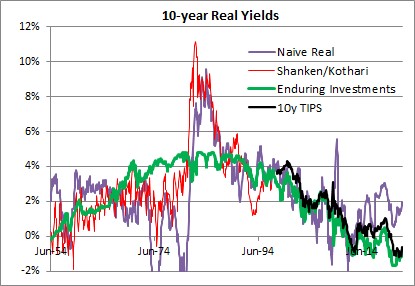
The long-term averages for these four series are as follows:
- Naïve real: 2.34%
- Shanken/Kothari: 3.13%
- Enduring Investments: 2.34%
- 10y TIPS: 1.39%
- Shanken/Kothari thru 2007; 10y TIPS from 2007-present: 2.50%
It isn’t just a coincidence that calculating a long-term average of long-term real interest rates, no matter how you do it, ends up being about 2.3%-2.5%. That is also close to the long-term real growth rate of the economy. Using Commerce Department data, the compounded annual US growth rate from 1954-2021 was 2.95%.
It is generally conceded that the economy’s sustainable growth rate has fallen over the last 50 years, although some people place great stock (no pun intended) on the productivity enhancements which power the fantasies of tech sector investors. I believe that something like 2.25%-2.50% is the long-term growth rate that the US economy can sustain, although global demographic trends may be dampening that further. Which in turn implies that something like 2.00%-2.25% is where long-term real interest rates should be, in equilibrium.[2] Kashkari says “We do know that neutral rates have been falling in advanced economies around the world due to factors outside the influence of monetary policy, such as demographics, technology developments and trade.” Except that we don’t know anything of the sort, since there is a strong argument against each of these totems. Abbreviating, those counterarguments are (a) aging demographics is a supply shock which should decrease output and raise prices with the singular counterargument of Japan also happening to be the country with the lowest growth rate in money in the last three decades; (b) productivity has been improving since the Middle Ages, and there is no evidence that it is improving noticeably faster today – and if it did, that would raise the expected real growth rate and the demand for money; and (c) while trade certainly was a following wind for the last quarter century, every indication is that it is going to be the opposite sign for the next decade. It is time to retire these shibboleths. Real interest rates have been kept artificially too low for far too long, inducing excessive financial leverage. They will eventually return to equilibrium…but it will be a long and painful process.
At the time I wrote the passage above, 10-year TIPS yielded about 0.25%; today they yield 2.125%. It turned out that returning to equilibrium wasn’t at all a long process. But it certainly was painful!
Returning to the original point: just because 10-year rates are now approximately at equilibrium is not at all a prediction that they will remain at equilibrium. Indeed, if I made that prediction I would be making a very similar mistake to the one I criticized above. Mean reversion in rates is not a particularly powerful force, when set against an active central bank and a profligate legislature. But if it matters at all, it is very important to correctly identify the mean to which rates should revert.
And it’s not 2%.
[1] https://www.minneapolisfed.org/article/2022/policy-has-tightened-a-lot-is-it-enough
[2] The reason that real interest rates will be slightly lower than real growth rates is that real interest rates are typically computed using the Consumer Price Index, which is generally slightly higher than the GDP Deflator.
Illustrating the Cost of Leverage Effect on Returns
A couple of weeks ago, I presented a blog post called “The Effect of Crazy Time on Portfolio Allocations,” in which I pointed out that the effect of increasing volatility generally is to decrease the optimal portfolio allocations towards safer allocations. It was one of those posts where you initially say ‘well, duh’ but hopefully liked the fact that I ‘proved’ the intuition with the illustrations. While market volatility since then has been almost unbelievably low, it is hard for me to imagine that is sustained. It feels a little like a ‘deer in the headlights’ reaction from investors, as the Trump Train comes on so rapidly that all they can do is pull the shades.
I suspect that at some point, unless the Donald suddenly becomes a milquetoast business-as-usual kind of President, we will see those allocations shift.
But a few days ago I had another realization that called to mind the same old CFA-Level-I charts. I was explaining to someone who wanted me to leverage our really cool inflation-tracking strategy[1] that leveraging a mid-single-digits return makes a lot of sense when the cost of leverage is zero, but not so much sense when the cost of leverage was mid-single-digits. I’ve talked about this before – in October 2023 I published “Higher Rates’ Impact on Levered Strategies.”[2] I showed a table, but there’s a really simple way to illustrate the same thing.

I don’t really need the portfolio efficient frontier here. Maybe the optimizer spits out some share of the optimal portfolio that represents an investment in some hedge fund strategy you really like. Maybe it doesn’t. More likely, you don’t even use an optimizer. But if you really like that strategy, but want higher returns, you ask the manager ‘hey, can you lever that’? The manager says sure. But the manager can’t give you twice the returns for twice the risk – the leverage math doesn’t work that way. If the cost of leverage is 3% – which you can tell it is in this chart because that’s where the line hits the axis, at a risk-free rate of 3% – then your return for twice the risk is (2 x 4% – 1 x 3%) = 5%. So you pick up only 1% return for doubling the risk. And you can see that on the chart, because that’s the point the red line goes through: 5% return, 15% risk. For 3x risk, you get (3 x 4% – 2 x 3%) = 6%. And so on. The slope of the line is such that 7.5% additional risk gets you 1% additional return, no matter how many times you lever it.
So why do people ask for leverage? Well, because since 2008 the overnight rate was mostly at 0%.

If you can borrow at zero then levering simply multiplies risk and return simultaneously. At 2x leverage, your return is (2 x 4% – 1 x 0%) = 8%. You can see where this goes since 0 times anything drops out of the formula.
But this doesn’t work at higher costs of leverage. If the cost of leverage is equal to the expected return, then you just get more risk every turn of leverage you deploy. And if the cost of leverage is above the expected return, you make things worse every time you add leverage.

So it doesn’t make any sense to lever low-return strategies unless the cost of leverage is really low. And by the way, it doesn’t make much sense to lever high-return strategies unless they happen to be low risk. Because this math doesn’t just work with expected returns but also (and more importantly) with actual returns. Suppose you have a strategy that has a 6% expected return and a 15% risk. Say, an equity index. Now, you lever it 2x with the cost of leverage at 5% (by the way, if you use a levered ETF you’re not escaping the cost of leverage…but that’s for another day). Your expected return is now 7%, with 30% risk (check your understanding by doing the math).
Now, however, you get a 2-standard deviation outcome to the downside. Supposedly that happens only one year out of 40, but we know that there are fat tails in equity markets. But whatever the real probability, your unlevered return is now 6% – 2 x 15% = -24%. But now you’re riding the lightning and your return on the 2x leverage is (2 x -24% – 5%) = -53%. (Alternatively, you get to the same number if you just look at the new 7%ret/30%risk portfolio return as 7% – 2 x 30%).
Hedge fund managers understand this math…or should; if they don’t then get out…and it should change the numbers they report in forward-looking statements when interest rates are higher, for levered strategies. I will not comment on normal industry practice…
[1] To be clear, none of the red dots in this article represent the risk/return tradeoff for that strategy. I’m not trying to cagily present our fund’s performance because that would get me in trouble.
[2] This was a golden era for the blog. Right about the same time I also published one of my best posts in years, pointing out how the CME Bond Contract has shortened in duration and also has negative convexity again. “How Higher Rates Cause Big Changes in the Bond Contract.” How I loved that piece.
Growth. Does. Not. Cause. Inflation.
I am constantly amazed at certain articles of faith among the economics community. In my line of expertise, one of the most amazing to me is the absolute conviction with which the economics community believes that if the economy grows too fast, inflation will result and if it grows too slowly, disinflation or deflation will result. That this conviction is so strongly held is especially incredible, since there is essentially no evidence for that belief.
Theory says it is so. Growing too fast puts too much pressure on land, labor, and capital, which causes their prices to rise and therefore the price of the output. I mean, obviously.
Except that it doesn’t seem to have ever happened that way, at least for a long, long time.
Heck, let’s just take recent experience. In the last twenty years, we have had two global economic crises. The upheaval in 2008 was the largest since at least the Great Depression. The economic contraction in 2020 made the Global Financial Crisis look like a piker. So obviously, if we look at inflation it must have massively slowed down in those events, right?

Hmmm. Now, I’ve showed the Core CPI price level against GDP. If you squint, you can see a small deceleration in core CPI in 2010: it actually reached only +0.6% y/y at one point. We never even reached deflation, despite the fact that the GFC was triggered by housing and housing is by far the largest component of CPI. I don’t need to say anything about the COVID period because it is so recent. Core inflation vaulted higher, and continued to do so long after economic output had been fully restored to its prior level.
The other wonderful counterexample I like to show is the 1970s.

Notice there are several flat points here, where GDP was steady-to-lower and the price level kept on truckin’ (that’s a 1970s reference, kids). Notice that since I’m using core CPI, you can’t even say ‘well, the OPEC embargo caused energy prices to spike and that also slowed the economy.’ Yes, it did, but shouldn’t that slowing of the economy have taken pressure off of other non-energy prices? Well, it didn’t. Inflation was robust during the 1970s, despite growth that lurched forward and back in fits and starts.
Those are fun, visual aids but sometimes our eyes can deceive us and hide or exaggerate a relationship that is statistically present (or not). So here I did the economist thing and ran scatterplots at different lags. Each of these shows the y/y change in GDP on the x-axis (quarterly observations, since 1960 until 2024), and y/y changes in Core CPI on the y-axis. Chart A shows the y/y changes contemporaneously (1965Q1 vs 1965Q1, e.g.). Chart B lags the inflation one quarter, so we see if this year’s growth affected this year’s inflation but lagged a little bit. Chart C lags the inflation one year, so we see if this year’s growth affects the coming year’s inflation. And Chart D lags the inflation two years, so we see if this past year’s growth affects next year’s inflation.

The correlation coefficients, for your reference: -0.18, -0.13, 0.03, 0.14. That’s thin gruel on which to make a strong argument about growth causing inflation, in my mind.
Now, I’ve run these regressions since 1960 since the core CPI index only goes back to 1957. The same regressions with headline inflation show coefficients of -0.11, -0.05, 0.10, and 0.11. I’m actually surprised they’re not any better, because energy prices should be correlated with growth and flatter the relationship. The OPEC embargo does hurt that relationship, but even if we just run these regressions since 1980 the correlations between growth and headline inflation are just 0.13, 0.19, 0.16, and -0.09.
So where do we get the idea that growth causes inflation?
Well, if I look at GDP growth versus headline inflation, from 1929 until 1960, and I exclude 1946 when industry relaxed from its war footing and war-time price controls were removed, then I can coax a really nice correlation of 0.73.

Indeed, if you look at the correlation between 1929 and 1945, it becomes a whopping 0.88. That’s science, baby – fitting the data to the story! But now I think we get to the heart of the matter because something else momentous happened in 1948 and that was the publication of the first edition of the most-used textbook in history: Paul Samuelson’s Economics. It is no surprise, perhaps, that generations of economists learned this ‘fact’ based on a correlation of 0.88…that has been falling ever since.
Since that time, the correlation between core inflation and growth has been low, and sometimes even negative, over very long periods. If there is any causal relationship, it is completely swamped in exceptions. Decades-long exceptions. It is time to give up this idea. One unfortunate consequence of that is that the way the Federal Reserve operates is as if there is one dial it can turn and that is ‘the dial that increases growth until inflation gets hot, then decreases growth.’ The problem is that isn’t one dial, it’s two. In general, I think the Fed should keep its hands off the growth dial, but if it wanted to meddle on rare occasions it would do so by manipulating medium-term interest rates. To control inflation, it needs to moderate the growth of the money supply. Frankly, in my opinion the FOMC should simply focus on the latter mission and let growth, and markets, take care of themselves. They’re not good at any of these missions anyway.
The Effect of Crazy Time on Portfolio Allocations
I am continually fascinated by how many second-order ‘understandings’ are missed, even by those people who have a really good first-order understanding of finance. For example, every financial advisor understands that bonds are less volatile than stocks. Most financial advisors understand that stocks and bonds in a portfolio together also benefit because they’re not correlated. Some financial advisors, and most CTAs, understand that diversifying a portfolio works because when you add uncorrelated assets together, the risk of the whole is less than the sum of the risks because of the offset from the correlation effects. Those are all coarse understandings that any financial professional should ‘get.’ However, it is fairly unusual for advisors or even CTAs to understand that the correlation of stocks and bonds undergoes a state shift when inflation get above about 2.5% for a few years, and become correlated, and that means more risk for the same combination of stocks and bonds. Here’s that chart I love to show, updated through the end of the year.

While that’s an example of a ‘second-order understanding’ that isn’t widely known, it isn’t what I want to write about today. Actually, for a change what I want to discuss is something that has nothing directly to do with inflation, and that is the effect of volatility on asset allocation.
This is an important discussion right now, because whether or not you have gotten the message yet that President Trump is going to be much more Machiavellian in his approach to the global world order than prior Presidents have been – and whether you think that’s a good thing or a bad thing – you surely must have noticed that the volatility of the markets under this regime is likely to be somewhat higher than under Sleepy Joe and also higher than it was during Trump’s first term. And that leads to the second-order understanding about what that implies for markets. Hang with me here; if you’re not a finance person this gets a little hairy.
The next chart shows Modern Portfolio Theory on one chart.

The blue line is the Markowitz efficient frontier: every point on the line represents a portfolio of assets that is the least-risky for that level of expected return. So, the highest vertical point is a portfolio of 100% in the asset with the highest expected return…you can’t get more return without leverage.[1] In this case, let’s assume that is equities. As you go down the curve, you allocate more to other less-risky assets and give up some portfolio return. Because assets are not 100% correlated, you can always get a portfolio that has at least as good (and usually better) returns for a unit of risk than any single asset – that’s the benefit of diversification. As you get to very low expected returns, you get to the part of the curve you’d have to be irrational to be on because you get higher risk and lower returns, and so we usually ignore that part of the curve that bends back.
The red line is popularly called the “Capital Asset Line.” Assuming there is some zero-risk instrument (that’s not already in the assets we’ve considered, so there’s some hand-waving here) and you can both borrow and invest at that rate, you can think of a portfolio that is the ‘best’ portfolio on the blue curve, either combined with the zero risk instrument (sliding down the red line to the left) or levered at the zero risk instrument (moving up the red line to the right). The ‘best’ portfolio here is defined as the place where the red curve is tangent to the blue curve.
A lot of times you’ll just see those two lines, but it doesn’t answer the question of which portfolio an actual investor prefers. It turns out that investors do not have linear risk preferences…that is, if I make my portfolio 10% more risky, perhaps I require 1% more return but if I make it another 10% risky, I’m going to need more than 1% additional return. I’m not only risk averse, but I get more risk averse the larger the potential risks. [Lots of experimental data on this. If I offer you a bet where you pay me $1 and on the basis of a coin flip I will either pay you $2 or $0, you are much more likely to take that bet than if I offer you a bet where you are risking $10,000 for the chance at $20,000…or zero]. So the purple dotted line is a hypothetical ‘investor indifference curve’. I just made up that term because I can’t remember what the theoreticians call it. The curve represents all of the combinations of risk and return that make the investor equally happy. So, the best portfolio for this investor is where the purple line – the highest purple line we can find, indicating the MOST happiness – touches the red line.
With me? Now consider the next chart. All I have done here is to increase the risk of every asset and shift the whole portfolio efficient frontier to the right.

What happens? The Capital Asset Line (red) now flattens out. And that means that the prior purple line no longer has a point of tangency. We have to go to a lower purple line, and since the purple line is concave upward the red line becomes tangent to the purple line at a point further to the left (the slope of the red line is flatter, and the flatter parts of the purple line are to the left). I’ve put the new ‘optimal portfolio’ as a dot in purple.
The implication is this: if overall risk in markets is perceived to have permanently increased, then rational investors will move from portfolios with more risky assets to portfolios with fewer risky assets.
You probably could have guessed that without all of the curves. If I am comfortable with a certain amount of risk, and the overall risk of things goes up, then it stands to reason that I’d work to reduce my overall risk. The second-order understanding here is, then, that if President Trump is perceived by investors to increase the overall volatility in markets and individual country and company outcomes, we should expect investors to lighten up on equities.
And that brings me to the final chart. This is the Baker, Bloom and Davis news-based Economic Policy Uncertainty Index, which counts the number of articles in US-based news sources that contain a set of predefined terms that indicate uncertainty about economic policy. The dotted lines below show weekly data; the heavy red line shows the 12-week moving average to get rid of the noise.

Notice the three prior spikes on the chart are during and immediately following the end of the internet/stock market bubble in the early 2000s, the end of the housing bubble and the Global Financial Crisis in 2008-09, and the COVID crisis. All three of those episodes were associated with significantly lower markets, although you could argue that harsh bear markets might trigger some policy uncertainty (that certainly happened after 2008). The jump on the right is the Trump jump, and it is already higher than any other period on this chart other than COVID.[2] Volatility we have. Uncertainty we have. And even if you like the President’s policies, the volatility means that we should not be surprised to see investors pull some chips off the table.
[1] If you take this best-returning asset and leverage it, you basically get a straight line going up and to the right forever; the slope of the line depends on the cost of leverage.
[2] Incidentally, the index goes back to about 1985 and although I didn’t show it there are two more bumps that are similar to the leftmost two on this chart: around the 1993 recession, and around the time of the stock market crash in 1987. They are all lower than the Trump jump.
Trump Tactical Targeted Tariffs: A Reminder of the Impact of Tariffs
Representative Alexandria Ocasio-Cortez, aka AOC, recently railed against the President when he threatened Colombia with tariffs if they should refuse to accept their citizens being deported back to them. In her typical hyperventilated fashion, she implored us to “remember” that “WE pay the tariffs, not Colombia.”
For a change, AOC is not entirely wrong but merely mostly wrong. She seems to remember at least one important thing from Econ 101 and that is that businesses don’t pay anything to anyone, since a business is just a legal structure. Shareholders, other stakeholders, consumers, or suppliers pay and/or receive the cost of goods sold, taxes, wages, and so on. Unfortunately, I don’t think that was her point and she missed the important bit which is that ‘who pays the tariff’ depends almost entirely on the elasticity of demand for the product. Here are two charts. In each case, the tariff shifts the supply curve leftward/upward by the amount of the tariff, the same amount in both pictures. In each picture, the quantity consumed of the good being tariffed goes from c to d and the price goes from a to b as the market moves from one equilibrium to the other.


The first chart shows an inelastic demand curve, which is characterized by the fact that large changes in price do not change the quantity demanded very much. In this case, the main effect is that consumers buy almost as much of the good, but the price moves almost the full amount of the tariff. Consumers end up paying most of the tariff.
The second chart shows an elastic demand curve, in which even small changes in price induce large changes in the quantity demanded. In this case, the main effect is that consumers buy much less of the more-expensive good, and the price goes up only a little so that the seller bears most of the cost of the tariff.
Thus a blanket statement that “we pay the tariffs” is wrong. It is sensitive to the characteristics of the product market. One needs to be very careful about how we define the product market because it matters. I would argue that the elasticity of the demand for coffee is quite low, which is why Starbucks even exists. If the demand for coffee was very elastic, charging $5 a cup for bad coffee would not produce a line around the block at rush hour. But that is not what we are talking about here. The question here is, what is the demand elasticity for Colombian coffee? The answer to that question is very different. Coffee as a way to wake up in the morning has few close substitutes. But Colombian coffee has many, very very very close substitutes. My favorite right now is Ethiopian Yirgacheffe coffee. I also like a good Panama Boquete. Add 20% to the cost of the Boquete, and I think I’ll mostly drink the Yirgacheffe. Add 20% to both of them, and I’ll go to Brazilian Santos, or Colombian, or Kona.
I think the reaction of the Colombian President tells you everything you need to know about what he perceives about the demand for Colombian coffee and therefore the impact a tariff would have on exports of Colombian coffee to the United States. Trump very quickly got what he wanted with his Trump Tactical Targeted Tariffs (TTTT™). So to review: +1 for TTTT, -1 for AOC.
A couple of other points about tariffs and tariff strategy.
First, this episode illustrates a very important distinction to be made between the use of targeted tariffs and the use of blanket tariffs. Blanket tariffs, for example on everything we import from a major trading partner or on every trading partner, definitely increase prices for consumers. How much, and which prices, depends on how easily domestic untariffed supply can substitute for the imported supply. But the answer is certainly that prices go up. But let me point you to two articles I’ve written previously about this:
Tariffs Don’t Hurt Domestic Growth (https://inflationguy.blog/2019/08/28/tariffs-dont-hurt-domestic-growth/), August 28, 2019. This is a really good piece. In summary, tariffs are bad for global growth but they are not the unalloyed negative you learned about in school. How good/bad they are for growth depends on whether you are a net importer or a net exporter, and how large the Ex-Im sector is in your country. Truly free trade works in a non-theoretical world only if “(a) all of the participants are roughly equal in total capability or (b) the dominant participant is willing to concede its dominant position in order to enrich the whole system, rather than using that dominant position to secure its preferred slices for itself.” Really, you should read this.
The Re-Onshoring Trend and the Long-Term Impact on Core Goods (https://inflationguy.blog/2022/02/22/the-re-onshoring-trend-and-the-long-term-impact-on-core-goods/) February 22, 2022. This is not directly about tariffs, but the broad imposition of tariffs (if they happen) should be thought of as reinforcing this prior trend. The prior trend, of re-onshoring production to the US, has been under way for several years – the way that COVID exposed long supply lines certainly helped the trend but the long-term globalization trend was already reversing and in this article I argue that this means core goods inflation going forward is likely to be small positive, rather than persistently in deflation. In the context of the current discussion, President Trump has certainly made re-onshoring of production a major goal of his Administration. So whether it happens because of TTTT, or because of blanket tariffs, or because of tax breaks given for domestic production, the direction of the inflation arrow is clear.
I’m not worried about hyperinflation from tariffs and I think that if you’re the biggest and the strongest economic actor they’re probably more good than bad for domestic economic outcomes.
Reality is more nuanced than we learned in school. Not everything that expands the economy is good, and not everything that is good expands the economy. Not everything that is bad causes inflation to go up, and not everything that causes inflation to go up is bad.
What Makes a Stable Coin Stable?
The early growth of Bitcoin and the cryptocurrency space was originally stimulated by the mistrust of centralized control of monetary policy and financial institutions. While Bitcoin is a fiat currency, in the sense that it is not ‘backed’ by anything and has value only because other people believe it has value, the rules for the expansion of the total float of Bitcoin are mechanical and so the unit benefits from being isolated from the whim of flesh-and-blood central bankers. Milton Friedman once said in an interview with the Cato Institute that “We don’t need a Fed…I have, for many years, been in favor of replacing the Fed with a computer [which would, each year] print out a specified number of paper dollars…Same number, month after month, week after week, year after year.”[1] And, with Bitcoin, that is exactly what you have. Management of Bitcoin is decentralized, automatic, and the rules are stable.
Unfortunately, ‘fiat’ cryptocurrencies are anything but stable. Moreover, since their value depends entirely on the trust[2] of other actors in the economic system that these currencies will have value, it is entirely possible that any of them could crash just like any fiat currency sometimes crashes when confidence in the currency issuer vanishes. There is no intrinsic value to a fiat currency – digital, or analog – which means that they are stable only when looked at in a self-referential frame. A US Dollar has a stable value of $1 but is volatile from the viewpoint of a Mexican-peso-based observer. I will return to this observation presently.
Because these fiat cryptos are unstable when looked at by a participant in the analog world, the concept of ‘stablecoin’ was developed. In Coinbase’s summary ‘What is a stablecoin?’, the first two bullet points are:
- Stablecoins are a type of cryptocurrency whose value is pegged to another asset, such as a fiat currency or gold, to maintain a stable price.
- They strive to provide an alternative to the high volatility of popular cryptocurrencies, making them potentially more suitable for common transactions.[3]
Why is a stable price important? The answer goes back to the question of whether Bitcoin and similar cryptos are money, or assets. In the conventional definition of money, such a label only applies to units that provide a medium of exchange, store of value, and unit of account. First-generation cryptos certainly serve as a medium of exchange but are sketchy on the ‘store of value’ and ‘unit of account’ dimensions. Nothing natively is priced in BTC, so it is not a good unit of account, and the high volatility creates a high barrier to any argument about being a store of value. Cryptos are most assuredly financial assets. It is hard to argue that they are money.
Enter the stablecoin. By pegging the value to an existing currency, a stablecoin ‘borrows’ the characteristics of that currency as a store of value and unit of account. It’s true by mathematical association: if USDC is equal to one US dollar, and the US dollar is money, then (as long as it’s accepted a medium of exchange) USDC is money because it has equal ‘store of value’ and ‘unit of account’ dimensions.[4] A stablecoin maintains its stability by means of holding reserves and being fully convertible on demand into the underlying currency.[5]
But Stable with Respect to What?
Stability, though, depends on the frame of reference. Consider a stablecoin linked to the US Dollar, which always can be minted or burned at $1 (ignoring fees). Consider a second stablecoin linked to the Japanese Yen, which always can be minted or burned at ¥1. Which one is stable?

Figure 1 – US Dollar Frame – US Dollar is stable

Figure 2 – Japanese Yen Frame – Japanese Yen is stable
The answer, of course, depends on your frame of reference. From the standpoint of someone in Japan, who is buying goods and services with Yen, a stablecoin like USDC that is linked to the dollar is most assuredly not stable in any useful sense of the word. Conversely, a US dollar investor would not find a Yen stablecoin to be stable. This, then, is an important element of defining a stablecoin: something which matches the volatility and behavior of the basis of the frame you are in, is stable with respect to you. This raises an interesting question when it comes to stablecoin regulation. A coin could very easily be regulated as a stablecoin in one jurisdiction, and not be regulated as such in a different jurisdiction – even between regulatory jurisdictions that are congruent in their treatment of most assets.
What passes for stability, in short, depends on the transactional frame – literally, the underlying currency in which transactions happen – of the observer.
Stable with Respect to When?
The meaning of stability also fluctuates with the time horizon of the observer. Fixed-income investors are very familiar with the concept of Macaulay duration, which is the future horizon at which the value of a bond holding is completely insensitive to parallel shifts in the yield curve, because the change in the value of reinvested coupons (which goes up with higher interest rates) exactly offsets the change in the value of the remaining cash flows (which go down with higher interest rates). What is the riskiness of a bond with a 7-year duration? Or more to the point of this discussion – which is riskier, a 1-month Treasury bill, or a 7-year zero coupon bond?[6]
As it turns out, it depends on the applicable horizon of the observer.
Suppose an investor pursues one of two strategies: in the first strategy, he or she buys a 1-month Treasury bill, initially at 5%, and then rolls the proceeds every month for 7 years. Alternatively, he or she could buy a 7-year zero coupon bond yielding 5%. Using a simple two-factor model with no drift, I generated 250 iterations of T-bill paths and yield curve shapes, to produce hypothetical monthly time series of returns for the two strategies. For example, here is one such random path (Figure 3):

Figure 3 – Illustrative single random path of cumulative returns for two strategies
The a priori expected return is approximately the same for both strategies; sometimes the T-bill roll strategy ends up ahead and sometimes the buy-and-hold strategy wins. With similar expected returns, a rational investor would therefore choose the one which has the lowest risk. But the riskiness or stability of the returns depends very much on the observer’s time horizon. Each of the following three charts is drawn from the same 250 Monte Carlo iterations, but the cumulative return is sampled at a different horizon. In Figure 4, the cumulative returns are sampled at the 1-month horizon. In Figure 5, the sampling is at the 3-year horizon. In Figure 6, the sampling is at the 7-year horizon. For each figure, the cumulative return for the T-bill strategy is shown on the x-axis and the cumulative return for the zero-coupon-bond buy-and-hold strategy is on the y-axis.

Figure 4 – 1-month T-Bill strategy is riskless at a 1-month horizon

Figure 5 – Both strategies are relatively risky at a 3-year horizon

Figure 6 – The 7-year zero-coupon-bond is riskless (in nominal terms) at a 7-year horizon
Although this conclusion is trivial and inevitable to fixed-income investors, the reason for our observation here is to point out that what is considered ‘stable’ not only depends on one’s functional currency but also on one’s holding period horizon.
Is the Nominal Frame the Most Important Frame?
The prior points are likely obvious to most investors. If you are investing with the intention of spending the proceeds in US Dollars, then a USD frame is most relevant. If you are investing for a known future nominal payout (for example, a life insurance company hedging scheduled annuity flows), then an investment that matures to a given value at the time when the money is needed is the most-relevant frame. However, investors sometimes lose track of one of the most important frames, and that is the “real” frame where values track the price level.
While a $1 bill is ‘stable’ in nominal terms – it will always be worth $1 – it is very unstable in purchasing-power terms.

Figure 7 – A dollar is inherently unstable in the main consumer frame
The framework where we ignore the value of the dollar, in preference for the fixed price of the dollar at $1, is the “nominal” framework. When inflation is low and stable, this frame is a useful shorthand in much the same way that when traveling abroad a tourist in the year 2000 might translate Mexican Peso prices into US Dollar prices by dividing by 10 even though the exact exchange rate differs from 10:1. In the short term, such a shortcut framework makes up for in convenience what it surrenders in precision. But in the long term, what starts out as mild imprecision becomes wildly inaccurate as the Peso exchange rate has gone from 10:1 to 20:1.
Similarly, while the nominal frame is the default for short-term comparisons it is clearly not the most important one to a consumer. Someone who is negotiating a salary at a new job, who knows he or she made $40,000 per year in 2004, would be ill-suited to use that figure as the starting point. The frame that matters over time is the real, or inflation-adjusted, frame. In the chart above, if we plotted the purchasing power of an inflation-adjusted 1983 dollar, it would be a flat line at $1.[7] On the other hand, if we plotted the nominal value of that same inflation-adjusted 1983 dollar, it would show a mostly steady increase from $1 to $3.15 over the same time period.
As before, the frame matters. A dollar that is stable in nominal space is very unstable in purchasing-power space. A unit that is stable in purchasing-power space looks unstable in nominal space.
If an investor or consumer had to choose one frame to care about, it would surely be the one in which his or her money represents not just a medium of exchange and a unit of account, but also a store of value. What this means is that a coin that is native currency and inflation-adjusted in the local price level is the most stable of stablecoins. And what that further implies is that what we currently call ‘stablecoins’ are stable only in the narrow context of being fixed at a certain nominal value of domestic currency…and that is suboptimal since all investors and consumers live in a world where prices change.
Tying Frames Together
What is interesting is that each of these frames describes “stability” in a different context. People in one frame see their own side as stable and the other side as volatile – and the exact same thing is true, in reverse, for the other side.
The various frames do traffic with each other. A holder of US Dollars (in the nominal-USD-short-term-stable frame) exchanges those dollars with a person who holds Euros (in the nominal-Euro-short-term-stable frame). We call that an exchange rate. And what ties together the nominal dollar and the inflation-linked dollar is the price index.

Figure 8 – Exchanging dollars with different purchasing power is functionally the same as exchanging currencies with different purchasing power.
In fact, the relationship between the Dollar and the Euro is so much like the relationship between the nominal dollar and the inflation-linked dollar that in 2004 Robert Jarrow and Yildiray Yildirim wrote a paper describing how to value inflation-protected securities and derivatives using a model designed for foreign exchange.[8] And that highlights the fact that an inflation-linked stablecoin isn’t some strange construct but rather an important new product to be added to the cryptocurrency universe. It is just another currency – one that is fixed in time, rather in nominal dollars, that is exchangeable to today’s dollars at the ‘inflation exchange rate’. If a 1983 dollar existed today, it could be exchanged for $3.15 current dollars because the dollar that was frozen in time in 1983 buys more than today’s dollars. That’s just an exchange rate!
Conclusion
It seems that ‘stability’ is not a stable term. Perhaps a more accurate description of the current crop of ‘stablecoins,’ which are exchangeable 1:1 with the base currency, is “fixed coins.” Only an inflation-linked coin would be a “stablecoin” in the true sense of the word, and only because being stable in purchasing-power space is the most important frame.
[1] http://www.cato.org/publications/commentary/milton-rose-friedman-offer-radical-ideas-21st-century
[2] This is not to be confused with the trustless nature of the transaction verification process of the blockchain, where the peer-to-peer nature of the process allows transactors to be certain their counterparty has the amount of bitcoin in question before completing a transaction. Rather, this is a comment on the entire system itself.
[3] https://www.coinbase.com/learn/crypto-basics/what-is-a-stablecoin
[4] Arguing that a coin pegged to gold or other commodities is a stablecoin is a bit of a stretch. Such a coin may be granted intrinsic value by such backing, and it may even be a better store of value in the long run because of such backing, but it is lacking as a unit of account (nothing is priced in gold units) and as a short-term store of value it leaves a lot to be desired.
[5] So-called ‘algorithmic stablecoins’ are mostly stable because of fiat reasons. That is, only because people believe the algorithm can guarantee that the coin is fully backed, will they behave as if they are. My usage of ‘stablecoins’ leaves out algorithmic stablecoins.
[6] I made this a zero-coupon bond to make it easier. A zero-coupon bond has a Macaulay duration equal to its maturity. However, at the 7-year horizon, any bond with a 7-year Macaulay duration has the same risk to a parallel shift of the yield curve: none. The point of this paper, though, is not fixed-income mathematics so take my word for it for the sake of this argument.
[7] Naturally, whether it is truly precisely flat depends on whether the price index we are adjusting with is an accurate representation of changes in purchasing power. Of course, such an index would look different for every person based on his or her consumption patterns so the line would not be truly flat for any person. But it would be much more stable than the non-inflation-adjusted dollar.
[8] Jarrow, Robert A. and Yildirim, Yildiray, Pricing Treasury Inflation Protected Securities and Related Derivatives Using an Hjm Model (February 1, 2011). Journal of Financial and Quantitative Analysis (JFQA), Vol. 38, No. 2, pp. 337-359, June 2003, Available at SSRN: https://ssrn.com/abstract=585828
