Bond Beatings Continue
The beatings are continuing, and apparently morale really does improve with such treatment. Consumer Confidence for June vaulted to the highest level since early 2008, at 81.4 handily beating the 75.1 consensus. Both “present situation” and “expectations” advanced markedly, although the “Jobs Hard to Get” subindex barely budged. It is unclear what caused the sharp increase, since gasoline prices (one of the key drivers, along with employment) also didn’t move much and equity prices had been steadily gaining for some time. It may be that the rise in home prices is finally lifting the spirits of consumers, or it may be that credit is finally trickling down to the average consumer.
Whatever the cause, it is not likely to prevent the rise in money velocity that is likely under way, driven by the rise in interest rates. Between the rise in home prices – the Case-Shiller home price index rose a bubble-like 12.05% over the year ended April, and Existing Home Sales median prices have advanced a remarkable 14.1% faster than core inflation (a near record, as the chart below shows) over the year ended in May. (Lagged 18 months, such a performance suggests about a 3.9% rise in Owners’ Equivalent Rent for 2014).
 But of course, we must fear deflation more than ever!
The nonsense about deflation is incredible to me. Euro M2 growth hasn’t been this high (4.73% for year ended April) since August of 2009. Japanese M2 growth hasn’t been this rapid (3.4% for year ended May) since May 2002. US money supply is “only” growing at 6.5% or so, down from its highs but still far too fast for a sluggishly-growing economy to avoid inflation unless velocity continues to decline. But you don’t have to be a monetarist to be concerned about these things. You only need to be able to see home prices.
Core inflation in the US is being held down by core goods, as I have recently noted. In particular, CPI for Medical Care just recorded its lowest year-on-year rise since 1972, and Prescription Drugs (1.32% of CPI and an important part of core goods) declined on a y/y basis for the first time since 1973. The chart below (source: Bloomberg) illustrates that as recently as last August, that category was rising at a 4.0% pace.
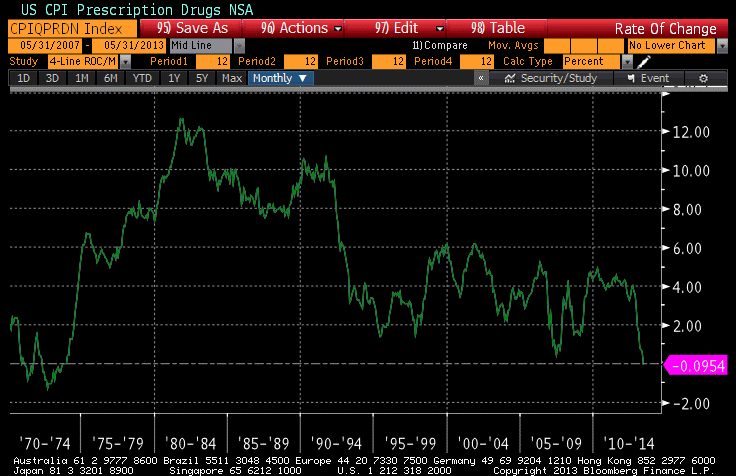
Now, I suspect that this has something to do with Obamacare, but no one seems to know the full impact of the law. Keep in mind that Medical Care in CPI excludes government spending on medical care. So, one possible narrative is that the really sick people are leaving for Obamacare while the healthy people are continuing to consume non-governmental health care services. This would be a composition effect and would imply that we should start looking at CPI ex-medical for a cleaner view of general price trends. I have no idea if this is what is happening, but I am skeptical that prescription meds are about to decline in price for an extended period of time!
But that’s the bet: either core inflation is going to go up, driven by things like housing, or it’s going to go down, driven by things like prescription medication. Place your bets.
Equity prices recovered today, but bond prices continued to slide into the long, dark night. For a really incredible picture, look at the chart below (source: Bloomberg), which shows the multi-decade decline in 10-year yields on a log scale, culminating in the celebrated breakout below that channel. Incredibly, the recent selloff has yields back to the midpoint of the channel and not outrageously far from a breakout on the other side!
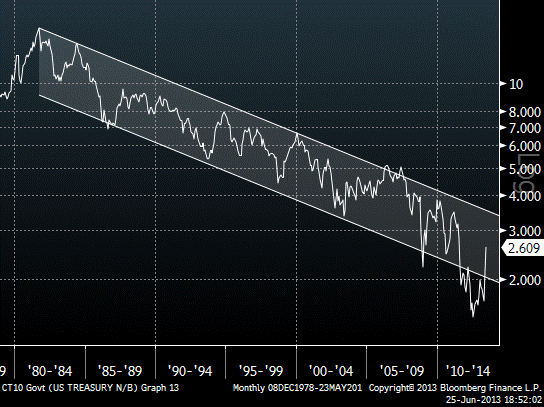
Incidentally, students of bond market history may be interested to know that the selloff has now reached the status of the worst ever bond market selloff (of 90 days or less) in percentage terms. Since May 2nd, 10-year yields have risen from 1.626% to 2.609%, a 98.3bp selloff which means that yields have risen 60.5% in less than two months.
And we are probably not done yet. I wrote about a month ago about the “convexity trade,” and I made the seemingly absurd remark that “This means the bond market is very vulnerable to a convexity trade to higher yields, especially once the ball gets rolling. The recent move to new high yields for the last 12 months could trigger such a phenomenon. If it does, then we will see 10-year note rates above 3% in fairly short order.”[emphasis in original] Incredibly, here we are with 10-year yields at 2.61%, up 60bps over the last month, and that statement doesn’t seem quite so crazy. As I said: I have seen it before! And indeed, the convexity trade is partly to blame for what we are seeing. I asked one old colleague today about convexity selling, and here was his response:
“massive – the REITs are forced deleveraging and there are other forced hands as well. The real money guys are too large and haven’t even sold yet – no liquidity for them. The muni market has basically crashed and at 5% yields in muni there is huge extension risk on a large amount of bonds: something like $750bln in bonds go from 10-year to 30-year maturities as you cross 5%.” (name withheld)
Now, I am not a muni expert so I have no idea what index it is I am waiting to see cross 5%. But the convexity trade is indeed happening.
Lots of bad things have happened to the market, but they really aren’t big bad things. In fact, I move that we stop using the term “perfect storm” to mean “modestly bad luck, but I had a lot of leverage.” The Fed was never going to be aggressively easy forever, and as various speakers have pointed out recently they didn’t exactly promise to be aggressively tightening any time soon. There is bad news on the inflation front, but the market is clearly not reacting to that. Some ETFs have had some liquidity issues, and emerging markets have tumbled, and there was a liquidity squeeze in China. But these are hardly end-of-the-world developments. What makes this a really bad month is the excess leverage, combined with the diminished risk appetite among primary dealers who have been warned against taking too much “proprietary risk.”
And markets are mispriced. Three-year inflation swaps imply that core inflation will be only 1.9% compounded for the next three years (the 1-year swap implied 1.6%; the 2y implies 1.75%). That is more than a little bit silly. While I have not been amazed that the convexity trade drove yields very high, and probably will drive them higher, it has surprised me that inflation swaps and inflation breakevens have continued to decline. Still, investors who paid heed to our admonition to be long breakevens rather than TIPS have done quite a bit better, as the chart below (source Bloomberg), normalized to February 25th (the date of one of our quarterly outlook pieces) illustrates.
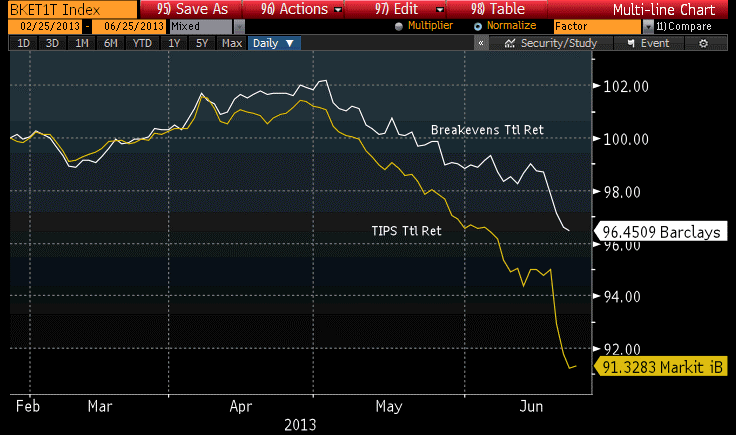
As the bond selloff extends, I don’t think TIPS will continue to underperform nominal bonds. I believe breakevens, already at low levels (the 10-year breakeven, at 1.97%, is lower than any actual 10-year inflation experience since 1958-1968), will be hard to push much lower, especially in a rising-yield environment.
Quick Notes on the Week
I have been quasi-vacationing this week on the Continent, and trying to follow the news and the markets. This will be a brief comment but I wanted to make a couple of quick notes:
1. I did not, and I still do not, understand why there was such a violent (and negative) reaction to the Fed’s statement and Bernanke’s suggestion that the “taper” may start later this year and end in mid-2014. There are all kinds of reasons not to freak out about that. First, it was approximately what was expected (although two weeks ago there were many who thought absurdly that the Fed would begin a taper at this meeting). Second, the taper is contingent on growth continuing to strengthen, and there are scant signs of that. Third, as Bullard showed today there is far from a consensus on whether Bernanke’s time frame is going to work out – and, while ordinarily the Fed Chairman’s vote is the only one that matters, in this case he is not going to be present for the end of the taper so what really matters is who is selected to replace him. Fourth, QE isn’t doing anything right now, except artificially depressing long Treasury yields. It is probably pressuring money supply growth, but not very much. The only thing that further QE will do is make the exit that much more difficult.
That said, the violent reactions to the Fed statement are prima facie evidence of what critics of the QE policy (me, for one) have always said: we have no idea how rates and markets will react when the Fed finishes and unwinds this policy, regardless of Bernanke’s assurances. The harsh reaction (quite a bit more than I expected, especially with such a tepid adjustment to the expected trajectory) is great evidence of how over-dependent the market is on the view that the Fed’s support makes losses extremely difficult. And, I will say again, this would be so much easier if the Fed wasn’t telegraphing everything, because then investors would have invested with much more caution. The reaction this week was partly due to the shock of actually hearing the Fed mention a date for the first time.
2. Speaking of investing with much more caution, the amazing stress in certain ETFs that has accompanied significant but not exactly dramatic moves in (for example) emerging markets should blare two huge lessons to investors. The first is that you can’t increase liquidity of a pool of assets by putting them in an ETF wrapper. A pile of illiquid securities, or securities that can become illiquid in a crisis, are not more liquid because you can get a quotation every second. An ETF consisting of emerging markets bonds is never going to be more liquid than the underlying emerging markets bonds (although it may be more granular, and there are other ETF advantages…but not liquidity). An ETF consisting of commodity futures, by contrast, will be tremendously liquid because the underlying commodity markets are tremendously liquid. The second lesson is more subtle, and that is that an ETF of less-liquid securities is, in a crisis, only as liquid as the least liquid element. If you present an ETF to me for redemption and there is 1% of it that I can’t get any bid on, then the best you’re going to get is a quote at 99% of the “fair” market price. And that is especially true these days, since dealers and market-makers are capital-constrained and can’t merely take those illiquid positions on the books.
3. There is a lot of dry tinder around in the world today, and never for a minute suppose that they are not related. Stress begets stress. Two million people protesting in Brazil are doing so partly because of economic stress. Tight money market rates in China (persistent since if the central bank adds too much liquidity it will cause the CNY to depreciate) is a partial consequence of economic stress. A return of Greece from the frying pan to the fire: economic stress. And so on. This is not a safer world for all of the QE.
4. Finally, remember that growth and inflation are not related in any meaningful way. Median home prices rose more than 15% over the last year according to a report this week, and not because of great economic results. Money velocity is rising with interest rates although we may not see the results for some months. Inflation, which got a boost in the US this week with a strong CPI report (see my brief comments here), surprised on the high side in the EU and UK. TIPS yields are at +0.56% in the 10-year sector and 10-year breakevens are at 1.92%. There is absolutely no reason to own Treasuries rather than TIPS at this point. The 10-year expected real return of stocks is now less than 1.5% per annum above 10-year TIPS, and there is absolutely no reason to own equities rather than TIPS. Are TIPS cheap on an absolute basis? No. But they are screamingly cheap on a relative basis in an environment of rising inflation (and nothing the central banks can do about it – at least those who aren’t actively trying to boost it). Long-time readers will know I have been tepid at best about TIPS for some time. But, while 0.56% isn’t ridiculously cheap (and they could still get there!), our models are already maxed out on breakeven exposure and are starting to add to outright long exposure in TIPS.
Summary of My Post-CPI Tweets
The following is a summary and further explanation of my tweets following today’s CPI release:
- core #inflation +0.167, a smidge higher than expected but basically in line. Dragged down by medical care (-0.13%).
- Housing #inflation a solid 0.3%…this part is, as we expected, accelerating.
- Core commodities still dragging down overall core, now -0.2% y/y while core services still 2.3%.
- I still think Owners’ Equiv Rent will get to our year-end target but core goods not behaving. Have to lower our core CPI range to 2.5%-2.8%
- That 2.5%-2.8% still much higher than Street. Still assumes OER continues to accelerate, and core goods drag fades. Fcast WAS 2.6-3.0.
- Note that CPI-Housing rose at a 2.22% y/y rate, up from 1.94% last month. Highest since late ’08 early ’09. Acceleration there is happening.
- Major #CPI groups accel: Housing, Trans, Recreation (63.9%), Decel: Food/Bev, Apparel, Med Care, Educ/Comm (32.7%)
- Overall, IMO this CPI report is much more buoyant than expected. Core goods is flattering some ugly trends.
The important part of this CPI report is that CPI-Housing is finally turning up again, as I have been expecting it would “over the next 1-3 months.” Hands down, the rise in housing inflation (41% of overall consumption) is the greatest threat to effective price stability in the short run. Home prices are rising aggressively in many places around the country, and it is passing through to rents. Primary rents (where you rent an apartment or a home, rather than “imputed” rents) are up at 2.8% year/year, the highest level since early 2009, but not yet showing signs that it is about to go seriously vertical. Some economists are still around who will tell you that rapidly rising home prices are going to cause a decline in rents, as more rental supply comes on the market. That would be a very bizarre outcome, economically, but it is absolutely necessary that this happen if core inflation isn’t going to rise from here.
The last 7 months of this year see very easy comparisons versus last year, when CPI rose at only a 1.6% annualized pace for the May-December period. Only last June saw an increase of at least 0.20%. So, even with a fairly weak trend from here, core CPI will rise from 1.7% year/year. If each of the last 7 months of this year produces only 0.2% from core CPI, the figure will be at 2.2% by year-end. At 0.25% monthly, we’ll be over 2.5%; at 0.3% per month core CPI will be at 2.9% by year-end. So our core inflation forecast, at 2.5%-2.8%, is not terribly aggressive (and if we are right on housing inflation, it may be fairly conservative).
We have not changed our 2014 expectation that core CPI will be at least 3.0%.
Classic
Numerous classic cognitive errors are on display at once in these markets. We have “overconfidence,” with large bets being made on the basis of strongly-believed models and forecasts…but these are forecasts of the dynamics of a system whose configuration is distinctly unlike anything we have seen before, even remotely. What does a “taper” do to rates? How can we know, since we have never even had QE, much less a taper, before? How aggressively does it make sense to bet on the outcome of such a transition period, given rational-sized error bars on the estimates?
We also see naïve extrapolation of trends. TIPS go down every day, it seems, for no better reason than that “core inflation is low, and the Fed is no longer going to be maintaining as loose a policy.” Ten-year TIPS yields have risen 83bps since April 25th (5y TIPS, +107bps since April 4th). Ten-year breakevens have fallen from 2.59%, within 15bps of an all-time high, on March 14th to 2.03% – the lowest since January 2012 – now. What has changed? Our model identified TIPS as cheap to Treasuries (that is, breakevens too low for the level of nominal rates) and went nearly max-long when breakevens were still at 2.30%. It is some solace that this position has fared better than a long position in TIPS, but when markets simply follow recent momentum mindlessly it can be painful.
Year-ahead core inflation is priced in the market at roughly 1.50%, despite the fact that current core inflation of 1.7% is only at this level because of persistently soggy core goods prices (and core goods are much more volatile than core services prices). Meanwhile, although core services prices remain buoyant, housing rents have not even begun to respond to the sudden boom in housing prices. To realize the core inflation priced into the 1-year inflation swap, core goods prices need to remain low and rends would need to decelerate while a shortage of owner-occupied housing drives the prices of existing homes skyward. It is possible, but it would be a very unusual economic occurrence. As I have previously written, we are maintaining our forecast for core inflation in 2012 at 2.6%-3.0%; although we may tweak that lowers if next week’s CPI is disappointing, we will not be changing it dramatically. Based on both top-down and bottom-up forecasts, we think the inflation market right now is very wrong. However, in accordance with paragraph 1, above, our 80% confidence interval for that estimate would be quite wide. Still, we feel that most errors looking out at least one year are going to be in the direction of higher inflation, not lower inflation.
Now, our forecast relies significantly on the behavior of the housing market, since shelter is the largest share of the budget for most of us. There has been a lot written recently about how the rise in rates could shatter the housing recovery. But let me explain why I don’t think that will happen.
I remember reading many years ago in “The Money Game” by Adam Smith (a pseudonym) that “you make more money with good investing decisions than with good financing decisions.” At least, I think that’s where I read it. In any event, it is true: if you are creating the next Microsoft, it makes very little difference if you finance it at 2% or at 15%, because the investment performance will completely obliterate the cost of financing. And this is why higher rates, even significantly higher rates, will not derail the housing market while prices are rising at 10%+ per annum. A home buyer is clearly happier to borrow at 3% than at 5% (tax-deductible), but if the home price is appreciating at 10% per annum (tax free, for much of it, and tax-deferred in any event) then it is a home run for the buyer either way. What hurts the housing market is when the expectation of future home price changes goes from go-go to stop-stop. And, with most consumers concerned with inflation and recent price trends in the home market, this isn’t going to change soon.
Here is an illustration of the real-world response of housing to rates. This first chart is the Mortgage Banking Association’s Refinancing index, plotted against 10-year Treasury rates (inverted). You can see that the recent rise in rates is having a significant impact on refinancing activity.

And this next chart is a chart of the MBA Purchase Index, showing activity on mortgages related to new purchases of homes. Again, the 10-year Treasury rate is inverted. You can see that there is no meaningful correlation here; if anything, purchase activity has been rising over the past year while rates have also been rising.

So, rest easy: higher interest rates are not going to meaningfully impact the housing market, unless they go much higher. Indeed, homebuyers might reasonably believe here that there is a “Bernanke put” on home prices in the same way that investors (correctly) believed there was a “Greenspan put” on stock prices. The Fed (and for that matter the state and federal governments) clearly have responded and can reasonably be expected to respond robustly to a future home price bust. So why not be long real estate here, if your downside is protected…and in any case, is limited to your home equity?
And if home prices do not decline, then rents are not going to decline, and in fact need to accelerate to keep up with the previously-seen rise in home prices. That is going to cause core inflation to rise going forward.
.
One final note: over the next month or two I hope to put out a few more articles like the one I wrote on June 8th about equity returns and inflation, but focusing on other asset classes such as real estate, infrastructure, commodity indices, etcetera. But in the meantime, I wanted to point out one security to keep an eye on. It is one of only two inflation-linked bonds that is traded on an exchange with a daily price and reasonable bid/offer spreads. The symbol is OSM (for Bloomberg users: you need the <CORP> key), and it is a floating-rate inflation-linked bond issued by SLM Corp with a March 2017 maturity. The problem with this security is that it is very hard to figure out what its true yield is unless you have an inflation derivatives curve, and even harder to figure out whether the issue is priced correctly given that you own SLM credit. The recent selloff has driven the real yield of this issue to (approximately) 3.40%, which is obviously much higher than is available for TIPS. The bad news is that the bond is still fairly expensive given the spread that should exist for a SLM bond, but in terms of raw real yield to maturity there are not many inflation-linked bonds out there with that yield. I am not recommending this security, but mention it as a point of information for investors who may want to check it out on their own.
Equity Returns and Inflation
There has been a lot written in the academic literature about why equity returns and inflation seem to be inversely related. What is amazing to me is that Wall Street seems to still try to propagate the myth that equities are a good hedge for inflation (sometimes “in the long run” is added without irony), when virtually all of the academic work since 1980 revolves around explaining the fact that equity returns are bad in inflationary times – especially early in inflationary times. There is almost no debate any longer about whether equity returns are bad in inflationary times. About the strongest statement that is ever made against this hypothesis is something like Ahmed and Cardinale made in a Journal of Asset Management article in 2005,[1] that “For a long-term investor such as a pension fund, the key implication of these results is that short-term dynamics cannot be completely ignored in the belief that the stock market will turn out to be a perfect inflation hedge in the long run.” For someone looking for a refutation of the hypothesis, that is pretty small beer.
And yet, it is amazing how often I am called to defend this observation! So, since it seems I have never fully documented my view in one place, I want to refer to a handful of articles and concepts that have shaped my view about why you really don’t want to own equities when inflation is getting under way.
I will repeat a key point from above: this is not news. In the mid-1970s, several authors tackled the question about stocks and inflation, and all found essentially the same thing. My favorite summing up comes from the conclusion of an article by Zvi Bodie in the Journal of Finance:[2]
“The regression results obtained in deriving the estimates seem to indicate that, contrary to a commonly held belief among economists, the real return on equity is negatively related to both anticipated and unanticipated inflation, at least in the short run. This negative correlation leads to the surprising and somewhat disturbing conclusion that to use common stocks as a hedge against inflation one must sell them short.”
By the early 1980s this concept was fairly well accepted (something about deeply negative real returns over the course of a decade-plus probably helped with the acceptance). In a seminal work in 1981,[3] Eugene Fama suggested that the negative relationship between equity returns an inflation is actually proxying for a positive relationship between real activity and equity returns (which makes sense), but since real activity tends to be inversely related to inflation rates, this shows up as a coincidental relationship between bad equity returns and inflation. But I am not here to argue the nature of the causality. The point is that since about 1980, the main argument has been about why this happens, not whether it happens.
The reason it happens is this: while a business, in inflationary times, sees both revenues and expenses rise, and therefore reasonably expects that nominal profits should rise over time with the price level (and overall, it generally does), the indirect owner of shares in a business cares about how those earnings are discounted in the marketplace. And, over a very long history of data, we can see strong evidence that equity multiples tend to be highest when inflation is low and stable, and much lower when there is either inflation or deflation. The chart and table below represent an update I did for a presentation a couple of years ago (it doesn’t make much sense to update a table using 120 years of data, every year) illustrating this fact. The data is from Robert Shiller’s site at http://www.econ.yale.edu/~shiller/data/ie_data.xls but I first saw the associated chart (shown below it) in Ed Easterling’s excellent (and highly-recommended) book, Unexpected Returns: Understanding Secular Stock Market Cycles
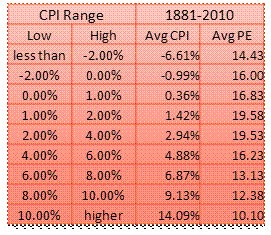

Now, it should be noted Modigliani and Cohn in 1979 argued that equity investors are making a grievous error by discounting equities differently in high-inflation and low-inflation environments. They argue that since equities are real assets, investors should be reflecting higher future earnings when they are discounting by higher nominal rates, so that the multiple of nominal earnings should not change due to inflation except for various things like tax inefficiencies and the like whose net effect is not entirely clear. Be that as it may, it has been a very consistent error, and it seems best to assume the market will be consistent in its irrationality rather than inconsistent by suddenly becoming rational.
So, if inflation picks up, then so do earnings – but only slowly. And in the meantime, a large change in the multiple attached to those (current) earnings implies that the current equity price should decline substantially when the adjustment is made to discount higher inflation. After that sharp adjustment, it may be that equity prices become decent hedges against inflation. And in fact, if multiples were particularly low now then I might argue that they had already discounted the potential inflation. But they are not – 10-year P/Es are very high right now.
In short, there is almost no evidence supporting the view that equities are a decent hedge for inflation in the short run, and some careful studies don’t even find an effect in the long run. In a thorough white paper produced by Wood Creek Capital Management,[4] George Martin breaks down equity correlations by industry and time period, and only finds a small positive correlation between Energy-related equities and inflation – and that is likely due to the fact that energy provides most of the volatility of CPI in the short-run. Among many meaningful conclusions about different asset classes, Dr. Martin concludes that equities do not offer a good short-term inflation hedge, nor a good long-term inflation hedge.
In fact, I think (especially given the current pricing of equities) the case is worse than that: equities are, as Dr. Bodie originally said in 1976, likely to hedge inflation only if you short them.
[1] “Does inflation matter for equity returns?”, Journal of Asset Management, vol 6, 4, pp. 259-273, 2005.
[2] “Common Stocks as a Hedge Against Inflation”, The Journal of Finance, Vol. 31, No. 2, Papers and Proceedings of the Thirty-Fourth Annual Meeting of the American Finance Association Dallas, Texas December 28-30, 1975 (May, 1976), pp. 459-470, Wiley, Article Stable URL: http://www.jstor.org/stable/2326617
[3] “Stock Returns, Real Activity, Inflation, and Money”, The American Economic Review, Vol. 71, No. 4 (Sep., 1981), pp. 545-565, American Economic Association, Stable URL: http://www.jstor.org/stable/1806180
[4] “The Long Horizon Benefits of Traditional and New Real Assets in the Institutional Portfolio,” Wood Creek Capital Management, February 2010. Available at http://www.babsoncapital.com/BabsonCapital/http/bcstaticfiles/Invested/WCCM_Real_Assets_White_Paper_Final.pdf.
Rough Week, but it Could Have Been Worse
It was an interesting week. Considerable volatility in the foreign exchange markets (the dollar fell 5.5 handles from 105.50 yen to 95 yen before bouncing to 97.5 yen at week’s end) and a slide in several foreign equity markets (chiefly the Nikkei, -6.5%, but also the UK -2.6%, Italy -3.0%, Mexico, Brazil, Turkey -9%, etc) impacted the U.S. bourse at the margin but not severely. On Monday, a weak ISM helped push US stocks lower and bonds higher; but on Friday an as-expected Employment report led to a massive equity rally and sharp losses on bonds with the 10-year yield reaching a new high for the move.
The reaction from bonds isn’t terribly surprising. Bond funds are seeing near-record outflows as everyone knows that yields would not be near these levels without Fed backing, and no one wants to be the last one out. Any fear that “taper” is going to happen soon was going to send yields higher, and as I wrote on May 29th there is some risk for much higher yields.
The equity reaction on Friday is a little more confusing. Sure, the airwaves were full of news of the “better than expected” payrolls, although the combination of the May positive surprise (+12k) and the revisions to the prior two months (-12k) puts the Jobs number precisely on the consensus estimates while the Unemployment Rate rise slightly due to a rise in the participation rate. To be sure, there is nothing in the number to force the Fed to consider a “taper” with any kind of urgency, but considering that Bernanke and Dudley have already signaled that no taper is imminent, this is hardly news: the data on Friday was almost exactly as-expected.
Going forward, the market continues to face the same hurdles: higher rates mean more competition for investment dollars and will pressure equity prices. Lower unemployment implies that the current ratio of real wage growth relative to gross margins – which reflects the great power of capital right now relative to labor, with margins at record highs while real wages stagnate – will begin to shift back in favor of wages and away from capital. Higher rates also imply higher money velocity and hence, higher inflation. (See chart, source Bloomberg.)

If 5-year rates went to, say, 2%, and M2 velocity rose to 1.732 as the regression suggests, it would represent a 12.9% rise in money velocity. If M2 merely ticks along at the current (high, but not as high as it was) rate of 6.6% growth year-on-year, and GDP grows at an optimistic 4% rate, then it implies inflation of roughly 15.7% (1.129 * 1.066 / 1.04).
There are a lot of “ifs” in that statement, and I want to make clear that I am not forecasting 15.7% inflation over the next year, or even the next two years combined. But the point is that the risks are not insignificant. It isn’t a rise of core CPI to 2.5% by year-end that is the potential problem, although stocks might not take that well. It is a rise above that, which causes rates to rise, which causes velocity to accelerate further, etcetera in a spiral that the Fed is powerless to do anything about since it must first remove $1.9 trillion in excess reserves from the banking system…
And in that sort of inflationary environment, equities would be roundly trashed. A reader asked me to expound further on my prior observations about equities and inflation, and this seems like the right place to do it. However, so as to limit the length of this article, I am posting that further discussion/article separately here.
Is This the “Real” Selloff?
Let the wailing and gnashing of teeth begin: the stock market is down almost 5% from the highs!
It was once the case that investors viewed equity market volatility with aplomb. When you could only check your stock prices daily in the paper, and when people were cautious and unlevered because they recognized that crazy things sometimes happened and they couldn’t count on the central bank to bail them out, a 5% setback was just part of the normal zigs and zags. But now we see the VIX rising into the high teens, and a bid developing in Treasuries.
The bid, however, is not as apparent in TIPS. Investors irrationally consider TIPS a “risk-on” asset, even though they are safer than Treasuries since they pay in real dollars. It’s a wonderful thing, because every time there is a market upset “risk-off” trade, TIPS and/or breakevens start to offer terrific value and instead of losing when the panic passes, as with normal Treasuries that slide back down when the flight-to-quality passes, TIPS valuations will snap back. In the meantime, they offer hard-to-miss entry points. For example, right now the 10-year breakeven is at 2.19%, which means expectations are that the Fed will miss its 2% target on PCE on the low side over the next ten years (since PCE is regularly around 0.25%-0.5% below CPI).
Even if that happens, the Fed surely will not miss it by very much (in that direction) – in the worst recession of our lifetimes, core CPI printed 1.8% for 2009, 0.8% for 2010, 2.2% for 2011, and 1.9% for 2012. Headline CPI was 2.7%, 1.5%, 3.0%, and 1.7%, so the average for core over the last four years of epic financial disaster has been 1.7% and for headline, 2.2%. So why in the world would someone buy a 10-year Treasury note at 2.09% when they can own 10-year TIPS for -0.10% + inflation? There seems to me to be mostly downside to holding nominal bonds relative to TIPS…but investors will consistently make this error, and it may get worse, if stocks continue to correct.
However, that error will not last for long, I suspect. CPI will be released on June 18th, and I expect everyone will expect a very soft core inflation number. I believe the housing part of inflation will start to heat up as soon as this month, and I would be very surprised to see inflation print below what will surely be very soft expectations. If core inflation prints 0.3%, rather than last month’s 0.1%, the market will be completely the other way.
That’s not the near-term concern, though. Near-term, investors are concerned that the weak economic growth we have seen for the last several years rolls over rather than continuing to accelerate. The weak ISM print on Monday (the first below 50 since 2009) and today’s modest downward surprise in the ADP employment number (135k new jobs, the weakest since September) has increased nervousness that a stock market which is currently trading at nearly 23 times 10-year earnings, in an environment of record gross margins, might not be able to handle an environment that is less than perfect. I don’t blame investors for that concern.
Another concern, which oddly seems to be vying for equal time, is that the Fed “sounds serious” about ceasing its program of securities purchases. I am highly doubtful that both the weak growth and the end-of-QE concerns can both come to fruition, but even if growth continued to bump along at soft, but not recession levels I doubt the Fed would be cutting QE very soon. The Fed speakers who “sound serious” about reining in QE are mostly established hawks like Dallas Fed President Fisher, who said on Tuesday that “we cannot live in fear that gee whiz, the market is going to be unhappy that we are not giving them more monetary cocaine.” Against that, set the people whose votes actually matter: Bernanke, who evinces few concerns that there’s anything negative about QE and so isn’t in any particular hurry to stop it, and Dudley, who said recently that it will be a few months before the Fed can even decide on a tapering strategy (which would presumably have to precede an actual taper). I side with Fisher on this one, but my vote counts just about as much as Mr. Fisher’s.
(However, I can’t wait to see what my friend Andy at fxpoetry.com does with the cocaine comment tomorrow).
My view has not changed much: I think growth is going to be slow, but we’re probably not going to slip back into recession although we are technically due for one by the calendar. I think inflation is going to rise, and keep rising, and I think the Fed will be very slow to stop QE. Even once it stops QE, it will be slow to remove the accommodation, and inflation will continue to accelerate while it does so. I think stocks are overvalued and offer very poor real returns going forward. I do think that TIPS are now a much better deal than Treasuries, and not a bad deal on an outright basis relative to equities – the first time in a while I could have said that. In fact, the expected 10-year real return on equities is less than 2% more than the expected 10-year real return on TIPS (the latter of which has no risk), which is the worst valuation for stocks relative to TIPS since August of 2011.
In fact, here’s a fact which is worth dwelling on for any investor who says that stocks are a good deal because nominal interest rates are low. Stocks, of course, are real assets (although they tend to do poorly in inflationary periods, as I have said), and if you want to compare them to an interest rate you ought to be comparing them to a real interest rate rather than a nominal interest rate. So, let’s do that. The chart below (Source: Bloomberg) shows the 10-year TIPS yield (in yellow, inverted) plotted against the S&P 500 for the period I just mentioned.
 I think the conclusions are likely obvious. The last time real yields were at these levels, the S&P was between 1200 and 1400 (if you want to be generous about the early-2012 example). It’s over 1600 now.
Deflation Isn’t An Export; Crazy Talk Is
We are once again witnessing the market effects of a deficit of basic knowledge of economics. This is, of course, no news in itself: the list of economic conceptual errors, to say nothing of forecast errors, made by market participants over the last decade is long enough to constitute an entire course of study at an accredited college. But the current misunderstanding is somewhat bothersome because it requires only a rudimentary level of common sense to see that it cannot be so; therefore, the fact that this misunderstanding persists is a sign that people aren’t even bothering to think about whether the received wisdom is correct.
The question concerns Japan, as so many questions soon will. The statement is made that the aggressive quantitative easing by the Bank of Japan is “exporting deflation”, and is thus the profligate monetary policy of Japan creates the risk of declining inflation domestically.
To see how bankrupt (no pun intended) this thinking is, simply perform the following thought experiment. Suppose country A can cause deflation in country B by easing monetary policy aggressively. It must also be true, then, that country B can cause deflation in country A by easing their policy aggressively. Therefore, the best strategy must be for both country A and country B to ease aggressively, since that way they will both get the benefits of monetary policy easing but both will deflate.
Obviously, that’s lunacy! In this two-country case, there is much more money and yet much lower prices. This can only true if monetarist theory is completely wrong.
Let’s try a slightly-more-sophisticated version of the same confusion. Instead, we make the statement that country A can cause deflation in country B by easing policy relatively more aggressively than country A. But this still creates gains, because once country B starts to ease aggressively, country A can also ease aggressively as long as they ease less aggressively, and experience falling prices along with the other supposed rewards of monetary policy. Again, this is clearly nonsense (although a little less clearly).
This is another version of the confusion of the real/nominal confusion. In this case, people observe that the country which is more aggressive in easing will tend to see its currency decline. This is true, and it is also true (as a separate statement) that a declining currency tends to increase inflation and a rising currency tends to decrease inflation. This is where the confusion sets in: by easing aggressively, the BOJ is causing the dollar to rally – although it declined sharply today – and making investors think that will pressure our domestic inflation lower.
But where did the money go?
It is true that if the US dollar rallies then, all else equal, our domestic inflation will decline. But in this case, all else is assuredly not equal. In this case, there is much more liquidity in the system as a whole. And the effect of that liquidity swamps the effect of the FX change. I used to use a simple regression model of core inflation that included both year-on-year changes in FX and M2, lagged appropriately (along with rosemary, cumin, tarragon, and some other spices). The coefficient for the change in M2 was 0.36: that is, a 10% change in M2 would, all else equal, push core inflation up 3.6%. The coefficient for the change in the dollar index was 0.014: a 10% rise in the dollar would cause core inflation to decline 0.14%. Since these two effects typically offset each other to some degree, monetary policy is more effective in pushing prices higher if you’re the only central bank doing QE…but not much more effective.
Because historically the crazy monetary policies have been pursued by countries in isolation, which have seen their currencies crater while their inflation went to the moon, many investors have incorrectly conflated the two events. This is one reason that some traders have been expecting the dollar to collapse for some time now. But if everyone is pursuing QE, then the effect on the currency is indeterminate (not to mention unstable). The only reason we’re seeing the Yen depreciate is that they are significantly more aggressive, for now, than the rest of the world is in pursuing QE.
So in short, Japan is “a bug in search of a windshield”: yes. The Bank of Japan’s aggressive QE will cause inflation in Japan: yes. The depreciation of the Yen will “export deflation” to the rest of the world: no. In fact, the BOJ’s action will raise the price level in the rest of the world, although less than it will raise its own price level because the currency move will offset a small part of the liquidity effect.
Now, I am sure that someone will object that this violates Purchasing Power Parity, which suggests that the A-B currency pair should change exactly enough to offset the difference in price-level changes in countries A and B. My two quick observations are: (1) PPP is useful theory but doesn’t seem to describe the real world (see the Wikipedia entry on PPP for some evidence and objections), and (2) if PPP is right, then exporting deflation is also impossible. According to PPP, the BOJ QE would have no effect on our price level…so it’s not a very effective objection to my argument that “exporting deflation” is crazy talk.
Bonds and the “Convexity Trade”
It has been a long time since we have had to worry about and think about the phenomenon of mortgage convexity and the effect that it can have on the bond market. But with 10-year interest rates up 50bps in less than 1 month, and some of the selloff recently being attributed to “convexity-related selling,” it is worth reminiscing.
We need to start with the concept of “negative convexity.” This is a fancy way of saying that a market position gets shorter (or less long) when the market is going up, and longer (or less short) when the market is going down. That’s obviously a bad thing: you would prefer to be longer when the market is going up and less long when the market is going down (and, not surprisingly, we call that positive convexity).
Now, a portfolio of current-coupon residential mortgages in the US exhibits the property of negative convexity because the homeowner has the right to pre-pay the mortgage at any time, and for any reason – for example, because the home is being sold, or because the homeowner wants to refinance at a lower rate. Indeed, holders of mortgage-backed securities expect that in any collection of mortgages, a certain number of them will pre-pay for non-economic reasons (such as the house being sold) and the rest will be pre-paid when economic circumstances permit. Suppose that in a pool of mortgages, the average mortgage is expected to be paid off in (just to make up a number, not intended to be an accurate or current figure) ten years. This means that the security backed by those mortgages (MBS for short) would have a duration of about ten years, so that a 1% decline in interest rates would, in the absence of convexity, cause prices to rise about 10%.[1]
Now, that’s really just a guess based on where interest rates are currently. As interest rates change, so does the duration of the bond. If mortgage interest rates fall significantly, then most of the mortgages in that MBS would pre-pay and the duration of the security would fall sharply. Suppose that after a sufficient decline in interest rates, the same pool of mortgages in that MBS is expected to be pre-paid on average in only 3 years. Now a further 1% decline in interest rates will only cause the price of the MBS to rise about 3%. This is negative convexity, and what is significant here is how holders of MBS respond. In order to maintain a similar market exposure, the owner of the MBS needs to buy more bonds, swaps, or MBS to maintain his duration. That is, into a rally, the MBS owner needs to buy more. This is “buying high,” and it’s the manifestation of one side of that negative convexity.
Suppose that instead interest rates rise sharply. Now, instead of expecting those mortgages to economically pre-pay over the next 10 years, we realize that the opportunities for these homeowners to refinance just went away (at least for a while); consequently, we now expect the mortgages to pay off in 15 years on average, rather than 10. A further rise of 1% in interest rates will cause prices to fall 15% rather than 10%. Again, the MBS holders need to respond, and they do so by selling bonds, swaps, or MBS to maintain duration. That is, into a selloff, the MBS owner needs to sell more. This is “selling low,” and it’s the manifestation of the other side of that negative convexity.
Put together, a manager of a large MBS portfolio is earning a higher-than-average coupon, but is also systematically buying high and selling low on his hedges and losing a little money each time. More importantly for our case here is that if the market moves enough to trigger the hedging activity then we say that “the convexity trade” has caused a significant amount of selling into a selloff, or a significant amount of buying into a rally, and this essentially means fuel is being added to the fire and the move is worsened. The mortgage market is massive, and especially with dealers having less capacity for market-making risk-taking a big convexity trade could cause a huge move. In the 2000s, I recall two massive selloffs of at least 125bps over a period of just a few weeks, in which every 5bps seemed to bring out another huge seller and push the market another 5bps.
Figuring out exactly what the trigger level is at which the convexity trade kicks in is the domain of mortgage analysts, and there is a lot of brainpower and computing power put to this analysis. These folks can tell you that “a 10-year note rate of 2.25% will cause the market to get longer by 150bln 10-year note equivalents [just to be clear, this is a made up example],” which in turn implies that there will be substantially more selling when interest rates approach that level.
Now, I don’t know what the current trigger levels are, but I can tell you a few more things from years of experience.
First is that the market’s negative convexity is greatest when the market has rallied to a new level and stayed there for a long time, allowing most borrowers to refinance their mortgages to the current coupon. The chart of 10-year yields below (Source: Bloomberg) illustrates this point. In 2008, 10-year note yields fell below 2.5%, but did so very quickly and few people had a chance to refinance (plus, mortgage spreads were quite wide and credit was hard to get), so the mortgage market maintained something like its prior equilibrium.

However, over 2010 and especially after mid-2011, rates got substantially lower and stayed lower; mortgage credit also got somewhat easier than in early 2009 (although obviously underwater homeowners cannot refinance, and this limited the amount of refinancing activity so that MBS prepay speeds weren’t as rapid as the pre-2008 models had expected). We have now been at these levels for some time, so that I suspect the market’s average coupon is substantially lower today than it was two years ago. This means the bond market is very vulnerable to a convexity trade to higher yields, especially once the ball gets rolling. The recent move to new high yields for the last 12 months could trigger such a phenomenon. If it does, then we will see 10-year note rates above 3% in fairly short order.
The second point is somewhat more subtle. The nature of the negative convexity in the higher rate direction is different from the nature of the negative convexity in the lower rate direction. When rates fall, we are looking at borrowers refinancing, which means that we can stair-step lower: rates fall, borrowers refinance, rates fall further, borrowers refinance again, etcetera. But when rates rise, the duration increase is caused by a lack of activity. Borrowers eschew refinancing. And this, fundamentally, can only happen once no matter how far rates move. If it is not economical to refinance with rates 2% higher, then few borrowers will refinance. But at 5% higher rates, there is no additional effect: once your model expects essentially zero refinancing, the convexity trade is over until you get substantial new origination of mortgages, and this takes longer. Therefore, in a selloff the convexity trade is somewhat self-limiting. It sure doesn’t feel like it at the time, but it is.
This is a long article but it is worth reflecting on because of the conclusion, and that is this: if rates rise because the Fed begins to raise rates (or finds it doesn’t have enough will to keep them low, once the bond market expects much higher inflation), then there is no “cap” on how high they can go. But if rates rise in a sloppy fashion because of a convexity trade, there really is a cap. It would be ugly to see interest rates rise another 100bps (and really, really bad for stocks I think), but if they did so because of the convexity trade then we would probably get a bunch of that move reversed thereafter.
I don’t have a strong opinion about whether we are at that point yet, and I no longer have access to great mortgage analysts. But Fed speakers should tread very lightly, as I doubt the first trigger point is terribly far away and you surely don’t want to hit it.
There is one reason I don’t think that the bond market selloff we have seen to date is heavily driven by convexity-related flows, and that is that TIPS yields have risen faster than nominal bond yields. Over the period during which nominal 10-year yields have risen 50bps, 10-year TIPS yields have actually risen 58bps. If the trade was a convexity-driven trade, it would be primarily affecting nominal yields, which means that while TIPS would be suffering, they would be suffering less than nominal bonds, rather than more. (The flip side is that if you are bearish here because you think the convexity trade might kick in, you should also expect breakevens to widen substantially when that trade does kick in). Indeed, TIPS at -0.13% is the best bargain we have seen in quite some time (see chart, source Bloomberg).

Indeed, our multi-asset strategy has kicked the TIPS component all the way up to 11%, which is the highest it has been in a long while. TIPS are not cheap, but they are cheaper, and they are extremely cheap relative to nominal bonds. And they are not yet as cheap as i-Series savings bonds, although the yield advantage of those bonds has dropped from the 159bps it was when I wrote about it here to “only” 93bps. But that’s still a great arb, and so I continue to advocate i-bonds.
[1] I am abstracting from the niceties of Macaulay versus modified versus option-adjusted duration here for the purposes of exposition.
“I Say, Let ‘Em Crash”
John Mauldin wrote a piece last week about Brown-Vitter, a piece of legislation making its way through Congress that has a “simple” approach to getting the government out of the bank-rescue business: for big banks (basically defined in the legislation as banks who use derivatives to structure customer deals), a massive capital buffer is demanded, which would effectively take big US banks out of the derivative business and greatly increase costs and decrease variety of derivative and other solutions (many bonds issued by corporate entities are coupled with a swap to the dealer, which would now be subject to a massive capital charge).
The appeal of the legislation is its simplicity. It simply destroys the business model of the largest banks.
Moreover, it doesn’t solve the “too big to fail” problem. It merely changes the hurdle of how much bad stuff needs to happen, in order to cause a bank to fail in the first place and to require saving. It wouldn’t cause the government to exit the position of writing puts on banks: it would merely move the strike prices of those puts.
I will say that in my interactions with Wall Street banks, I have not run across anyone who is concerned, at least not yet, that Brown-Vitter will actually become law. It is simply too blunt of an approach – akin to burning a town down in order to keep it from being flooded.
The cynic in me says that all of this legislation is designed mainly to produce big contributions from banks to the reelection campaigns of public officials. There is a much simpler way to get the government out of the too-big-to-fail business, which furthermore does not involve causing massive side effects in the derivatives and other markets. Congress could simply pass a rule that prohibits the government (including the Fed) from bailing out a private enterprise. Problem solved, subsidy ended.
The Fed already has the power to close down and wind down insolvent banks. Of all of the Fed’s powers, this is the one that has been used most successfully over the years. It isn’t the failure of a bank that is the problem, but the chaotic failure of a bank that is the problem. Task the Fed with reducing the chaos inherent in large bank failures, and let the chips otherwise fall where they may.
