Archive
Ben, Can I Speak With Your Mommy?
Although the market action was restrained today, one gets the feeling that it was the heat rather than the lack of news. There were at least two events worth commenting on today.
The first was the Housing Starts figure, which at 836k (versus 960k expected) was about 13% worse than expected. As the chart below (source: Bloomberg) shows, housing starts are now about 16% below the highs hit earlier this year. And the industry, while upbeat (see the NAHB upside surprise yesterday), must be that way because of the perceived future business since the level of starts we are retreating from is only slightly above the level reached at the depths of the 1991 recession.

However, this is positive news both for investors in housing and for the economy as a whole. The decline in housing starts appears to be a price response to higher interest rates (it certainly isn’t a response to a glut, as inventories are extremely low right now). It is terrific news that this is happening, because it is a rational response to higher interest rates on the part of spec builders (who are much more sensitive to financing than is the average homebuyer). On the chart below, I’ve added the 10-year Treasury yield (inverted).

Note that the correlation of levels from January 1990 to December 2006 is about -0.80: you can see the zig-zags line up pretty well, and remember this is not even mortgage rates but Treasury rates. But you can see that from 2003 to 2005 or so, Housing Starts continued to rise while interest rates were also rising.
While it’s on much less data, and clearly the intercept of the regression is very different, the correlation of these two series has resumed a fairly high inverse correlation (-0.68) since December 2008.
The growth news here isn’t particularly good, since higher rates will clearly lead to fewer housing starts. It isn’t horrible, since the construction and real estate industry is, after all, a much smaller part of the economy now than it was in the height of the bubble. But after all, that is how higher interest rates are supposed to impact growth – so it’s natural, even if the Fed may not care for the messiness of nature.
In any event, less building translates into more support for prices in the existing housing market, which is good for homeowners and financial investors. Some economists will also expect the higher home prices to ignite further economic growth, via a “wealth effect,” but I am skeptical of that in this case. In the mid-2000s, there was clearly a wealth effect from the home price boom, because the combination of higher prices and lower interest rates meant that consumers could cash out home equity to support additional spending. But in the extant case, increasing home prices are occurring in conjunction with interest rates going up. In that circumstance, there will not be very much refinancing activity (why refinance into a higher rate mortgage?). So, is the wealth effect caused by wealth per se, or by wealth that can be drawn on and spent, via refinancing? I suspect it is the latter, which means that the higher wealth will have a much lower “wealth effect” coefficient going forward and some economists, and probably the Fed, will overestimate growth as a result.
Speaking of the Fed, the other event of the day was the start of Chairman Bernanke’s final monetary policy report to the Congress – unless it turns out that he stays Chairman longer than expected, for example because no other candidate is found who can be confirmed and actually wants the job. Remember, this Chairman got to play Santa Claus; the next one gets to be Scrooge (pre-visitation).
For the most part, this was an unremarkable testimony. After being careful to ladle on the dovishness in good measure after the bond market reacted to the Fed’s declaration that QE will be ending soon (not to mention, a lot of negative convexity in the market), there was no way that Bernanke was going to be anything but quite supportive.
But one part sort of struck me because it is a major departure from the line taken by all previous Fed chairmen. In the past, the Fed was generally willing to pursue a fairly accommodative monetary policy if fiscal policy was restrictive or at least responsible. Chairman Greenspan even made that promise explicit, and public, in 1995. (See here for background on that period.) And Bernanke himself, four years ago, admonished the Congress to “demonstrate a strong commitment to fiscal sustainability in the longer term.”
But Chairman Bernanke is now complaining about the effort to make mild cuts in government spending. Today he said that “fiscal policy is stunting the recovery,” and that “the risks remain that tight federal fiscal policy will restrain economic growth over the next few quarters by more than we currently expect.”
To be clear, he is complaining about the fact that Federal expenditures over the last six months were only $1.688 trillion, compared to $1.717 trillion in the last six months of 2012. It isn’t that there has been dramatic spending restraint due to the sequester – it has been, at best, very mild (we can get a more-generous figure by comparing against the first six months of 2012, in which case spending is down from $1.851 trillion…about 1% of GDP). Revenues are up, by about $202bln with comparison against the year-ago period (about 1.25% of GDP). This is a drag, but it isn’t a 2.25% drag because this is replaced at least in part elsewhere in the economy. Indeed, revenues are up and spending is down partly because the economy is doing better. It’s called an automatic stabilizer…that’s how it works.
In any event, if the Chairman of the Fed is going to whine when very moderate fiscal conservatism causes the economy to expand at only 1-2% per year, then what chance do we ever have of balancing the budget? Who is wearing the big boy pants? Ben, can I speak with your mommy?
And, if we’re not going to even try very hard to balance the budget, what chance do we have to restrain inflation, once the tide has decisively turned? The answer is none. No chance at all, unless someone – or people generally – demand fiscal and monetary sanity be returned.
Moderate Monetary Policy: Vice Or Virtue?
Barry Goldwater once said “Extremism in the defense of liberty is no vice. And moderation in the pursuit of justice is no virtue.” It is one of the great quotes of the 20th century, and so I feel moderately guilty to convert it to my own selfish uses by saying that “Extremism in the defense of bad monetary policy is no virtue. And neither is moderation in the attack on inflation.”
And that, for the most part, is the story of the day.
Much of the day’s trading session was as languorous as the Bermuda-shorted walkers on Lexington Avenue in the wilting, moist heat of the New York summer. But, late in the day, the release of the minutes from the last FOMC meeting and the subsequent question-and-answer session from Chairman Bernanke roused traders and rattled markets.
The minutes themselves were filled with comments on inflation that are likely to be held up as articles of ridicule in only a few months.
The extremism of St. Louis Fed President Bullard, in defense of bad policy, summed it up: “Mr. Bullard dissented because he believed that, in light of recent low readings on inflation, the Committee should signal more strongly its willingness to defend its goal of 2 percent inflation. He pointed out that inflation had trended down since the beginning of 2012 and was now well below target.” He was not alone, as “…most participants…anticipated that [inflation] would remain below the Committee’s 2 percent objective for some time.”
If by “some time” they mean “several months,” then I suppose this will end up being right. But there is very little doubt that core inflation will be over 2% very quickly, unless some interesting data quirk provides an encore to the Medicare-induced decline in core CPI over the last six months. This is where good analysis is supposed to play a role. The chart below (Source: Bloomberg) shows core CPI, along with another measure of the central tendency of inflation: the Cleveland Fed’s Median CPI.
 Now, in this column I have written quite a bit previously about what exactly is happening to core CPI, and why we shouldn’t pay too much attention to its recent decline (in summary: it is all in core commodities and especially pharmaceutical prices, while the biggest chunk of CPI, housing, is in the process of turning higher). But the point of this chart is that the deviation in core CPI compared to median CPI should be a clue to the thoughtful analyst to look more closely at what is going on, since the median is barely moving – and remains above 2% – while the average is declining. What this tells you, statistically, is that there are a few big outliers to the downside that are skewing the core reading lower. It is upon further investigation that the observation about housing-versus-pharmaceuticals (which cause core PCE to be even lower, since core PCE exaggerates the effect of medical care while understating the importance of housing) ought to be crystal clear. You don’t have to be an inflation expert to figure that out. You just need to look at the data carefully. It takes a bit more expertise, but not a ton, to observe that the second half of the year should see core inflation rise because of easy comparisons to the year-ago period, if for no other reason.
And the Fed came to the right conclusion…
“Several transitory factors, including a one-time reduction in Medicare costs, contributed to the recent very low inflation readings. In addition, energy prices declined, and nonfuel commodity prices were soft…”
…and then butchered the forecast for higher core inflation by incorrectly attributing it:
“Most participants expected inflation to begin to move up over the coming year as economic activity strengthened…”
It’s a simple forecast (although the rise will be more than they expect it to be), and they at least got the sign of the movement in inflation right. Maybe they even got the causes right, privately, but just felt it was too hard to explain in the minutes.
But, I doubt it.
The FOMC participants are not expecting, as it also says, inflation to move above 2% (on core PCE, which would be somewhat higher on core CPI). It’s a very marginal forecast they are making here. More extremism, though, was provided by the IMF’s Chief Economist Olivier Blanchard, who said in an interview that he is “not at all worried about inflation” in the U.S., because in his view (although stated as fact) inflation can rise because of an overheated economy or people’s expectations of cost increases. People, said Blanchard, who fear a jump in prices are “plain wrong.”
What is plain wrong is that they picked a guy to be chief economist who doesn’t understand the first thing about inflation. Virtually no one who has studied the matter believes that inflation expectations cause inflation. This is because there is nothing remotely suggestive of that in the data (and, moreover, no one can figure out how having customers who are afraid of cost increases can cause a vendor in a competitive marketplace to jack up prices with no other reason). Many people believe that an “overheated economy” can cause inflation to rise, so that’s at least a more common error, but consider that that core inflation fell in the U.S. from 1995-1999, and then rose from 2000 to 2002. Consider that it fell from 2006 to 2008 with unemployment below 5% and then rose sharply in 2011 with unemployment around 9%. Given that, is it unreasonable to ask that a chief economist at least be less strident in his statement about how plain wrong everyone else is?[1]
There was some volatility on the release of the FOMC minutes, with inflation markets getting pressured modestly on the theory that the minutes were not quite as dovish as was hoped, and there was at least some fair discussion about the importance of holding down inflation. Eventually, that is. But inflation breakevens as well as commodities prices (and stocks, and bonds, etc) rallied when Chairman Bernanke took some questions after his speech in Boston. In his responses, he backed off the recent tapering signals further – really, they’ve been backpedaling so fast on this that they’re behind where they started – by saying that inflation and the state of the jobs market indicates that more Fed stimulus is needed. The fact that this comment, myopically focused on the very short run followed a speech with the grand title of “The First 100 Years of the Federal Reserve: The Policy Record, Lessons Learned, and Prospects for the Future” was an irony apparently lost on the Chairman.
But, hey, let’s face it. He’s going to be gone when the important work of policy normalization gets started. As the President said recently, he’s stayed far longer than he wanted to. Is it unreasonable to expect him to just be ‘phoning it in’ at this point? Yet his moderation is no virtue, especially if you own fixed-rate bonds or other assets that will perform poorly when inflation rises.
[1] I, on the other hand, am free to do so since I am not the Chief Economist of the IMF nor the Chairman of the Federal Reserve, and moreover because no one much cares what I think. Ah, the freedom of irrelevance!
Bond Beatings Continue
The beatings are continuing, and apparently morale really does improve with such treatment. Consumer Confidence for June vaulted to the highest level since early 2008, at 81.4 handily beating the 75.1 consensus. Both “present situation” and “expectations” advanced markedly, although the “Jobs Hard to Get” subindex barely budged. It is unclear what caused the sharp increase, since gasoline prices (one of the key drivers, along with employment) also didn’t move much and equity prices had been steadily gaining for some time. It may be that the rise in home prices is finally lifting the spirits of consumers, or it may be that credit is finally trickling down to the average consumer.
Whatever the cause, it is not likely to prevent the rise in money velocity that is likely under way, driven by the rise in interest rates. Between the rise in home prices – the Case-Shiller home price index rose a bubble-like 12.05% over the year ended April, and Existing Home Sales median prices have advanced a remarkable 14.1% faster than core inflation (a near record, as the chart below shows) over the year ended in May. (Lagged 18 months, such a performance suggests about a 3.9% rise in Owners’ Equivalent Rent for 2014).
 But of course, we must fear deflation more than ever!
The nonsense about deflation is incredible to me. Euro M2 growth hasn’t been this high (4.73% for year ended April) since August of 2009. Japanese M2 growth hasn’t been this rapid (3.4% for year ended May) since May 2002. US money supply is “only” growing at 6.5% or so, down from its highs but still far too fast for a sluggishly-growing economy to avoid inflation unless velocity continues to decline. But you don’t have to be a monetarist to be concerned about these things. You only need to be able to see home prices.
Core inflation in the US is being held down by core goods, as I have recently noted. In particular, CPI for Medical Care just recorded its lowest year-on-year rise since 1972, and Prescription Drugs (1.32% of CPI and an important part of core goods) declined on a y/y basis for the first time since 1973. The chart below (source: Bloomberg) illustrates that as recently as last August, that category was rising at a 4.0% pace.
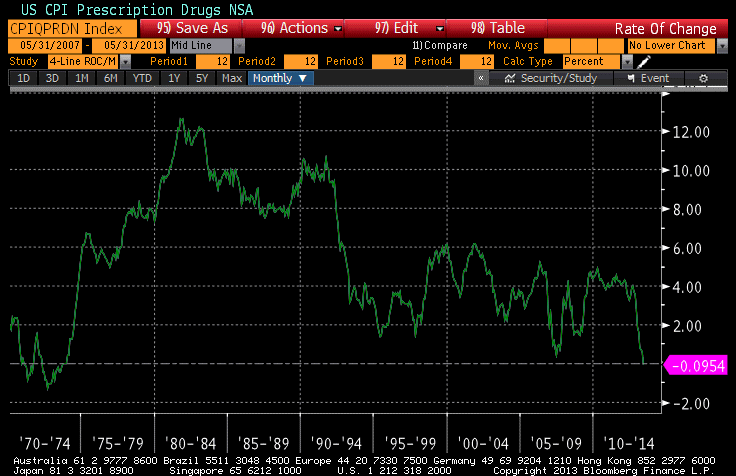
Now, I suspect that this has something to do with Obamacare, but no one seems to know the full impact of the law. Keep in mind that Medical Care in CPI excludes government spending on medical care. So, one possible narrative is that the really sick people are leaving for Obamacare while the healthy people are continuing to consume non-governmental health care services. This would be a composition effect and would imply that we should start looking at CPI ex-medical for a cleaner view of general price trends. I have no idea if this is what is happening, but I am skeptical that prescription meds are about to decline in price for an extended period of time!
But that’s the bet: either core inflation is going to go up, driven by things like housing, or it’s going to go down, driven by things like prescription medication. Place your bets.
Equity prices recovered today, but bond prices continued to slide into the long, dark night. For a really incredible picture, look at the chart below (source: Bloomberg), which shows the multi-decade decline in 10-year yields on a log scale, culminating in the celebrated breakout below that channel. Incredibly, the recent selloff has yields back to the midpoint of the channel and not outrageously far from a breakout on the other side!
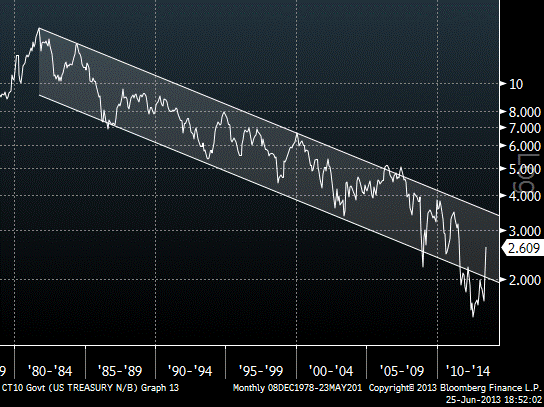
Incidentally, students of bond market history may be interested to know that the selloff has now reached the status of the worst ever bond market selloff (of 90 days or less) in percentage terms. Since May 2nd, 10-year yields have risen from 1.626% to 2.609%, a 98.3bp selloff which means that yields have risen 60.5% in less than two months.
And we are probably not done yet. I wrote about a month ago about the “convexity trade,” and I made the seemingly absurd remark that “This means the bond market is very vulnerable to a convexity trade to higher yields, especially once the ball gets rolling. The recent move to new high yields for the last 12 months could trigger such a phenomenon. If it does, then we will see 10-year note rates above 3% in fairly short order.”[emphasis in original] Incredibly, here we are with 10-year yields at 2.61%, up 60bps over the last month, and that statement doesn’t seem quite so crazy. As I said: I have seen it before! And indeed, the convexity trade is partly to blame for what we are seeing. I asked one old colleague today about convexity selling, and here was his response:
“massive – the REITs are forced deleveraging and there are other forced hands as well. The real money guys are too large and haven’t even sold yet – no liquidity for them. The muni market has basically crashed and at 5% yields in muni there is huge extension risk on a large amount of bonds: something like $750bln in bonds go from 10-year to 30-year maturities as you cross 5%.” (name withheld)
Now, I am not a muni expert so I have no idea what index it is I am waiting to see cross 5%. But the convexity trade is indeed happening.
Lots of bad things have happened to the market, but they really aren’t big bad things. In fact, I move that we stop using the term “perfect storm” to mean “modestly bad luck, but I had a lot of leverage.” The Fed was never going to be aggressively easy forever, and as various speakers have pointed out recently they didn’t exactly promise to be aggressively tightening any time soon. There is bad news on the inflation front, but the market is clearly not reacting to that. Some ETFs have had some liquidity issues, and emerging markets have tumbled, and there was a liquidity squeeze in China. But these are hardly end-of-the-world developments. What makes this a really bad month is the excess leverage, combined with the diminished risk appetite among primary dealers who have been warned against taking too much “proprietary risk.”
And markets are mispriced. Three-year inflation swaps imply that core inflation will be only 1.9% compounded for the next three years (the 1-year swap implied 1.6%; the 2y implies 1.75%). That is more than a little bit silly. While I have not been amazed that the convexity trade drove yields very high, and probably will drive them higher, it has surprised me that inflation swaps and inflation breakevens have continued to decline. Still, investors who paid heed to our admonition to be long breakevens rather than TIPS have done quite a bit better, as the chart below (source Bloomberg), normalized to February 25th (the date of one of our quarterly outlook pieces) illustrates.
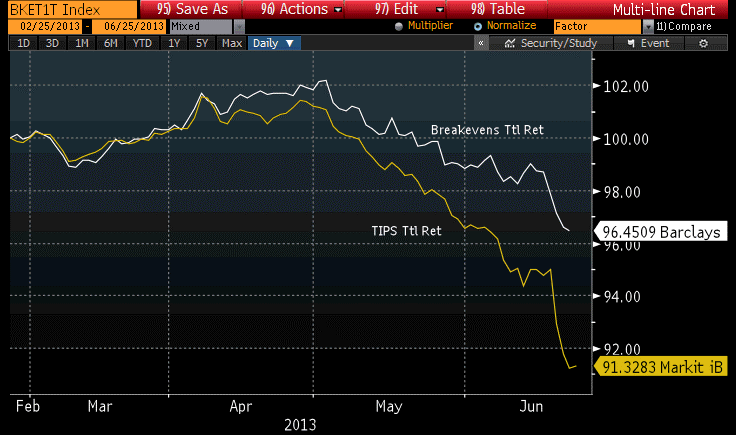
As the bond selloff extends, I don’t think TIPS will continue to underperform nominal bonds. I believe breakevens, already at low levels (the 10-year breakeven, at 1.97%, is lower than any actual 10-year inflation experience since 1958-1968), will be hard to push much lower, especially in a rising-yield environment.
Equity Returns and Inflation
There has been a lot written in the academic literature about why equity returns and inflation seem to be inversely related. What is amazing to me is that Wall Street seems to still try to propagate the myth that equities are a good hedge for inflation (sometimes “in the long run” is added without irony), when virtually all of the academic work since 1980 revolves around explaining the fact that equity returns are bad in inflationary times – especially early in inflationary times. There is almost no debate any longer about whether equity returns are bad in inflationary times. About the strongest statement that is ever made against this hypothesis is something like Ahmed and Cardinale made in a Journal of Asset Management article in 2005,[1] that “For a long-term investor such as a pension fund, the key implication of these results is that short-term dynamics cannot be completely ignored in the belief that the stock market will turn out to be a perfect inflation hedge in the long run.” For someone looking for a refutation of the hypothesis, that is pretty small beer.
And yet, it is amazing how often I am called to defend this observation! So, since it seems I have never fully documented my view in one place, I want to refer to a handful of articles and concepts that have shaped my view about why you really don’t want to own equities when inflation is getting under way.
I will repeat a key point from above: this is not news. In the mid-1970s, several authors tackled the question about stocks and inflation, and all found essentially the same thing. My favorite summing up comes from the conclusion of an article by Zvi Bodie in the Journal of Finance:[2]
“The regression results obtained in deriving the estimates seem to indicate that, contrary to a commonly held belief among economists, the real return on equity is negatively related to both anticipated and unanticipated inflation, at least in the short run. This negative correlation leads to the surprising and somewhat disturbing conclusion that to use common stocks as a hedge against inflation one must sell them short.”
By the early 1980s this concept was fairly well accepted (something about deeply negative real returns over the course of a decade-plus probably helped with the acceptance). In a seminal work in 1981,[3] Eugene Fama suggested that the negative relationship between equity returns an inflation is actually proxying for a positive relationship between real activity and equity returns (which makes sense), but since real activity tends to be inversely related to inflation rates, this shows up as a coincidental relationship between bad equity returns and inflation. But I am not here to argue the nature of the causality. The point is that since about 1980, the main argument has been about why this happens, not whether it happens.
The reason it happens is this: while a business, in inflationary times, sees both revenues and expenses rise, and therefore reasonably expects that nominal profits should rise over time with the price level (and overall, it generally does), the indirect owner of shares in a business cares about how those earnings are discounted in the marketplace. And, over a very long history of data, we can see strong evidence that equity multiples tend to be highest when inflation is low and stable, and much lower when there is either inflation or deflation. The chart and table below represent an update I did for a presentation a couple of years ago (it doesn’t make much sense to update a table using 120 years of data, every year) illustrating this fact. The data is from Robert Shiller’s site at http://www.econ.yale.edu/~shiller/data/ie_data.xls but I first saw the associated chart (shown below it) in Ed Easterling’s excellent (and highly-recommended) book, Unexpected Returns: Understanding Secular Stock Market Cycles
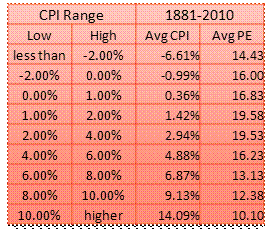

Now, it should be noted Modigliani and Cohn in 1979 argued that equity investors are making a grievous error by discounting equities differently in high-inflation and low-inflation environments. They argue that since equities are real assets, investors should be reflecting higher future earnings when they are discounting by higher nominal rates, so that the multiple of nominal earnings should not change due to inflation except for various things like tax inefficiencies and the like whose net effect is not entirely clear. Be that as it may, it has been a very consistent error, and it seems best to assume the market will be consistent in its irrationality rather than inconsistent by suddenly becoming rational.
So, if inflation picks up, then so do earnings – but only slowly. And in the meantime, a large change in the multiple attached to those (current) earnings implies that the current equity price should decline substantially when the adjustment is made to discount higher inflation. After that sharp adjustment, it may be that equity prices become decent hedges against inflation. And in fact, if multiples were particularly low now then I might argue that they had already discounted the potential inflation. But they are not – 10-year P/Es are very high right now.
In short, there is almost no evidence supporting the view that equities are a decent hedge for inflation in the short run, and some careful studies don’t even find an effect in the long run. In a thorough white paper produced by Wood Creek Capital Management,[4] George Martin breaks down equity correlations by industry and time period, and only finds a small positive correlation between Energy-related equities and inflation – and that is likely due to the fact that energy provides most of the volatility of CPI in the short-run. Among many meaningful conclusions about different asset classes, Dr. Martin concludes that equities do not offer a good short-term inflation hedge, nor a good long-term inflation hedge.
In fact, I think (especially given the current pricing of equities) the case is worse than that: equities are, as Dr. Bodie originally said in 1976, likely to hedge inflation only if you short them.
[1] “Does inflation matter for equity returns?”, Journal of Asset Management, vol 6, 4, pp. 259-273, 2005.
[2] “Common Stocks as a Hedge Against Inflation”, The Journal of Finance, Vol. 31, No. 2, Papers and Proceedings of the Thirty-Fourth Annual Meeting of the American Finance Association Dallas, Texas December 28-30, 1975 (May, 1976), pp. 459-470, Wiley, Article Stable URL: http://www.jstor.org/stable/2326617
[3] “Stock Returns, Real Activity, Inflation, and Money”, The American Economic Review, Vol. 71, No. 4 (Sep., 1981), pp. 545-565, American Economic Association, Stable URL: http://www.jstor.org/stable/1806180
[4] “The Long Horizon Benefits of Traditional and New Real Assets in the Institutional Portfolio,” Wood Creek Capital Management, February 2010. Available at http://www.babsoncapital.com/BabsonCapital/http/bcstaticfiles/Invested/WCCM_Real_Assets_White_Paper_Final.pdf.
Rough Week, but it Could Have Been Worse
It was an interesting week. Considerable volatility in the foreign exchange markets (the dollar fell 5.5 handles from 105.50 yen to 95 yen before bouncing to 97.5 yen at week’s end) and a slide in several foreign equity markets (chiefly the Nikkei, -6.5%, but also the UK -2.6%, Italy -3.0%, Mexico, Brazil, Turkey -9%, etc) impacted the U.S. bourse at the margin but not severely. On Monday, a weak ISM helped push US stocks lower and bonds higher; but on Friday an as-expected Employment report led to a massive equity rally and sharp losses on bonds with the 10-year yield reaching a new high for the move.
The reaction from bonds isn’t terribly surprising. Bond funds are seeing near-record outflows as everyone knows that yields would not be near these levels without Fed backing, and no one wants to be the last one out. Any fear that “taper” is going to happen soon was going to send yields higher, and as I wrote on May 29th there is some risk for much higher yields.
The equity reaction on Friday is a little more confusing. Sure, the airwaves were full of news of the “better than expected” payrolls, although the combination of the May positive surprise (+12k) and the revisions to the prior two months (-12k) puts the Jobs number precisely on the consensus estimates while the Unemployment Rate rise slightly due to a rise in the participation rate. To be sure, there is nothing in the number to force the Fed to consider a “taper” with any kind of urgency, but considering that Bernanke and Dudley have already signaled that no taper is imminent, this is hardly news: the data on Friday was almost exactly as-expected.
Going forward, the market continues to face the same hurdles: higher rates mean more competition for investment dollars and will pressure equity prices. Lower unemployment implies that the current ratio of real wage growth relative to gross margins – which reflects the great power of capital right now relative to labor, with margins at record highs while real wages stagnate – will begin to shift back in favor of wages and away from capital. Higher rates also imply higher money velocity and hence, higher inflation. (See chart, source Bloomberg.)

If 5-year rates went to, say, 2%, and M2 velocity rose to 1.732 as the regression suggests, it would represent a 12.9% rise in money velocity. If M2 merely ticks along at the current (high, but not as high as it was) rate of 6.6% growth year-on-year, and GDP grows at an optimistic 4% rate, then it implies inflation of roughly 15.7% (1.129 * 1.066 / 1.04).
There are a lot of “ifs” in that statement, and I want to make clear that I am not forecasting 15.7% inflation over the next year, or even the next two years combined. But the point is that the risks are not insignificant. It isn’t a rise of core CPI to 2.5% by year-end that is the potential problem, although stocks might not take that well. It is a rise above that, which causes rates to rise, which causes velocity to accelerate further, etcetera in a spiral that the Fed is powerless to do anything about since it must first remove $1.9 trillion in excess reserves from the banking system…
And in that sort of inflationary environment, equities would be roundly trashed. A reader asked me to expound further on my prior observations about equities and inflation, and this seems like the right place to do it. However, so as to limit the length of this article, I am posting that further discussion/article separately here.
Is This the “Real” Selloff?
Let the wailing and gnashing of teeth begin: the stock market is down almost 5% from the highs!
It was once the case that investors viewed equity market volatility with aplomb. When you could only check your stock prices daily in the paper, and when people were cautious and unlevered because they recognized that crazy things sometimes happened and they couldn’t count on the central bank to bail them out, a 5% setback was just part of the normal zigs and zags. But now we see the VIX rising into the high teens, and a bid developing in Treasuries.
The bid, however, is not as apparent in TIPS. Investors irrationally consider TIPS a “risk-on” asset, even though they are safer than Treasuries since they pay in real dollars. It’s a wonderful thing, because every time there is a market upset “risk-off” trade, TIPS and/or breakevens start to offer terrific value and instead of losing when the panic passes, as with normal Treasuries that slide back down when the flight-to-quality passes, TIPS valuations will snap back. In the meantime, they offer hard-to-miss entry points. For example, right now the 10-year breakeven is at 2.19%, which means expectations are that the Fed will miss its 2% target on PCE on the low side over the next ten years (since PCE is regularly around 0.25%-0.5% below CPI).
Even if that happens, the Fed surely will not miss it by very much (in that direction) – in the worst recession of our lifetimes, core CPI printed 1.8% for 2009, 0.8% for 2010, 2.2% for 2011, and 1.9% for 2012. Headline CPI was 2.7%, 1.5%, 3.0%, and 1.7%, so the average for core over the last four years of epic financial disaster has been 1.7% and for headline, 2.2%. So why in the world would someone buy a 10-year Treasury note at 2.09% when they can own 10-year TIPS for -0.10% + inflation? There seems to me to be mostly downside to holding nominal bonds relative to TIPS…but investors will consistently make this error, and it may get worse, if stocks continue to correct.
However, that error will not last for long, I suspect. CPI will be released on June 18th, and I expect everyone will expect a very soft core inflation number. I believe the housing part of inflation will start to heat up as soon as this month, and I would be very surprised to see inflation print below what will surely be very soft expectations. If core inflation prints 0.3%, rather than last month’s 0.1%, the market will be completely the other way.
That’s not the near-term concern, though. Near-term, investors are concerned that the weak economic growth we have seen for the last several years rolls over rather than continuing to accelerate. The weak ISM print on Monday (the first below 50 since 2009) and today’s modest downward surprise in the ADP employment number (135k new jobs, the weakest since September) has increased nervousness that a stock market which is currently trading at nearly 23 times 10-year earnings, in an environment of record gross margins, might not be able to handle an environment that is less than perfect. I don’t blame investors for that concern.
Another concern, which oddly seems to be vying for equal time, is that the Fed “sounds serious” about ceasing its program of securities purchases. I am highly doubtful that both the weak growth and the end-of-QE concerns can both come to fruition, but even if growth continued to bump along at soft, but not recession levels I doubt the Fed would be cutting QE very soon. The Fed speakers who “sound serious” about reining in QE are mostly established hawks like Dallas Fed President Fisher, who said on Tuesday that “we cannot live in fear that gee whiz, the market is going to be unhappy that we are not giving them more monetary cocaine.” Against that, set the people whose votes actually matter: Bernanke, who evinces few concerns that there’s anything negative about QE and so isn’t in any particular hurry to stop it, and Dudley, who said recently that it will be a few months before the Fed can even decide on a tapering strategy (which would presumably have to precede an actual taper). I side with Fisher on this one, but my vote counts just about as much as Mr. Fisher’s.
(However, I can’t wait to see what my friend Andy at fxpoetry.com does with the cocaine comment tomorrow).
My view has not changed much: I think growth is going to be slow, but we’re probably not going to slip back into recession although we are technically due for one by the calendar. I think inflation is going to rise, and keep rising, and I think the Fed will be very slow to stop QE. Even once it stops QE, it will be slow to remove the accommodation, and inflation will continue to accelerate while it does so. I think stocks are overvalued and offer very poor real returns going forward. I do think that TIPS are now a much better deal than Treasuries, and not a bad deal on an outright basis relative to equities – the first time in a while I could have said that. In fact, the expected 10-year real return on equities is less than 2% more than the expected 10-year real return on TIPS (the latter of which has no risk), which is the worst valuation for stocks relative to TIPS since August of 2011.
In fact, here’s a fact which is worth dwelling on for any investor who says that stocks are a good deal because nominal interest rates are low. Stocks, of course, are real assets (although they tend to do poorly in inflationary periods, as I have said), and if you want to compare them to an interest rate you ought to be comparing them to a real interest rate rather than a nominal interest rate. So, let’s do that. The chart below (Source: Bloomberg) shows the 10-year TIPS yield (in yellow, inverted) plotted against the S&P 500 for the period I just mentioned.
 I think the conclusions are likely obvious. The last time real yields were at these levels, the S&P was between 1200 and 1400 (if you want to be generous about the early-2012 example). It’s over 1600 now.
A Broken Record But It’s A Good Song
There has been a bunch of new data over the last couple of days, but I am afraid that all of the new stuff will not keep me from sounding like a broken record.
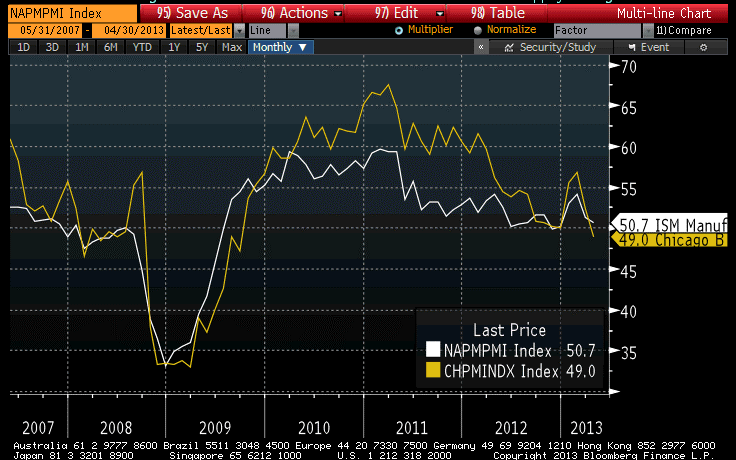
Consumer Confidence jumped yesterday, but more interesting is the fact that the “Jobs Hard to Get” subindex rose to the highest level since late last year, suggesting that weak jobs data isn’t entirely a one-off. Today, the ADP report was weaker-than-expected, at 119k (versus expectations for 150k) and a downward revision to last month. The Chicago Purchasing Managers’ Index on Tuesday was the weakest since 2009, but the ISM Manufacturing report today was on-target. Still, neither manufacturing index is generating much confidence that the economy is about to take off, and the early-year bump has been entirely reversed (see chart, source Bloomberg).
The Shiller Home Price Index, reported on Tuesday, was higher-than-expected at 9.3% year-on-year, rather than the 9.0% expected (and versus an 8.1% last!). What’s really interesting about this is that the recent surge in year-on-year growth has come because the usual seasonal pattern that sees prices sag in the springtime hasn’t been in evidence this year – accordingly, the year-on-year comparisons have gotten easier as prices have gone sideways rather than falling as they tend to do between August and March (see chart, source Bloomberg).

That’s interesting because such a phenomenon was also a condition of the bubble years prior to 2007 – prices generally rose steadily with only a hint of seasonality. Post-bubble, if you wanted to sell your house in February you had to offer a concession on price. Those concessions aren’t happening any more, which is a back-door confirmation of the overall price action.
As I have said before, ad nauseum, we are seeing slow and/or falling growth and firm and/or rising inflation in the pipeline, and that’s not at all inconsistent. Mainstream economists, and journalists of all stripes, seem to accept as a fundamental verity the linkage between growth and inflation, but the only minor problem with this firmly-held belief is that it ain’t so. Growth is bad, and inflation is still going to go up. In Q1, core CPI rose at a 2.1% pace, and I still think that for the full year core CPI will rise at 2.6%-3.0%.
I want to add a quick word here about a thesis that has been advanced recently. The thought is that if the abrupt housing demand is coming from investors rather than consumers, then rising housing prices might be consistent with pressure on rents. I think it’s important to clear up this confusion. Microeconomics tells us that when the price of a good goes up, the price of a substitute tends to rise as well. It is possible, if the overall price level is flat, that a phenomenon such as is described in this hypothetical could happen, with home prices rising and rents falling. But what is much more likely is that rents simply go up more slowly than home prices, so that they decline relative to home prices, rather than declining absolutely. This is, in fact, what we see historically: large increases in home prices tend to lead to increases in rents, but not of the same magnitude, and vice-versa. Whether the mechanism for this is a systematic institutional investor presence or just a large number of one-off instances of individuals renting out their second “investment” homes doesn’t really matter. Accordingly, I don’t expect to see a drastically different course carved out by the rental/home price relationship from what it has been historically. The main difference may be that the lags between home prices, inventories, rents, and so on might get screwed up somewhat, if institutional investors cause this to happen in a more organized way than the organic way in which it usually happens.
Another aside: there has also been a lot made recently, especially in commodity markets, about weak data from China. It is amazing how important it is to global commodity markets that China grows at 9% and not 8%. If I were a member of Chinese leadership, I would be trying to convince my data bureau to release slightly weak figures, since every time it does the hedge funds of the world offer large amounts of commodities as discount prices, which is just what a growing economy needs. It’s not like anyone believes the figures when they are reported to be high; I wonder why we believe it when they are reported to be low?
In addition to the data today, the Federal Reserve finished its meeting and announced no change in monetary policy for now. And there isn’t one coming for a while, either. There was no important change in the statement, although the Fed did take care to remind us that it “is prepared to increase or reduce the pace of its purchases to maintain appropriate policy accommodation as the outlook for the labor market or inflation changes.” [emphasis added] That’s comforting. But the simple fact is that the economy isn’t going to be booming any time soon, and the Committee isn’t going to taper its purchases unless it does because they labor under the delusion that they’re helping. Perhaps next year.
For the rest of the week, investors will be focused on Friday’s Employment Report. I am not really worried about the report being weaker-than-expected, because from everything I read it seems that the market is already anticipating something close to Armageddon (or at least, that’s how they are explaining the continued pressure on breakevens and commodities). So far, this is a routine slowdown that might be slipping into a renewed recession. Meanwhile, expectations on Friday are for Payrolls of 145k, up from 88k but down from the pace of the last year. And the ‘whisper’ number seems to be lower than that. I suspect the more likely surprise is that there is an upward revision to the 88k and the number exceeds estimates. Somehow, that will be also perceived as a negative for breakevens!
TIPS suffered today, even as nominal bonds rallied. Our Fisher yield decomposition model currently suggests that TIPS are as cheap, relative to nominals, as they have been since early September last year (when 10-year breakevens were at the same level they are at now). I am quite bullish on breakevens from here.
Rage Against the Machines
The explosion today wasn’t at the White House. That was a false report, put out when the Twitter account of the Associated Press was hacked. But that report immediately led to immolation at some high-frequency trading (HFT) fund, somewhere, almost certainly. The S&P immediately dropped 16 points as some news algorithm (or algorithms) scraped the tweet and immediately converted it into sell orders. As they say in the circus, “whoops!” And, as in the circus, that utterance is almost immediately followed by the sound of ambulances. In an otherwise very quiet market, there was a five minute period of very active trading, punctuated by swearing so loud you could almost hear it.
Somewhere, there is a fund that was founded on the basis of its smart algos that can “react faster than humans can react,” which took losses faster than a human could have taken losses. Ouch, I say. Ouch. But my sympathy for HAL is tempered by the fact that HAL has no sympathy for me.
I am pretty sure that the rapid movement in housing prices has nothing to do with HFT algorithms, although the violence of the move is starting to be vaguely reminiscent. Fortunately, home sales documentation is still not effected in microseconds, so we all still have a chance to beat the machines. Over the last few days, we have seen Existing and New Home Sales data, and the FHA’s Home Price Index; the more stable two of these confirmed that home prices continue to accelerate. In fact, as the chart below shows, the year-on-year rise in Existing Home median prices is more than 10% faster than core inflation for only the second time since the data has been kept. The first time that happened was in the midst of the housing bubble.

Housing is nowhere near bubble territory yet, and as the chart also shows the rise in home prices can persist at better than 10% over CPI for at least a little while. However, it can’t last too long because of the reflexivity of it: eventually, no matter what happens to home prices, the increases will pass into core inflation and the spread will be eaten away from the bottom.
This isn’t even necessarily a negative sign of a re-inflating bubble. In principle, if home prices had gotten overextended on the downside in a “negative bubble,” this could simply be a snap-back and just healthy. However, that doesn’t appear to be the case. I showed here that median existing home prices as a multiple of median household income are right on the average for the last 36 years or so – certainly not cheap. The chart below shows a similar relationship for New Homes. Note that with new homes, one would expect an uptrend since the average new home has grown in size over the years and loan qualifications have also allowed lower-income borrowers to dedicate larger shares of their incomes to buying new homes.[1]

The simple implication of the fact that home prices continue to accelerate higher is that core inflation is absolutely going to head higher. I think that Owners’ Equivalent Rent will turn higher in the next couple of months; Pimco recently wrote a piece saying they think the upturn takes until late this year; but it will happen. And it will happen regardless of whether the “shadow inventory” of homes hits the market or not, although if there really is a large unsold shadow inventory of homes, that will moderate the advance. My question is: where is this shadow inventory? Existing home prices are 10-20% off the lows depending on what series you use. Are sellers waiting for a return to the peak?
Some observers have noted that homes are now suddenly appearing on the market, and they divine a supply response. This is possible, but what is more likely is that this is the normal seasonal pattern: people put their homes on the market in the spring, not in the winter. This is why the sales data are seasonally-adjusted, so don’t trust your anecdotal evidence! The chart below shows the nonseasonally-adjusted single family Existing Home Sales (source: NAR) for the last few years. You can see that the data mavens fully expect home sales to be picking up now, which is why there are many more homes on the market suddenly. There are every year at this time.

So I think we are still left with the conundrum. Where are all of those shadow homes? We know where the new homes are – they were never built, because the market was awful. That inventory will respond as builders build new homes. But as for the shadow inventory of existing homes…maybe they don’t exist?
From the standpoint of inflation, the question of shadow inventory only matters to the trajectory of future inflation, not to the question of how much CPI will rise in 2013 and 2014. Those OER increases are virtually baked in the cake, unless something very strange is happening. While an important lesson of the last few years is that very strange things happen all the time, we’re talking about a specific very strange thing: the possibility that the price of a good (a home) rises, and the price of a close substitute (a rental) does not. While those can diverge from time to time, I have great confidence in the economic verity that the prices of substitutes tend to move together.
The only way there might be a big divergence is if home prices are rising because the investment value of the home, and not its value as housing, is what is increasing (although in the bubble years, rents eventually rose as well). But if that is the case, wouldn’t that in itself be a sign that there is concern about inflation, so that people are seeking real assets wherever they can find them? Concern about inflation need not lead to inflation, but it may be a contemporaneous indication that inflation is rising and it merely hasn’t shown up in the data yet.
The rise in home prices is the biggest single alarm being sounded about inflation at the moment, and it seems to me that it pays to listen to it, and check that the doors and windows are locked…just to be sure.
[1] This is a much smaller effect with existing homes, since the average square footage of the homes existing in the entire nation changes much more slowly; also, many existing homes are move-up homes so the marginal-borrower effect, which I suspect is pretty small anyway except for the bubble years, is less pronounced.
The Economy in the Plastic Bubble
We’re going to leave behind the topic of Cyprus for a day. It does seem as if events are coming to a head, but with banks there closed until Tuesday (and the ECB lifeline in place until Monday), there will be lots of news over the next few days but most of it will be heat without light.
So, speaking of heat and light, let’s look at today’s data. Specifically, let’s look at Existing Home Sales.
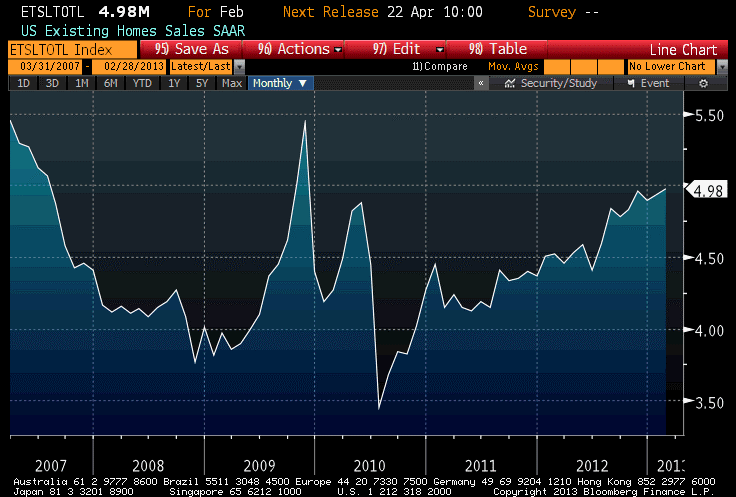
While the total sales number fell just shy of the 5mm-unit level, the 4.98mm print still represented the highest number (aside from the home-buyer-tax-credit induced surge in 2009) since 2007 (see chart, source Bloomberg).
The inventory of homes available for sale bounced off of 14-year lows, but remains at levels lower than any we’ve seen in over a decade.
And, near and dear to my heart, the median price of existing homes accelerated from last month (although, due to historical revisions, last month’s y/y was revised down to 10.67%) and stands at 11.34%. The January Home Price Index from FHA also came out; the 6.46% year-on-year rate of increase in that index is also the highest post-2007.
There are long lags between both of these indices and the appearance of price pressures in the Consumer Price Index, but at the moment all indicators of housing point the same direction: Owner’s Equivalent Rent should be in the 2.75% neighborhood by year-end, and could be as high as 3%. This is a key part of our forecast that core CPI should reach 2.6%-3.0% by year-end, and accelerate further in 2014.
The amazing recent run in home prices – which I suspect is driven in part by institutional investor interest in real estate – has caused existing home prices as a multiple of household income to move above levels that prevailed for the last quarter-century of the 20th century. The housing industry likes to present charts of housing affordability, which takes into account the current level of interest rates, because currently those interest rates make even the relatively high home prices look more affordable.
Yes, I said “relatively high home prices.” The median sales price of existing homes averaged 3.36x median household income from 1975 to 2000, with a relatively small range of values around that average. Even including the bubble, when the multiples reached 4.8x, the average through 2011 only rose to 3.54. As of year-end 2012, the multiple was back to approximately 3.48 and if median prices rise “only” 8% this year (remember, the current pace is 11.3% and rising) the multiple will be around 3.6x by the end of the year (see chart, source U.S. Census Bureau, National Association of Realtors, Enduring Investments).

Notice that even at the depths of the crisis, home prices were only slightly cheap by pre-2000 standards. Similarly, equity prices at the lows only reached approximately fair value by pre-2000 standards. There are two interpretations of this fact set. It could mean that the pre-2000 era valuations were too low, and that modern financial markets and structures make higher valuation multiples permanently viable. Or it could mean that the Federal Reserve continues to artificially support markets at multiples that are not likely to be sustainable in the long run. I suspect the latter point is more accurate, although I am open-minded about whether the former point might have some validity.
This isn’t necessarily a bad strategy, if the idea is to let the market stair-step down to equilibrium rather than letting it crash there all at once. But I don’t see anything that suggests the Federal Reserve has the slightest idea how to value assets. I understand that they don’t want to substitute their own analysis for the market’s judgment (at least, that would be the counterargument), but that’s what they’re doing anyway – with no indication that they plan to back off anytime soon. The Fed is just more comfortable in the bubble, and afraid to leave it entirely. But don’t we have to, eventually?
The VIX returned to 14 today, which makes a bit more sense to me than the 12.7 level of yesterday. It still seems low to me, but at least there is a way for long-vol positions to actually lose.
A Bad Day At The Federal Reserve
There will be many more days ahead for the Fed, and many of them will have plenty of good news. It is a mistake to trya and read too much into one day’s economic releases. With that said, here is my attempt to do exactly that.
I tweeted the following real-time reactions (@inflation_guy) following the CPI release this morning:
- Ready for an exciting day…CPI, Claims, Philly Fed, a 30-year TIPS auction, wild commodity swings, 3 Fed Presidents…buckle up!
- Hello! Core inflation +0.3%, higher-than-expected. Look out above.
- Apparel +0.8%. Some will pooh-pooh the number on that basis, but Apparel has been trending higher for more than a year.
- To be fair, core inflation BARELY rounded up to +0.3%. But the market was looking for +0.16% or +0.17%.
- Core Services remains at +2.5% y/y, but core goods ticks up to +0.4%. The recovery of core goods has been something we’re looking for.
- Somewhat surprisingly, the +0.251% rise in core inflation did so without having a rise in Owners’ Equiv Rent. Went from 2.1% y/y to 2.08%
- Accel Inflation: Housing, Apparel, Educ/Commun, Other (54.7% of basket); Decel: Food/Bev, Transp, Med Care, Rec (45.3% of basket)
- In Transp, the drag was almost all fuel. New/used Cars, maintenance, insurance, airline fares, inter- and intracity transp all up.
- What’s amazing in the CPI today is how much it did with how little from the main driver of housing. That uptick is yet to come.
- …and, next month, headline will get upward pressure from the steep rise in gasoline, which also dampens discretionary spending.
The primary takeaway from the CPI release is this: yes, core inflation surprised a little bit on the high side. But it did so without the support of the main factor that I think will push core inflation almost certainly higher going forward: housing. Rents (both primary and OER) neither accelerated nor decelerated this month from the prior year-on-year pace. And yet, there is really no temporary factor that pushed inflation higher this month. It was fairly broad-based. Apparel stood out on the month-to-month change perspective, but here is the chart (source Bloomberg) on Apparel:
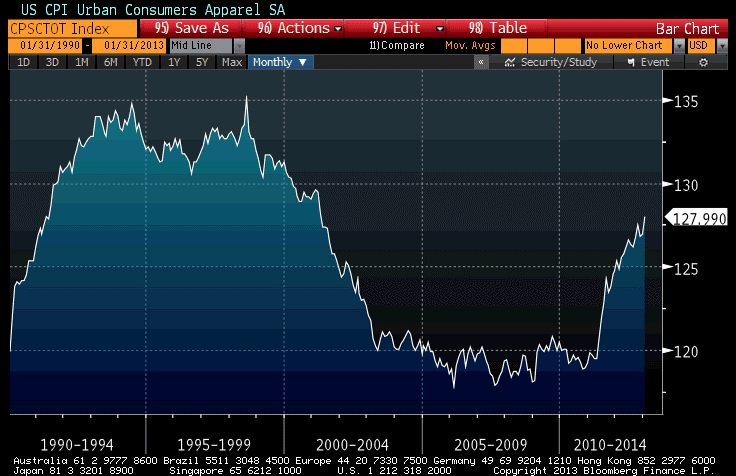
This month doesn’t appear to me as too much of a true outlier. The underlying dynamic there has simply changed.
So this month core inflation stayed at 1.9%; next month it is very likely to return to 2.0% as we are dropping off the weak February change from last year. And all of that, before the housing inflation hits the data.
Speaking of housing inflation, there is no sign yet of that abating. In today’s Existing Home Sales report, the year-on-year change in Median Existing Home Sales Prices rose to 12.61%, another post-2005 record, and the highest real price increase ever, outside of 2005. This is happening because the inventory of new homes has dropped to almost a record low – really! Sure, the chart below (source Bloomberg) ignores “shadow inventory,” but it is starting to look more like the inventory of new homes now.
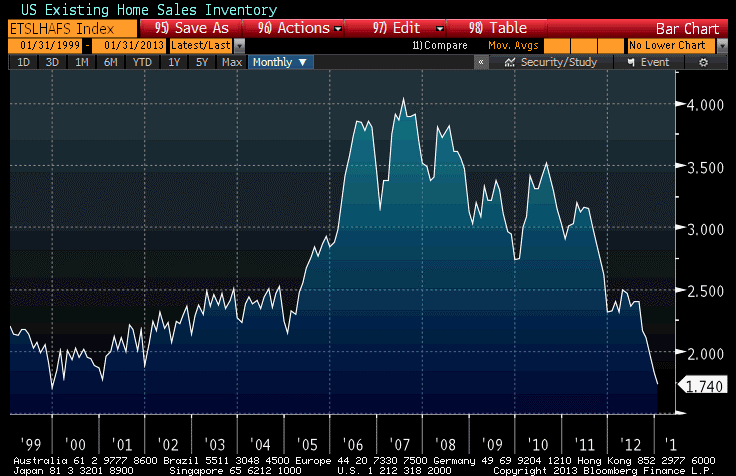
Some of that is seasonal, but there’s no doubt that lower inventories are now helping the home pricing dynamic. And, as I’ve shown previously, the inventory of existing homes actually has a nice relationship with shelter inflation 1-2 years later (Source: Enduring Investments):

The current level of inventories translates into a 3.6% expected rise in CPI-Shelter over the course of 2014. So you see, we’re not only firing inflationary rounds but we’re also continuing to feed more ammunition into the gun for next year. Our model of housing inflation projects Owners’ Equivalent Rent no lower than 3% by year-end 2013. And if that happens, there is no way that overall core inflation is going to be at 2%.
Now, in addition to the bad news on prices and the news on home prices that are probably seen at the Fed as a guarded positive (after all, it means the mortgage crisis is essentially over as more borrowers will be ‘above water’ again every month hereafter), there was also a mild surprise on the high side from Initial Claims (362k versus 355k) and a bad miss on the Philly Fed index for February. This latter was expected at +1.0 after -5.8 last month; instead it dropped to -12.5. Philadelphia-area manufacturers have reported softening business conditions in three of the last four months, suggesting that December’s pop to +4.6 was the outlier. Now, there were similar one-month dips in August of 2011 and June of 2012, so we’ll have to see if it is sustained…but it is consistent with the report out of Wal-Mart and the worsening of business conditions in Europe.
Higher prices (and more coming, on the headline side, as retail gasoline prices have now risen in 35 consecutive days) and lower business activity. This is exactly the opposite of what the Fed wants. It has been a bad day at the Fed.
However, it is exactly what traditional monetarism expects: accommodative monetary policy leads to higher prices (check), and has no effect on real activity in the absence of money illusion (check). So score one point for Friedman today.
And so, what else would you expect after such a day? Bond yields are declining, inflation breakevens are narrowing, and industrial commodities (metals and energy) are sliding. As with so much else these days, that makes no sense, unless you just don’t know what’s going on. When we encounter these bouts with irrationality (or, more fairly, thick-headedness), the market can be frustrating for a long time – and the ultimate denouement can sometimes be jarring. As I said earlier in this post: buckle up!
