Archive
A Payrolls Report that Matters Again
Tomorrow’s Employment Report offers something it hasn’t offered in a very long time: the chance to actually influence the course of monetary policy, and therefore markets.
Now that the taper has started, its continuation and/or acceleration is very “data dependent.” While many members of the FOMC are expecting for the taper to be completely finished by the middle of this year (according to the minutes released yesterday), investors understand that view is contingent on continued growth and improvement. This is the first Payrolls number in a very long time that could plausibly influence ones’ view of the likely near-term course of policy.
I don’t think that, in general, investors should pay much attention to this report in December or in January. There is far too much noise, and the seasonal adjustments are much larger than the net underlying change in jobs. Accordingly, your opinion of whether the number is “high” or “low” is really an opinion about whether the seasonal adjustment factors were “low” or “high.” Yes, there is a science to this but what we also know from science is that the rejection of a null hypothesis gets very difficult as the standard deviation around the supposed mean increases. And, for this number and next months’ number, the standard deviation is very high.
That will not prevent markets from trading on the basis of whatever number is reported by the BLS tomorrow. Especially in fixed-income, a figure away from consensus (197k on Payrolls, 7.0% on the Unemployment Rate will likely provoke a big trade. On a strong figure, especially coupled with a decline in the Unemployment Rate below 7%, you can expect bonds to take an absolute hiding. And, although it’s less clear with equities because of the lingering positive momentum from December, I’d expect the same for stocks – a strong number implies the possibility of a quicker taper, less liquidity, and for some investors that will be sufficient sign that it’s time to head for the hills.
I think a “weak” number will help fixed-income, and probably quite a lot, but I am less sure how positive it will be for the equity market.
In any event, welcome back to volatility.
Meanwhile, with commodities in full flight, inflation breakevens are shooting higher. Some of this is merely seasonal – over the last 10 years, January has easily been the best month for breakevens with increases in the 10-year breakeven in 7 of the 10 years with an overall average gain of 15bps – and some of it is due to the reduction of bad carry as December and January roll away, making TIPS relatively more attractive. Ten-year breakevens have risen about 18bps over the last month, which is not inconsistent with the size of those two effects. Still, as the chart below (Source: Bloomberg) shows, 10-year breakevens are back to the highest level since before the summer shellacking.
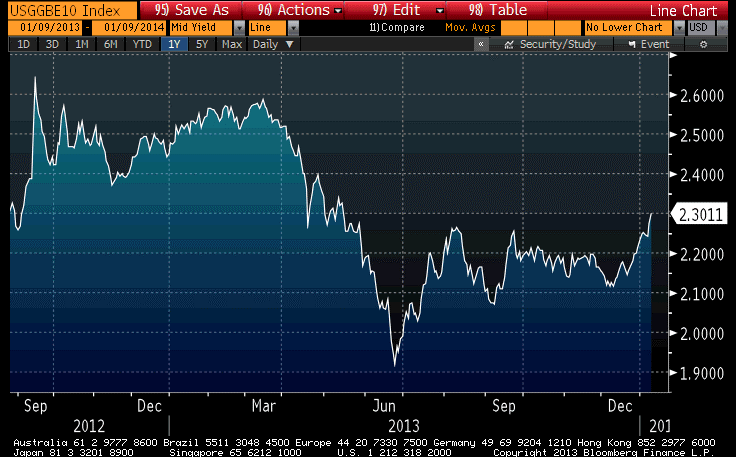 Indeed, according to a private metric we follow, TIPS are now back almost to fair value (they only very rarely get absolutely rich) compared to nominal bonds. This means that the benefit from being long breakevens at this level solely consists of the value that comes from the market’s mis-evaluating the likelihood of increasing inflation rather than decreasing inflation – that is, a speculation – and no longer gets a “following wind” from the fact that TIPS themselves were cheap outright. I still prefer TIPS to nominal Treasuries, but that’s because I think inflation metrics will increase from here and, along with those metrics, interest in inflation products will recover and push breakevens higher again.
RE-BLOG: Tales of Tails
Note: The following blog post originally appeared on June 27th, 2010 and is part of a continuing year-end ‘best of’ series, calling up old posts that some readers may have not seen before. I have removed some of the references to then-current market movements and otherwise cut the article down to the interesting bits. You can read the original post here.
…I also raised my eyebrows at an article in the UK Telegraph which declares that the Fed is considering a “fresh monetary blitz” since the recovery is faltering. I am always happy to be skeptical when an article doesn’t name names, but this seems to me to be fairly likely to be true:
“Key members of the five-man Board are quietly mulling a fresh burst of asset purchases, if necessary by pushing the Fed’s balance sheet from $2.4 trillion (£1.6 trillion) to uncharted levels of $5 trillion.”
The strategy makes sense, if you believe that the long-term effects of dramatic monetary policy movements can be evaluated over a period of a couple of quarters. I would not be surprised at all to discover that the thinking at 20th Street and Constitution Avenue is something along the lines of “hey, we did it once and didn’t cause inflation, so why not take out the paddles again? CLEAR! ZAP.” I’ve written before of the odd set of speeches we saw earlier this year describing a wondrous alchemy that the Fed seemed to believe they could accomplish: buy assets rapidly to save the economy by keeping rates low and adding liquidity. Sell the assets without completely reversing the effect by doing so slowly. Clearly, if there is real belief that the Board can pump and dump without the “dump” causing any problems, then for God’s sake why not pump?
Obviously, that’s a bunch of hooey, but I remain wary that there may be those who believe it.
The market on Friday was led (and maybe even supported) by financial stocks, because the market finally learned the form of the financial reform bill. It is bad, and will cause severe damage to bank earnings. It isn’t as bad as some people feared, but it is about as bad as was ever likely to become law. Prop trading at banks is still banned, and banks will have two years to push trading of commodities, non-investment grade bonds, and CDS that are not cleared through an exchange to separately-capitalized subsidiaries. Most derivatives will have to be cleared and traded on exchanges, which means less customization (bad for dealers, and bad for clients too). This law will be bad for turnover, bad for margins, and will cause leverage ratios to decline (probably the only reasonable part of the prescription, from my view). The Dupont model tells me those three things imply much lower ROE.
So why did bank stocks rally? This is worth a deep reflection because it explains something about markets.
Bank stocks rallied because as bad as the legislation is, the fact that we now know the form of the legislation removes the most onerous tail risks.
Bob Merton, many years ago, observed that the equity of a company can be thought of as a call option on the value of a firm: the value can only go to zero, if the firm is insolvent, but can be worth a great deal. So what do we know about options? One of the things we know is that a great deal of the value of an option comes from the expected value of unlikely, extreme outcomes. If you remove the chance at the home run, an option gets much cheaper.
This is one big reason that bear markets often end with a sharp rally off the lows (although please note that it does not follow that every sharp rally implies an end to the bear market!) – once the disaster case, the chance of an outright crash or broad economic or financial calamity, recedes in probability, the value of equities rise appreciably. A company which avoids bankruptcy by a hair will see its stock rise dramatically when the chance of losing everything goes away. Observe the behavior of many of the financials during the crisis. When TARP and other bank-supportive mechanisms began to have traction the sector leaped, not because earnings were about to be multiplied 10 times but because the fear of zeros greatly receded.
(Aside #1: Most analysts, of course, look at equity values as related linearly to earnings, and in normal circumstances they are. …a PE of 25x is rich, 15x is cheap, for example. But this is likely because behavioral biases prevent analysts from considering the value of the disaster which they think is very unlikely. In any case, a 15x multiple might be quite expensive indeed compared to a 25x multiple, if the former company is about to receive a legal judgement that could potentially destroy the firm. Indeed, one real problem with conventional investment analysis is that the 15x multiple stock might be cheap, or the multiple may in fact be a sign that tail risks are higher for this equity than for the 25x one. Buying enormous dividend yields is often unproductive because the high yield implies a market belief, often correct, that the dividend is not likely to be paid or paid in that amount.)
(Aside #2: Because so much of the value in an option comes from the tail, evaluating options using simple Black-Scholes when the underlying risk isn’t lognormal can be extremely dangerous, especially with exotic options that have path-dependent valuations and with options on underlying instruments that are known to have a high likelihood of non-linear performance – near-bankrupt equities, for example. Black-Scholes implied vols are nearly useless in such a case).
So, owning a stock or stocks generally when the tail risks are about to recede is a good recipe for making sparkling returns. But we have another name for this sort of investing strategy: “catching a knife.” You can own an AIG-like bounce, but also get run over by Lehman. On the flip side, because as an equity investor you own these negative tail events naturally, you can add a lot of value by avoiding the blow-up.
Rising volatility, then, tells you two things: first, it tells you that the market’s sense of the risk of a possible calamity is growing; second, it tells you that once these fears recede you might earn a solid return. You already knew this; it’s why the VIX is considered a contrary indicator by some.
Does it make sense to be investing more, then, when a blowup might happen, or investing less? As it turns out, the answer to this question is not entirely clear but thanks to the Kelly Criterion we can make some observations. The Kelly Criterion describes the optimal bet size, as a proportion of the bankroll, for a series of uncorrelated bets with a given edge and payoff. The simple observation (which becomes a lot less simple after they start involving the math) is that you want to bet more of your payroll if you are (a) getting good odds and (b) are very confident of the outcome. That is, your bet size should increase if you are getting good odds, and have a good edge. Kelly worked out the math to determine what the optimal bet size should be under certain conditions.
The relevance here is as follows: when a crisis hits, two things are happening to you as an equity investor. First, you are becoming more confident that the market will reward you for buying when everyone else is selling, because (as noted above) unless the world actually does end you are likely to be getting a good price. Second, though, you need to recognize that the increasing chance of debacle implies a worse payoff. In April of 2008, the chances of losing everything the next day were pretty slim. In mid-September 2008, the chances were appreciable that a bunch of your portfolio might be in trouble. So your edge (confidence in winning, if the bet was repeated a bunch of times) was growing, but your odds (payoff if you win, relative to your loss if you don’t) were worsening.
The schematic below shouldn’t be taken literally, but is meant to illustrate the basic relationships.
 These lines are the pure results from the Kelly formula for the indicated inputs. Perhaps an investor might consider his/her “bankroll” in this case to be the maximum portfolio concentration in equities. Obviously, if you are extremely confident that you are going to win, then no matter what the payoff you should be making a pretty reasonable bet; therefore, the lines converge on the right. But as we move left, we get a sense of the tradeoff between the edge and the odds. When volatility is rising, the investor is moving to the left, implying a lower confidence of a payoff; if the market is trading to lower prices, it improves your odds but you can see that you would need vastly better odds to counteract the effect of increased uncertainty. I would suggest that in the range of normal investor confidence, rising volatility implies that you should tend to be taking chips off the table, even though it means you may miss a minor pop if the world doesn’t end.
We are not currently in a crisis quite like what we saw in 2008. But the elevated levels of implied volatility suggest that crisis is not so far off as we would like to see it. I think this means that we should be avoiding the possibility of the long negative tail, and taking chips off the table.
———
You can follow me @inflation_guy, or subscribe to receive these articles by email here.
Madness or Wisdom?
Trading, and to some extent investing, is all about knowing when markets are moving with the wisdom of the crowds and when they’re moving with the madness of the crowds. In recent years, there has seemed to be much more madness than wisdom (a statement which can probably be generalized beyond the financial markets themselves, come to think of it). Where do we stand now?
I think a recent letter by John Hussman of Hussman Strategic Advisors, entitled “An Open Letter to the FOMC: Recognizing the Valuation Bubble In Equities,” is worth reading. Hussman is far from the only person, nor even the most august or influential investor, questioning the valuation of equities at the moment. Our own valuation models have had the projected 10-year compounded real return of equities below 3% for several years, and below 2% since late April. For a time, that may have been sustainable because of the overall low level of real rates, but since the summertime rates selloff the expected equity premium has been below 1.5% per annum, compounded – and is now below 1% (see Chart, source Enduring Investments).
 Hussman shows a number of other ways of looking at the data, all of which suggest that equity prices are unsustainable in the long run. But what really caught my eye was the section “Textbook speculative features”, where he cites none other than Didier Sornette. Sornette wrote a terrific book called Why Stock Markets Crash: Critical Events in Complex Financial Systems, in which he argues that markets at increased risk of failure demonstrate certain regular characteristics. There is now a considerable literature on non-linear dynamics in complex systems, including Ubiquity: Why Catastrophes Happen by Mark Buchanan and Paul Ormerod’s Why Most Things Fail: Evolution, Extinction and Economics . But Sornette’s book is one of the better balances between accessibility to the non-mathematician and utility to the financial practitioner. But Hussman is the first investor I’ve seen to publicly apply Sornette’s method to imply a point of singularity to markets in real time. While the time of ‘breakage’ of the markets cannot be assessed with any more, and probably less, confidence than one can predict a precise time that a certain material will break under load – and Hussman, it should be noted, “emphatically” does not lay out an explicit time path for prices – his assessment puts Sornette dates between mid-December and January.
Hussman, like me, is clearly of the belief that we are well beyond the wisdom of crowds, into the madness thereof.
One might reasonably ask “what could cause such a crash to happen?” My pat response is that I don’t know what will trigger such a crash, but the cause would be the extremely high valuations. The trigger and the cause are separate discussions. I can imagine a number of possibilities, including something as innocuous as a bad “catch-up” CPI print or two that produces a resurgence of taper talk or an ill-considered remark from Janet Yellen. But speculating on a specific trigger event is madness in itself. Again, the cause is valuations that imply poor equity returns over the long term; of the many paths that lead to poor long-term returns, some include really bad short-term returns and then moderate or even good returns thereafter.
I find this thought process of Hussman’s interesting because it seems consonant with another notion: that the effectiveness of QE might be approaching zero asymptotically as well. That is, if each increment of QE is producing smaller and smaller improvements in the variables of interest (depending who you are, that might mean equity prices, long-term interest rates, bank lending, unemployment, etc), then at some point the ability of QE to sustain highly speculative valuations goes away and we’re left with the coyote-running-over-the-cliff scenario. Some Fed officials have been expressing opinions about the declining efficacy of QE, and Janet Yellen comes to office on February 2nd. I suspect the market is likely to test her very early.
None of this means that stocks cannot go straight up from here for much longer. There’s absolutely nothing to keep stock prices from doubling or tripling from here, except the rationality of investors. And as Mackay said, “Men, it has been well said, think in herds; it will be seen that they go mad in herds, while they only recover their senses slowly, and one by one.” Guessing at the date on which the crowd will toggle back from “madness” to “wisdom” is inherently difficult. What is interesting about the Sornette work, via Hussman, is that it circles a high-risk period on the calendar.
For two days in a row now, I’ve discussed other people’s views. On Wednesday or Thursday, I’ll share my own thoughts – about the possible effects of Obamacare on measured Medical Care inflation.
Twit or Treat?
I guess we have to add to the list of uncomfortable comparisons to 1999’s equity mania the Twitter IPO. A widely-known company with no earnings…and no visible way to produce any revenues of note, much less earnings…went public and promptly doubled. Hedge funds which were able to get in on the IPO allocation cheered this nice kick to their performance numbers, and the backers of the now-$25bln-company are surely elated. But the rest of us have got to be thinking about Pets.com.
It was an article by Hussman Funds (ht rich t) that got me thinking more deeply about these comparisons. Although the article was referred to me partly because of the insightful comments about the Phillips Curve, which echo similar comments I have made in the past, I kept reading to the end as I usually do when trapped in a Hussman article! While there are a number of us (including Hussman, Grantham, Arnott, e.g.) who have been concerned for a while about equity market valuations since we use similar metrics, I really haven’t been terribly concerned about the possibility of an imminent and steep market decline for a while, though I think returns from these levels over the next decade will be close to flat in real terms as they were after the 1999 peak. However, Hussman had me thinking about this.
I do think that there is one key difference from 1999, and that is that not everyone is talking about stocks. That is, not yet…the Twitter IPO might get us there – on Fox Business News today a young talking head (who was no more than 10 years old in 1999) made sure that viewers were informed that anyone could buy Twitter, just by calling their broker. (Not just anyone, though, could get in at the IPO price…a point the cub reporter neglected to mention).
The counter-argument to “is this a 1999 set-up?” takes two forms. The less-sophisticated form is “nuh-uh”, although usually said in a slightly more elaborate way that implies the questioner is a mindless, not to mention soulless, Communist who isn’t getting enough loving at home. The more-sophisticated argument is worth considering, but isn’t particularly soothing to me. This hypothesis is that this isn’t 1999, it’s 1997, before the parabolic blow-off and with lots of room left to run. It wasn’t as if there was any lack of skepticism about the stock market’s levels (which, sweetly, we considered lofty at the time):
“Is it possible that there is something fundamentally new about this current period that would warrant such complacency? Yes, it is possible. Markets may have become more efficient, competition is more global, and information technology has doubtless enhanced the stability of business operations. But, regrettably, history is strewn with visions of such “new eras” that, in the end, have proven to be a mirage. In short, history counsels caution.” – Alan Greenspan, February 26th, 1997
The bubble, of course, did not pop in 1997. It popped in 1999, after Greenspan had abandoned his prior skepticism (in late 1998, as he came to believe that “I do not claim that all market behavior is a rational response to changes in the real world. But most of it must be. For, were it otherwise, the relatively stable economic environments that have been evident among the major industrial countries over the generations would not be possible”). Between 1997 and 1999, there was plenty of time for investors to make money, and as long as they realized they were taking money for the future and got out before 2000…alas, very few of them did.
But, speaking from experience, the 1997-1999 period was very lonely. While investors who gradually sold their long positions out in 1998 and 1999 did much better than the ones they were selling to, they were also very unpopular at cocktail parties. The bearish analysts were put on the street, begging for tuppence. Which, considering that most of them were in the United States, was also unsuccessful.
The 1999 bubble…and the later property bubble…also did not burst until the Fed was actually tightening policy. It is on this point that many bullish arguments depend, but it is a weak one I believe. To be sure, there is no chance that the Fed will be tightening policy any time soon. The taper is not going to happen until 2014Q2 at the earliest, and I think it will take until later in 2014, when inflation figures will become uncomfortable, before they will start pulling back on QE. Some observers believe it will be much later. A Wall Street Journal article on Wednesday detailed a recent research paper written by the head of the monetary affairs division at the Fed; it argued that it may make sense for the Fed to lower its Unemployment Rate threshold and said that “an ‘optimal’ policy might keep rates near zero as late as 2017.”
The activist Fed continues to be one of the biggest risks to the market and the economy. As a trader, I know that 90% of trading is just sitting there, waiting for the ‘fat pitch’ you can do something about. It boggles my mind that a central banker doesn’t sit around at least that much, considering that they know even less about the complexities of the global economy than I know about the complexities of the market. And, unlike the global economy, the market doesn’t fight back when I act on it.
I actually have a feeling that we won’t be worrying about those Unemployment thresholds, either the old ones or the ones proposed in that paper. As I wrote late last month, the expansion is getting a bit long in the tooth and I would not be surprised to see another recession looming in 2014. I don’t have any reason for that outlook other than the calendar, but sometimes these reasons become obvious only in hindsight.
In any event, though, I wouldn’t wait around for the Fed to be tightening. It isn’t overnight funding rates that I would worry about, but longer-term interest rates, and there has already been a warning shot fired that indicates the Fed is not wholly in control of those rates.
So, it may be too early to be out of equities. Maybe even a lot too early. But one thing I am sure of is that it isn’t too late. It is the latter condition, not the former, that is the most damaging to one’s financial position.
The Longest Journey Begins With Delaying the First Step
Everyone expected markets to provide a lot of late-day volatility today, and so they did. The Fed apparently doesn’t mind surprising the market with a non-consensus outcome when that surprise gooses stocks and bonds higher. Here are some (fairly unstructured) thoughts about today’s declaration from the Fed that there will be no “taper” in its QE program yet:
- This has nothing to do with the fact that there was a minor wiggle in the Employment data, some weakness in Retail Sales, and some other disappointments this month. If that is now the standard…that the Fed plans to expand its balance sheet without bound as long as growth is not smashing the cover off the ball, then we are truly lost for QE will never, ever end. This month’s numbers were all within the normal variation for economic data, which do in fact vary even when the underlying economy is not. The old standard was “ameliorate a deep recession.” Then Greenspan turned that to “resist even a mild recession.” And now, is the standard “robust growth no matter what the long-term cost?” I don’t think so, and so I reject the notion that the failure to begin the taper has anything to do with the growth numbers.
- Similarly, the inflation numbers cannot be the reason. Core inflation is now rising, and the Fed has previously recognized that some of the decline in inflation has been due to transient effects of the sequester. Median inflation has remained steady at 2.1%, which is basically the Fed’s long-term target. The cost of 10-year deflation floors in the market are at the lowest level since they began to trade in 2009 (see chart, source Bloomberg and BGC Partners – the price is in up-front basis points). So it isn’t a lingering fear of deflation that has the Fed concerned.

- The Fed speakers over the last month have had ample opportunity to shoot down the idea that taper would start at this meeting, which has been the consensus for a long time. None of them did so, implying that the Fed was comfortable with that consensus. But something changed in the last few days, and that is that the odds-on next Fed Chairman went from being Larry Summers to being Janet Yellen, who happened to be in the meeting today.[1] Does this change the dynamic? Absolutely, since one reason Bernanke has started thinking and talking about tapering is so as to leave as clean a slate as possible so that the next Chairman wouldn’t have to start his term by tightening (sorry, I mean “reducing accommodation”) and scaring asset markets. Once Summers withdrew his name, Yellen’s vote got automatically much more important and the urgency to start the taper much less (since Yellen doesn’t believe there are any important costs to QE). Indeed, in his post-meeting presser Bernanke noted that the “first step” on a taper is “possible this year.” That is far to the dovish side of what the Street was expecting, but consistent with the notion that Yellen’s opinion will carry a heavy weight unless someone else is appointed to the post.
- Yellen said last June that the Fed’s objective is a quick return to full employment, and that Fed action might be justified “to insure against adverse shocks [emphasis mine],” or even if the Fed concludes that the recovery “is unlikely to proceed at a satisfactory pace.” So, perhaps I need to reconsider my point #1 above. Maybe that is the standard now.
- If in fact QE has no cost, then there is no reason to ever stop it. In fact, it should be accelerated. Most Fed officials seem recently to be coming to the realization that there is highly unlikely to be a costless economic remedy, even if they are not sure what the costs are or think they can be contained. Those people clearly have no voice any more, even though it appeared that those views in the last few months were gaining currency (no pun intended, since the dollar dropped to the lowest level since February after the announcement today – a Fed that was edging however slowly to being more-hawkish than average was good for the dollar; a weak, more-dovish than average central bank will be worse for the dollar all else equal). This is pedal-to-the-metal time.
- TIPS got a lot more expensive today, with the 10-year rallying 20bps to 0.475% and breakevens up 4.5bps one day before the Treasury auctions another slug of them. The auction ought still to go well, because caution has been thrown to the wind by our beloved central bankers. This is also good for commodities, and they rose today led by precious and industrial metals. Is it good for equities? Well…
- Equity analysts are like puppies. They completely forget what happened 5 minutes ago and every experience is brand new. There is never any context. So stocks shot higher today, with the S&P gaining 1.2%, because of the dovish Fed and lower interest rates. But over the last few months, as the taper grew closer and interest rates shot higher, all equities did was move to new highs. So, higher interest rates and a (relatively) hawkish Fed doesn’t hurt stock prices, but lower interest rates and a dovish Fed helps them? This may be why the Fed thinks that buying bonds keeps interest rates low and selling bonds doesn’t raise them. It’s a strange market-based notion of a perpetual motion machine. For goodness’ sake, let’s crank interest rates down 200bps, back up 200bps, down 200bps, and keep doing that and the stock market will be at 1,000,000 before you know it. Prosperity! But in fact it is probably more like a bicycle pump. Pushing down inflates the tire, pulling up doesn’t deflate it. It seems costless. However, if you keep doing that, eventually the tire will pop.
- Speaking of the perpetual motion machine, I enjoyed this little gem from the FOMC statement:
The Committee is maintaining its existing policy of reinvesting principal payments from its holdings of agency debt and agency mortgage-backed securities in agency mortgage-backed securities and of rolling over maturing Treasury securities at auction. Taken together, these actions should maintain downward pressure on longer-term interest rates, support mortgage markets, and help to make broader financial conditions more accommodative…
Really? It hasn’t worked recently. Lest they forget: the taper hadn’t started yet, but until today it was busy being discounted in the bond market. I don’t expect that merely continuing to buy bonds into the SOMA will push rates much lower again. We all know that this game ends, and we know how it ends. With 10-year notes at 2.70% I wouldn’t be selling them, but I also wouldn’t expect a massive rally to unfold. I would hold long positions in September and October, because those are the right months in which to hold bonds (especially with debt ceiling fight #2, Syria, Italy’s government disintegrating, and Germany’s election), but if the market gave me 2.45% to sell, I would sell.
[1] Note, though, that no person who has ever held the office of Fed Vice-Chairman has later been appointed to be Chairman…although Donald Kohn, since he was Vice-Chairman from 2006-2010, would also represent a departure from this same tradition. However, he was not in the room.
The Fed and Regulators Should Draw the Veil
When I remark, from time to time, that I think the Fed has made a mistake in increasing transparency of its deliberations and actions, people occasionally look at me as if I had come out opposed to motherhood or apple pie. But my point is that transparency is good if it permanently decreases risk…but it doesn’t.
What matters is how market actors respond to increased transparency. It is much like the old debate about whether football players ought to wear helmets. It is clear that helmets decrease the likelihood of brain damage in any given collision, compared to the un-helmeted rider in an identical collision. But it is also clear that as helmets have gotten better and better, football players have played faster and faster, with more abandon, and lead with their heads a lot more than they did when all they had was a leather cap. The net effect is indeterminate.[1]
In markets, increased transparency from a central bank or regulator leads to increased leverage in a very direct way. The central bank’s dial is for transparency, but the investor’s dial is for risk appetite and when the central bank turns its dial it does not change the investor’s risk preferences. The result is that increasing transparency, which decreases the risk at any given leverage and at any particular moment, leads to higher levels of leverage, which lowers the tolerance for error. And, as we have seen, central banks and regulators are quite prone to error.
In an interesting way, this is tied into the volume question. The chart below (source: Bloomberg) shows rolling 250-trading-day volume for the NYSE in billions of shares. As has been well-documented, market volumes have been steadily declining for years.

As we have mentioned here before, there are lots of excuses for lower market volumes on the major exchanges, and probably many of those excuses are part of the answer. But we can no longer simply attribute this to the movement of volumes to “dark pools.” There is simply less going on in the markets, whether in rates or in equities. Ask the dealers. Dodd-Frank and the Volcker Rule are simply decimating volumes. And this is not just bad for dealers, it is bad for everyone.
When a trade happens, there is information revealed. Indeed, in some markets a meaningful proportion of the volume transacted is between dealers who are testing the market to get more information. More trades means that there are more quanta of information. More quanta of information produces more confidence in prices. More confidence in prices means more support for the current prices, and more de facto liquidity.
Think of it this way. If a bond has never traded, and two counterparties come together to trade some at a price of 103, what is your estimate of the true market for another trade? Is it one tick around 103? If so, then you are displaying almost outrageous overconfidence – one data point between two counterparties, about whose motivations you know precisely nothing, tells you almost zero about what the true market (by which I mean, the prices at which you could buy, for an offer, or sell, for a bid, a typical-sized transaction) is, and even less about what the support market (by which I mean the prices at which you could transact in substantially larger sizes) is. And so bid/offer spreads, whether quoted on-screen or over-the-counter from a dealer in the security, must be wider since the market-maker just doesn’t know as much as he would if volumes were higher – and, more to the point, the market must be wider because the client who initiates the trade is likely to know more than the market-maker does about the right price. This is because the market-maker must make a market whether or not he knows the fair price, but the buyer or seller doesn’t have to trade unless he/she believes the fair price is outside of the quoted range. Of course, that’s where the information comes from: if the offer is lifted, it means someone is saying “I think the fair price is higher than your offer,” and that is information.
I mention this today for several reasons. First, because it has been a while since I showed the NYSE volumes chart in a while. Second, because there was an article on Bloomberg today entitled “Professor Who Helped Pop Junk Bubble Says Trace Slows Trade” which ties transparency to diminished volumes. To the extent that Trace produces true transparency and reduces the need for “testing” trades, it is a good thing…but then we should see tighter spreads for size, and while the study is suggestive it isn’t conclusive on this point. More interestingly, the professor in question also made the point that “less trading may hurt investors if, instead of reducing ‘noise’ from the market, the reduction slows how quickly new information alters prices.” And this point is also key:
”…if the decrease in trading activity is the result of dealers’ unwillingness to hold inventory, transparency will have caused a reduction in the range of investing opportunities. That is, even if a decline in price dispersion reflects a decrease in transaction costs, the concomitant decrease in trading activity could reflect an increased cost of transacting due to the inability to complete trades.”
So transparency, it seems, is not an unalloyed positive like apple pie. But lower trading volumes, which are partly the result of transparency (and partly the result of poorly-conceived rules like Dodd-Frank, the Volcker Rule, and Basel III), are very probably bad for everyone. This doesn’t just affect hedge funds. Markets which are deep and liquid are much less prone to sudden price breaks. With the US equity market still floating near the highs despite rapid increases in nominal and real interest rates and worst-ever outflows from ETFs last month, this is a point that may be more than academic at the moment.
[1] However, no one disputes that the faster game is a lot more fun to watch. What I suspect has happened is that the introduction of hard-sided helmets probably increased injuries until players essentially reached maximum speed/recklessness, after which point the further improvements in helmet design probably started to make the game safer again. But it is really hard to prove that.
It’s Risk Parity, Not Risk Party
I am disinclined to take victory laps when most people are losing money, but the recovery in commodities prices over the last week at the same time that bond and equity prices are both declining is a taste of success for my view that has been rare enough lately. That is, of course, the burden that a contrarian investor bears: to be wrong when everyone else is having fun, and to be right when no one wants to go out and celebrate. In fact, if you find yourself sharing your successes too often with other people who are having the same successes, I would submit you should be wary.
It is worth noting that the commodities rally has not been led by energy, despite the terrible violence in Egypt which threatens, again, to ignite a spark in the region. Today, the rise in commodities was led by gold and grains; yesterday by cows and copper (well, livestock and industrials).
I don’t think that this is because of a sudden epiphany about inflation. In fact, although breakevens have been recovering from the oversold condition in June (more on that in a moment), the inflation data today did nothing to persuade inflation investors that more protection is needed. I gave some thoughts about the CPI report earlier today in this post, but suffice it to say that it was not an upside surprise. (And yet, there are starting to appear more-frequent smart articles on inflation risks. I commend this article by Allan Meltzer to you as being unusually clear-eyed.)
And commodities are not moving higher because of renewed enthusiasm about growth, I don’t think. Today economic bell cow Wal-Mart cut its profit forecast because higher taxes are causing shoppers to be more conservative (perhaps in more ways that one). And, while today’s Initial Claims figure was good news (320k versus expectations for 335k), weakness was seen in Industrial Production (flat, with downward revisions, versus expectations for +0.3%) and both Empire Manufacturing and Philly Fed came in slightly weaker than expectations. None of this is apocalyptic, but neither is it cause for elation about domestic or global growth prospects.
While the nascent commodity rally makes me personally feel warm and fuzzy, the more-momentous move is in what is happening to interest rates. And here I need to recognize that until very recently, I thought that bonds would follow the typical pattern of a convexity-exacerbated selloff: after a rapid decline, the market would consolidate for a few weeks and then recover once the overhang had cleared. I’ve seen it aplenty in the past, and that was the model I was operating on.
But I believe rates are heading higher. Although the overhang from the prior convexity selloff has probably been distributed, there is a new problem as illustrated by the news today about Bridgewater’s “All Weather” fund. The All-Weather Fund is an example of a “risk parity” strategy in which, in simplified form, “low-volatility” strategies are levered up to have the same natural volatility as “high volatility” strategies. The problem is that levering up an asset class with a poor risk-adjusted return, as fixed-income is now, doesn’t improve returns or risks of the portfolio at large. The -8% return of the AWF in Q2 illustrates that point, and makes clear to anyone who bought the great marketing of “risk parity” strategies that they probably have much more rate risk than they want (although according to the Bloomberg article linked to above, Bridgewater “hadn’t fully grasped the interest-rate sensitivity” of being long 70% of net assets in inflation-linked bonds and another 48% in nominal bonds. I do hope that’s a mis-quote).
The unwinding of some of that rate risk (Bloomberg called the panicky dumping of a relatively cheap asset class, TIPS, into the teeth of a retail and convexity-led selloff “patching” the risk) helped TIPS bellyflop in May and June, and to the extent that institutional investors wake up and reduce their levered long bets on fixed income we might see lower prices much sooner than I expected across the entire spectrum of fixed-income. Indeed, without the Fed or highly levered buyers, it’s not entirely clear what the fair clearing price might be for the Treasury’s debt. I was at one time optimistic that we would get a bounce to lower yields after a period of consolidation, but this news is potentially a game-changer. Although the seasonal patterns favor buying bonds in August and early September, the potential downside is much worse than the potential upside.
The Healing Power of Quarter-End
Ah, it is so nice to be in this illiquid period right before quarter-end, when interested parties can easily ramp up prices to where they need them to be in order to get good end-of-period marks. One would think this game would diminish somewhat, given the crusades against the LIBOR and possibly FX price-setting conspiracies, but there’s no conspiracy here. There’s no need for investors and dealers to discuss putting the stock market up; everyone knows it happens and everyone knows why. The hedgies who flush microcaps higher because they can ought to be stopped, but there’s no way to stop the general tendency, especially when you have very clear indications of when that trade is supposed to begin…such as when Fed officials show up and start chanting “stocks shouldn’t go down!” in unison.
For the last couple of days, Fed officials have been out in force saying that the “market overreacted.” (Mostly, they mean the bond market, but for many people “the market” equals “stocks” because they think CNBC is about “markets” rather than “stocks”.) Today, New York Fed President Dudley, Fed Governor Powell, and Atlanta Fed President Lockhart pursued the overreaction theory in separate speeches, echoing Minneapolis Fed President Kocherlakota’s sentiment from yesterday. Yes, yes, we all know that everyone else will treat that as a signal to get long again (both stocks and bonds) into quarter-end, but what it really shows is that utter cluelessness of the people in charge at the Fed. Powell said that “Market adjustments since May have been larger than would be justified by any reasonable reassessment of the path of policy.” Well, duh. As I pointed out a while ago – before the real selloff – such a virulent selloff was entirely to be expected at some point due to convexity demands. The most-virulent part of the selloff may have coincided with Bernanke’s statements last week, and that might have triggered some of the convexity selling, but the degree of selloff had nothing to do with the Fed.
Someone should tell these guys that not everything is controlled by the Fed. Sometimes, rates move for other reasons.
To be sure, the Fed is correct about the fact that their communication is helping to cause the volatility. But it isn’t because they haven’t been clear enough, or that what they said was misinterpreted. The problem is too much communication, and making the path of policy (and any inflections in that policy path) crystal clear. When policymakers are opaque about monetary policy, then investors change their opinions stochastically, at random intervals; when policymakers set off a flare for every minor change in the trajectory, all investors change positions simultaneously. Transparency not only doesn’t reduce volatility, it is a prescription for creating volatility.
Clarity on the fiscal and regulatory front, incidentally, is quite different. Volatility in business ventures is high enough already to ensure that entrepreneurs don’t have an incentive to get too far out over their skis no matter how clear the regulatory environment, and decisions made in a business context don’t have the hair-trigger half-life of decisions in financial markets. Uncertainty, when long-term decisions have to be made, impairs that decision-making. But uncertainty is good when decisions are easily reversible and the cause of volatility is that consecutive orders to sell aren’t spread out enough. For stable markets, you want buys and sells to come all jumbled up, rather than all the buys together or all the sells together. For maximum economic growth, you want risk-takers to have the ability to make long-term decisions with confidence.
So while equity markets have rallied as we approach quarter-end, I don’t think this rally will far outlast quarter-end, because there are just too many negatives at the moment for equities – high multiples, rising interest rates, softening global growth, a less-benign regulatory environment etc. The selloff in stocks was never very bad (compared to bonds), because there’s not the same kind of convexity problem in stocks, but it also has a lot further to go than bonds do.
Fixed-income markets have rallied along with stocks, with TIPS leading the way up as they led the way down. The interpretation here is different, because in the case of the bond market we are looking at the well-known phenomenon of convexity selling. My advice for fixed-income investors, from long and painful experience, is this: don’t jump in with both feet yet. These bounces are normal in this kind of flush. It does probably mean we are closer to the end of the flush than to the beginning, but usually you need a period of a couple of weeks of sideways action before you can start to retrace the “convexity selling” damage and get back to something like fair value.
The healing period is necessary because every prospective bond buyer knows (or should know) that there are large trapped sellers out there who are waiting to pitch bonds overboard (at the new, improved levels!) if there is any sign of further market weakness. The rally over the last few days is fast money, doing what they think the news is telling them to do, and they will be back out as quickly as they got in.
We’ll see what happens next week. On the one hand, dealers will have more ability to hold positions (although they’re not supposed to, under the Volcker Rule); on the other hand, quarter end will be past and any inclination to hold off to avoid making a bad situation worse will be past as well. It will still be fairly illiquid, with a half-day on Wednesday, the Independence Day holiday on Thursday, and then Payrolls on Friday. I suspect we will see a resumption of prior trends in fixed-income and equities – although I hasten to add as a reminder that there will eventually be a rally off these rates. I just don’t think we’ve exhausted all of the sellers yet.
Bond Beatings Continue
The beatings are continuing, and apparently morale really does improve with such treatment. Consumer Confidence for June vaulted to the highest level since early 2008, at 81.4 handily beating the 75.1 consensus. Both “present situation” and “expectations” advanced markedly, although the “Jobs Hard to Get” subindex barely budged. It is unclear what caused the sharp increase, since gasoline prices (one of the key drivers, along with employment) also didn’t move much and equity prices had been steadily gaining for some time. It may be that the rise in home prices is finally lifting the spirits of consumers, or it may be that credit is finally trickling down to the average consumer.
Whatever the cause, it is not likely to prevent the rise in money velocity that is likely under way, driven by the rise in interest rates. Between the rise in home prices – the Case-Shiller home price index rose a bubble-like 12.05% over the year ended April, and Existing Home Sales median prices have advanced a remarkable 14.1% faster than core inflation (a near record, as the chart below shows) over the year ended in May. (Lagged 18 months, such a performance suggests about a 3.9% rise in Owners’ Equivalent Rent for 2014).
 But of course, we must fear deflation more than ever!
The nonsense about deflation is incredible to me. Euro M2 growth hasn’t been this high (4.73% for year ended April) since August of 2009. Japanese M2 growth hasn’t been this rapid (3.4% for year ended May) since May 2002. US money supply is “only” growing at 6.5% or so, down from its highs but still far too fast for a sluggishly-growing economy to avoid inflation unless velocity continues to decline. But you don’t have to be a monetarist to be concerned about these things. You only need to be able to see home prices.
Core inflation in the US is being held down by core goods, as I have recently noted. In particular, CPI for Medical Care just recorded its lowest year-on-year rise since 1972, and Prescription Drugs (1.32% of CPI and an important part of core goods) declined on a y/y basis for the first time since 1973. The chart below (source: Bloomberg) illustrates that as recently as last August, that category was rising at a 4.0% pace.
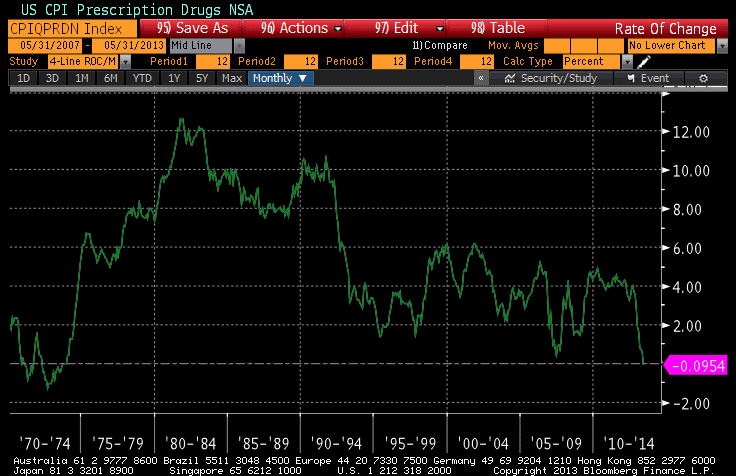
Now, I suspect that this has something to do with Obamacare, but no one seems to know the full impact of the law. Keep in mind that Medical Care in CPI excludes government spending on medical care. So, one possible narrative is that the really sick people are leaving for Obamacare while the healthy people are continuing to consume non-governmental health care services. This would be a composition effect and would imply that we should start looking at CPI ex-medical for a cleaner view of general price trends. I have no idea if this is what is happening, but I am skeptical that prescription meds are about to decline in price for an extended period of time!
But that’s the bet: either core inflation is going to go up, driven by things like housing, or it’s going to go down, driven by things like prescription medication. Place your bets.
Equity prices recovered today, but bond prices continued to slide into the long, dark night. For a really incredible picture, look at the chart below (source: Bloomberg), which shows the multi-decade decline in 10-year yields on a log scale, culminating in the celebrated breakout below that channel. Incredibly, the recent selloff has yields back to the midpoint of the channel and not outrageously far from a breakout on the other side!
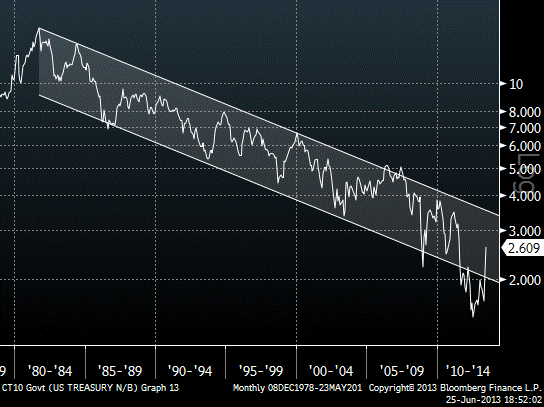
Incidentally, students of bond market history may be interested to know that the selloff has now reached the status of the worst ever bond market selloff (of 90 days or less) in percentage terms. Since May 2nd, 10-year yields have risen from 1.626% to 2.609%, a 98.3bp selloff which means that yields have risen 60.5% in less than two months.
And we are probably not done yet. I wrote about a month ago about the “convexity trade,” and I made the seemingly absurd remark that “This means the bond market is very vulnerable to a convexity trade to higher yields, especially once the ball gets rolling. The recent move to new high yields for the last 12 months could trigger such a phenomenon. If it does, then we will see 10-year note rates above 3% in fairly short order.”[emphasis in original] Incredibly, here we are with 10-year yields at 2.61%, up 60bps over the last month, and that statement doesn’t seem quite so crazy. As I said: I have seen it before! And indeed, the convexity trade is partly to blame for what we are seeing. I asked one old colleague today about convexity selling, and here was his response:
“massive – the REITs are forced deleveraging and there are other forced hands as well. The real money guys are too large and haven’t even sold yet – no liquidity for them. The muni market has basically crashed and at 5% yields in muni there is huge extension risk on a large amount of bonds: something like $750bln in bonds go from 10-year to 30-year maturities as you cross 5%.” (name withheld)
Now, I am not a muni expert so I have no idea what index it is I am waiting to see cross 5%. But the convexity trade is indeed happening.
Lots of bad things have happened to the market, but they really aren’t big bad things. In fact, I move that we stop using the term “perfect storm” to mean “modestly bad luck, but I had a lot of leverage.” The Fed was never going to be aggressively easy forever, and as various speakers have pointed out recently they didn’t exactly promise to be aggressively tightening any time soon. There is bad news on the inflation front, but the market is clearly not reacting to that. Some ETFs have had some liquidity issues, and emerging markets have tumbled, and there was a liquidity squeeze in China. But these are hardly end-of-the-world developments. What makes this a really bad month is the excess leverage, combined with the diminished risk appetite among primary dealers who have been warned against taking too much “proprietary risk.”
And markets are mispriced. Three-year inflation swaps imply that core inflation will be only 1.9% compounded for the next three years (the 1-year swap implied 1.6%; the 2y implies 1.75%). That is more than a little bit silly. While I have not been amazed that the convexity trade drove yields very high, and probably will drive them higher, it has surprised me that inflation swaps and inflation breakevens have continued to decline. Still, investors who paid heed to our admonition to be long breakevens rather than TIPS have done quite a bit better, as the chart below (source Bloomberg), normalized to February 25th (the date of one of our quarterly outlook pieces) illustrates.
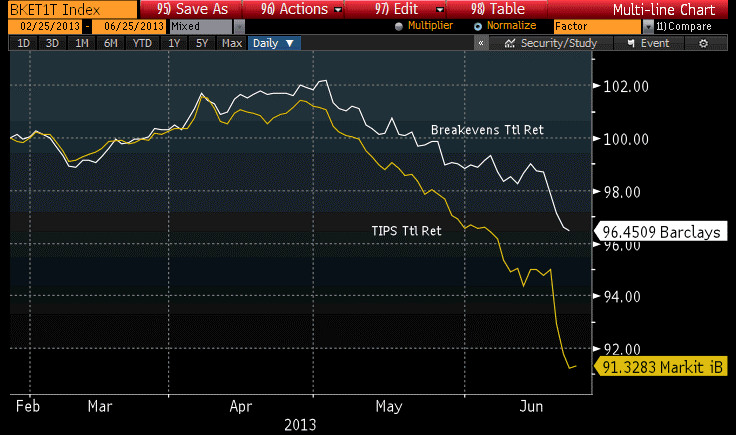
As the bond selloff extends, I don’t think TIPS will continue to underperform nominal bonds. I believe breakevens, already at low levels (the 10-year breakeven, at 1.97%, is lower than any actual 10-year inflation experience since 1958-1968), will be hard to push much lower, especially in a rising-yield environment.
