Archive
Quick Notes on the Week
I have been quasi-vacationing this week on the Continent, and trying to follow the news and the markets. This will be a brief comment but I wanted to make a couple of quick notes:
1. I did not, and I still do not, understand why there was such a violent (and negative) reaction to the Fed’s statement and Bernanke’s suggestion that the “taper” may start later this year and end in mid-2014. There are all kinds of reasons not to freak out about that. First, it was approximately what was expected (although two weeks ago there were many who thought absurdly that the Fed would begin a taper at this meeting). Second, the taper is contingent on growth continuing to strengthen, and there are scant signs of that. Third, as Bullard showed today there is far from a consensus on whether Bernanke’s time frame is going to work out – and, while ordinarily the Fed Chairman’s vote is the only one that matters, in this case he is not going to be present for the end of the taper so what really matters is who is selected to replace him. Fourth, QE isn’t doing anything right now, except artificially depressing long Treasury yields. It is probably pressuring money supply growth, but not very much. The only thing that further QE will do is make the exit that much more difficult.
That said, the violent reactions to the Fed statement are prima facie evidence of what critics of the QE policy (me, for one) have always said: we have no idea how rates and markets will react when the Fed finishes and unwinds this policy, regardless of Bernanke’s assurances. The harsh reaction (quite a bit more than I expected, especially with such a tepid adjustment to the expected trajectory) is great evidence of how over-dependent the market is on the view that the Fed’s support makes losses extremely difficult. And, I will say again, this would be so much easier if the Fed wasn’t telegraphing everything, because then investors would have invested with much more caution. The reaction this week was partly due to the shock of actually hearing the Fed mention a date for the first time.
2. Speaking of investing with much more caution, the amazing stress in certain ETFs that has accompanied significant but not exactly dramatic moves in (for example) emerging markets should blare two huge lessons to investors. The first is that you can’t increase liquidity of a pool of assets by putting them in an ETF wrapper. A pile of illiquid securities, or securities that can become illiquid in a crisis, are not more liquid because you can get a quotation every second. An ETF consisting of emerging markets bonds is never going to be more liquid than the underlying emerging markets bonds (although it may be more granular, and there are other ETF advantages…but not liquidity). An ETF consisting of commodity futures, by contrast, will be tremendously liquid because the underlying commodity markets are tremendously liquid. The second lesson is more subtle, and that is that an ETF of less-liquid securities is, in a crisis, only as liquid as the least liquid element. If you present an ETF to me for redemption and there is 1% of it that I can’t get any bid on, then the best you’re going to get is a quote at 99% of the “fair” market price. And that is especially true these days, since dealers and market-makers are capital-constrained and can’t merely take those illiquid positions on the books.
3. There is a lot of dry tinder around in the world today, and never for a minute suppose that they are not related. Stress begets stress. Two million people protesting in Brazil are doing so partly because of economic stress. Tight money market rates in China (persistent since if the central bank adds too much liquidity it will cause the CNY to depreciate) is a partial consequence of economic stress. A return of Greece from the frying pan to the fire: economic stress. And so on. This is not a safer world for all of the QE.
4. Finally, remember that growth and inflation are not related in any meaningful way. Median home prices rose more than 15% over the last year according to a report this week, and not because of great economic results. Money velocity is rising with interest rates although we may not see the results for some months. Inflation, which got a boost in the US this week with a strong CPI report (see my brief comments here), surprised on the high side in the EU and UK. TIPS yields are at +0.56% in the 10-year sector and 10-year breakevens are at 1.92%. There is absolutely no reason to own Treasuries rather than TIPS at this point. The 10-year expected real return of stocks is now less than 1.5% per annum above 10-year TIPS, and there is absolutely no reason to own equities rather than TIPS. Are TIPS cheap on an absolute basis? No. But they are screamingly cheap on a relative basis in an environment of rising inflation (and nothing the central banks can do about it – at least those who aren’t actively trying to boost it). Long-time readers will know I have been tepid at best about TIPS for some time. But, while 0.56% isn’t ridiculously cheap (and they could still get there!), our models are already maxed out on breakeven exposure and are starting to add to outright long exposure in TIPS.
Bonds and the “Convexity Trade”
It has been a long time since we have had to worry about and think about the phenomenon of mortgage convexity and the effect that it can have on the bond market. But with 10-year interest rates up 50bps in less than 1 month, and some of the selloff recently being attributed to “convexity-related selling,” it is worth reminiscing.
We need to start with the concept of “negative convexity.” This is a fancy way of saying that a market position gets shorter (or less long) when the market is going up, and longer (or less short) when the market is going down. That’s obviously a bad thing: you would prefer to be longer when the market is going up and less long when the market is going down (and, not surprisingly, we call that positive convexity).
Now, a portfolio of current-coupon residential mortgages in the US exhibits the property of negative convexity because the homeowner has the right to pre-pay the mortgage at any time, and for any reason – for example, because the home is being sold, or because the homeowner wants to refinance at a lower rate. Indeed, holders of mortgage-backed securities expect that in any collection of mortgages, a certain number of them will pre-pay for non-economic reasons (such as the house being sold) and the rest will be pre-paid when economic circumstances permit. Suppose that in a pool of mortgages, the average mortgage is expected to be paid off in (just to make up a number, not intended to be an accurate or current figure) ten years. This means that the security backed by those mortgages (MBS for short) would have a duration of about ten years, so that a 1% decline in interest rates would, in the absence of convexity, cause prices to rise about 10%.[1]
Now, that’s really just a guess based on where interest rates are currently. As interest rates change, so does the duration of the bond. If mortgage interest rates fall significantly, then most of the mortgages in that MBS would pre-pay and the duration of the security would fall sharply. Suppose that after a sufficient decline in interest rates, the same pool of mortgages in that MBS is expected to be pre-paid on average in only 3 years. Now a further 1% decline in interest rates will only cause the price of the MBS to rise about 3%. This is negative convexity, and what is significant here is how holders of MBS respond. In order to maintain a similar market exposure, the owner of the MBS needs to buy more bonds, swaps, or MBS to maintain his duration. That is, into a rally, the MBS owner needs to buy more. This is “buying high,” and it’s the manifestation of one side of that negative convexity.
Suppose that instead interest rates rise sharply. Now, instead of expecting those mortgages to economically pre-pay over the next 10 years, we realize that the opportunities for these homeowners to refinance just went away (at least for a while); consequently, we now expect the mortgages to pay off in 15 years on average, rather than 10. A further rise of 1% in interest rates will cause prices to fall 15% rather than 10%. Again, the MBS holders need to respond, and they do so by selling bonds, swaps, or MBS to maintain duration. That is, into a selloff, the MBS owner needs to sell more. This is “selling low,” and it’s the manifestation of the other side of that negative convexity.
Put together, a manager of a large MBS portfolio is earning a higher-than-average coupon, but is also systematically buying high and selling low on his hedges and losing a little money each time. More importantly for our case here is that if the market moves enough to trigger the hedging activity then we say that “the convexity trade” has caused a significant amount of selling into a selloff, or a significant amount of buying into a rally, and this essentially means fuel is being added to the fire and the move is worsened. The mortgage market is massive, and especially with dealers having less capacity for market-making risk-taking a big convexity trade could cause a huge move. In the 2000s, I recall two massive selloffs of at least 125bps over a period of just a few weeks, in which every 5bps seemed to bring out another huge seller and push the market another 5bps.
Figuring out exactly what the trigger level is at which the convexity trade kicks in is the domain of mortgage analysts, and there is a lot of brainpower and computing power put to this analysis. These folks can tell you that “a 10-year note rate of 2.25% will cause the market to get longer by 150bln 10-year note equivalents [just to be clear, this is a made up example],” which in turn implies that there will be substantially more selling when interest rates approach that level.
Now, I don’t know what the current trigger levels are, but I can tell you a few more things from years of experience.
First is that the market’s negative convexity is greatest when the market has rallied to a new level and stayed there for a long time, allowing most borrowers to refinance their mortgages to the current coupon. The chart of 10-year yields below (Source: Bloomberg) illustrates this point. In 2008, 10-year note yields fell below 2.5%, but did so very quickly and few people had a chance to refinance (plus, mortgage spreads were quite wide and credit was hard to get), so the mortgage market maintained something like its prior equilibrium.

However, over 2010 and especially after mid-2011, rates got substantially lower and stayed lower; mortgage credit also got somewhat easier than in early 2009 (although obviously underwater homeowners cannot refinance, and this limited the amount of refinancing activity so that MBS prepay speeds weren’t as rapid as the pre-2008 models had expected). We have now been at these levels for some time, so that I suspect the market’s average coupon is substantially lower today than it was two years ago. This means the bond market is very vulnerable to a convexity trade to higher yields, especially once the ball gets rolling. The recent move to new high yields for the last 12 months could trigger such a phenomenon. If it does, then we will see 10-year note rates above 3% in fairly short order.
The second point is somewhat more subtle. The nature of the negative convexity in the higher rate direction is different from the nature of the negative convexity in the lower rate direction. When rates fall, we are looking at borrowers refinancing, which means that we can stair-step lower: rates fall, borrowers refinance, rates fall further, borrowers refinance again, etcetera. But when rates rise, the duration increase is caused by a lack of activity. Borrowers eschew refinancing. And this, fundamentally, can only happen once no matter how far rates move. If it is not economical to refinance with rates 2% higher, then few borrowers will refinance. But at 5% higher rates, there is no additional effect: once your model expects essentially zero refinancing, the convexity trade is over until you get substantial new origination of mortgages, and this takes longer. Therefore, in a selloff the convexity trade is somewhat self-limiting. It sure doesn’t feel like it at the time, but it is.
This is a long article but it is worth reflecting on because of the conclusion, and that is this: if rates rise because the Fed begins to raise rates (or finds it doesn’t have enough will to keep them low, once the bond market expects much higher inflation), then there is no “cap” on how high they can go. But if rates rise in a sloppy fashion because of a convexity trade, there really is a cap. It would be ugly to see interest rates rise another 100bps (and really, really bad for stocks I think), but if they did so because of the convexity trade then we would probably get a bunch of that move reversed thereafter.
I don’t have a strong opinion about whether we are at that point yet, and I no longer have access to great mortgage analysts. But Fed speakers should tread very lightly, as I doubt the first trigger point is terribly far away and you surely don’t want to hit it.
There is one reason I don’t think that the bond market selloff we have seen to date is heavily driven by convexity-related flows, and that is that TIPS yields have risen faster than nominal bond yields. Over the period during which nominal 10-year yields have risen 50bps, 10-year TIPS yields have actually risen 58bps. If the trade was a convexity-driven trade, it would be primarily affecting nominal yields, which means that while TIPS would be suffering, they would be suffering less than nominal bonds, rather than more. (The flip side is that if you are bearish here because you think the convexity trade might kick in, you should also expect breakevens to widen substantially when that trade does kick in). Indeed, TIPS at -0.13% is the best bargain we have seen in quite some time (see chart, source Bloomberg).

Indeed, our multi-asset strategy has kicked the TIPS component all the way up to 11%, which is the highest it has been in a long while. TIPS are not cheap, but they are cheaper, and they are extremely cheap relative to nominal bonds. And they are not yet as cheap as i-Series savings bonds, although the yield advantage of those bonds has dropped from the 159bps it was when I wrote about it here to “only” 93bps. But that’s still a great arb, and so I continue to advocate i-bonds.
[1] I am abstracting from the niceties of Macaulay versus modified versus option-adjusted duration here for the purposes of exposition.
Telling Stories About TIPS
It always bugs me a bit when a market event that happens for one cause is attributed to another cause merely to advance an easy narrative. The awful 5y TIPS auction yesterday and subsequent flush of TIPS breakevens is being attributed to a “fading of inflation concerns.” There may be some fading of inflation concerns, although as I demonstrated in my last article expectations for core inflation haven’t been fading.
But the main reasons the auction failed were far simpler. Prime among these is that the 5-year TIPS have always had more problems being sold, because people who want inflation protection tend to primarily want long inflation protection. In the last couple of years, I’ve had discussions with many institutional investors who expressed interest when I discussed a 50-year inflation-linked bond. But the 5y TIPS are mainly of interest to (a) indexers and (b) foreign central banks. As such, they are prone to occasional disasters when the central banks don’t show up, dealer risk-taking appetite is low, and market momentum is such that dealers don’t feel like warehousing the auction risk until the indexes are rebalanced at month-end and the indexers come for the paper. This isn’t to say that I expected this to be a bad auction, because the last few auctions of all kinds have been pretty normal (that is, more like normal Treasury auctions than like TIPS auctions of old). But it’s not surprising to me that it happened. And it has nothing to do with inflation fears fading, except that some buyers perhaps figured they could buy at better levels later because of the market narrative about inflation fears fading.
And today, we’re seeing a big bounce-back in breakevens so far. What does that do to the narrative?
(As an aside, and for disclosure, our Fisher model identified TIPS as exceptionally cheap compared with nominal bonds after the auction and went fully long breakevens on the close.)
Preparedness
The sine qua non for a disaster is that no one is worrying about the disaster. Earthquakes are less damaging in Tokyo than the same earthquake would be in New York, because in Tokyo buildings are designed to be earthquake-resistant. This is also true in markets; if investors are guarded about purchasing equities because of all the bad things that can happen, then prices of equities will be very low and it will be difficult to effect a true crash in such a circumstance.
The opposite doesn’t necessarily follow in the physical world (if you don’t prepare for an earthquake, it doesn’t increase…so far as we know…the probability of it happening), but it occasionally does in the financial world. I pointed out in January the work by Arnott and Wu which indicates that a company which enjoys “top dog status” in terms of having the greatest market capitalization in its sector tends to underperform the average company in the market by 5% per year for a decade. This is largely because investors in such companies are not prepared for adverse surprises, so that any such surprises tend to be taken poorly. Similarly, problems in Cyprus had an outsized effect on markets because (remarkably) no one was prepared for there to be problems in Cyprus that the rest of the Eurozone wouldn’t simply write a check to cover.
By this standard, inflation is growing more dangerous by the day, as more and more investors and pundits start talking – incredibly – about deflation. St. Louis Federal Reserve President Bullard today told an audience at the Hyman Minsky Conference in New York that it is “too early” to worry about deflation. That statement must hit most readers of this column as hysterically funny, given how many readers typically complain that the CPI is far lower than their personal experience of inflation. Bullard also noted that he favors an increase in the pace of QE if inflation falls further. Since core inflation is currently at 1.9%, Bullard is essentially putting a floor on inflation near where we once thought the ceiling was.
I read somewhere today that the recent declines in copper and gold are “signs of deflation.” I disagree. At best, they are signs of fears of deflation, right? But even that, I don’t buy. While breakevens in the TIPS market have declined recently, they are still not particularly low by any historical standard (see chart of 10y BEI, source Bloomberg). Moreover, a not-insignificant part of that decline represents a direct response to energy’s retracement and isn’t a reaction to a softer opinion about core inflation.

In fact, the core inflation implied by the 1-year inflation swap, once energy is extracted, is above the current level of core inflation and near the highs that have been seen since early 2011 (see chart, source Enduring Investments).
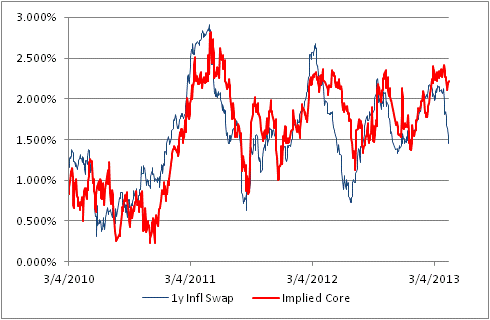
So I suspect, rather, that the causality runs the other way: the decline in copper and gold has caused an increase in chatter and vocal concern about deflation. But the people who are investing directly on whether deflation will happen aren’t seeing it. This is somewhat comforting, as it’s the people with actual money (rather than pundits and economists) who determine whether their institutions are ready.
Now, to the extent that the increased chatter actually leads to renewed relaxation in inflation expectations (ex-energy), it sets the stage for worse damage when it inevitably happens. Inflation, like earthquakes, is more injurious when societal institutions have not prepared for it. Median inflation in the U.S. over the last decade is about 2.5%. But in South Africa, it is 5.7%. In the U.S., a 5.7% inflation rate would cause major havoc, but South Africans would be amused at that since they deal every day with that pace of price change (as did Americans, in the 1980s). In Turkey, median inflation has been about 9.5%, but there again the society has adapted to it. To the extent that there is any fear in the U.S. about inflation rising to 5% or to 10%, institutions will prepare for it, and they will eventually learn to deal with it. It’s the shift to that new reality that can be especially painful.
The rest of the week has only minor economic data releases, with the Philly Fed report on Thursday (Consensus: 3.0 vs 2.0 last) the most important of them. A few Fed speakers will be on the tape. But the real market concern is concern in the market: the VIX has risen to 16.5 after having receded slightly on Tuesday; the dollar today retraced all of Tuesday’s decline and then some. Gold and commodities have not fallen further after the washout on Monday, but neither have they rejected the lower levels and rallied back. The S&P has support at 1540 or so but below that level there could be a substantial further fall. All of these markets have potential for important moves, and in the meantime there is the potential for renewed headlines out of Cyprus where there is consternation over the new demands from the EU. The trader in me would guess (stress: guess) at further weakness in equities, an attempt made by energy markets to hold near these levels, a halting rally into resting sell orders in precious metals markets, steady nominal bond markets but with some rebound higher in long breakevens. But here are the problems: (1) these are all connected – so I could easily miss on every one of these guesses; (2) any big move will affect sentiment on the others, so that there are copious feedback loops; (3) much of what happens will depend on the next quantum of news to hit the screens, and (4) Wall Street is less and less in a position to take risk and maintain orderly markets, as it has in the past. We might even simply tread water into the weekend and take our volatility on Monday. But I’m fairly convinced that more volatility is coming before markets calm down again.
But that’s not a problem, if you’re prepared for it!
.
Do you want to discuss any of this with me directly? To sign up for my free office hours, click here and pick a date and time.
Big Trade, Little Door
In ordinary times, the terrorist attack at the finish line of the Boston Marathon (officials are being careful not to call it “terrorism,” but I’m not an official so I can operate in the reality sphere) would absolutely trump anything that happened in the markets today and, in fact, would likely have been the cause of any market movement that actually occurred. That’s because most of the time markets echo the framework of the rest of reality: most of the universe is space, and most market activity is just empty noise.
This is the reason that traders who are continuously transacting in the markets are called “noise traders.”
But on Monday, there was plenty of market action and it had nothing to do with Boston, nor with the slightly-earlier ultimatum from North Korea to South Korea, which stated that military action would “start immediately.” (N.b.: There were many losers today, but one of them surely must be reckoned as Kim Jong-un. A tin-pot dictator makes a threat, and is almost immediately knocked off the front page of the New York Times by events in Boston. That must really annoy him.)
Before the attack in Boston, however, there was already plenty of financial pain. The carnage in the precious metals pits came right on cue after the negative sell-side reports of late last week had a chance to work on the psyches of investors. Gold fell 10%, and silver nearly 14%. This represents the worst two-day fall in gold in thirty years. And, while yesterday I pointed out that the commodity “super-cycle” certainly doesn’t look like one, I can understand how the picture of gold in real terms looks like it may be completing something big (see chart of gold expressed in December 2012 dollars using CPI, source Bloomberg).

There is considerable concern tonight that these losses may provoke selling in related markets as investors raise funds to meet margin calls. This is possible, although significant thumpings in the past in precious metals (it isn’t like this is the first time we’ve seen volatility in a commodity) didn’t provoke dramatic related-market action. To be sure, the avalanche is much more loaded now than it has been in the past, with equity markets sharply overvalued and investors already reaching a level of disgust with commodities. But I don’t think it goes too far. (Those may be my famous last words!)
What happened in gold and silver is a function of the big trade/little door syndrome, more than anything else. News outlets blamed the weak data yesterday in the U.S. and the small miss in Chinese GDP (7.7% versus 8.0% expected, but keep in mind that we all know these are made-up numbers) for setting off the wave of selling, but that’s just the latest straw. The break of technical levels on Friday, combined with the suddenly-burning desire of hedgies to not be the last one through the little door, is what led to such a dramatic move today. It may well continue until everyone who wants to get through the little door has done so. Or, it may not – but I would admonish an investor who wants to buy gold here to think like a trader rather than a playground monitor: don’t try to break up the fight. If the hedgies want to eat each other in a fight to get to the door, let them.
And, incidentally, remember that the big trade/little door syndrome is not limited to gold and silver. Think about equity exposures too. If you’re long by policy, fine. But if you’re long stocks and feeling uncomfortable about it, then “sell down to the sleeping point” at least.
The irony of the timing of the gold rout is potentially juicy, with CPI tomorrow. The decline in precious metals is happening partly because so many investors are abruptly convinced that inflation has truly been defeated. It is incredible to me that this belief is so widespread, but perhaps this is the sine qua non for the next washout in financial markets and the setup for the long-awaited up-move in commodities (for, although the “super-cycle” is evidently just now ending according to some observers, commodities prices have been in general decline for the last two years).
Growth is falling short of expectations, but that doesn’t have any implications for inflation. Tomorrow’s CPI is forecast to be flat and +0.2% on core, holding core inflation constant at 2.0%. Sentiment appears to be favoring a shortfall in those figures, but it is my belief that we are on the cusp of the next sustained move higher in core inflation, to be led by housing. Remember that the last two CPI figures haven’t exactly been soothing. Two months ago, core inflation was +0.3% when the market was expecting +0.2%. Last month, all eight major subgroups of CPI accelerated on a year-on-year basis, the first time that has ever happened since the current 8 subgroups have been in existence. I am loathe to pick the month where we’re going to see Owners’ Equivalent Rent finally break higher, because econometric lags are not written in stone. But it ought to be soon.
When it happens, expect sell-side economists and pundits of all stripes, to say nothing of the Federal Reserve, to downplay the significance of it. I wouldn’t expect a sudden rally in commodities or a rebound in breakevens (10-year breakevens are at the lows of the year, mainly because rates on the whole are declining – 10y TIPS yields are also within 3bps of the year’s low), but it might help stop the bleeding.
Breaking Open the Piggy Bank
We have one month in the books in 2013 already; my, how time flies when you’re having fun! But the fun may not last much longer.
I have spent lots of time, over the last year, answering the question “why hasn’t inflation responded to QE?” My response has been that it has: core inflation rose from 0.6% to 2.3% from October 2010 to January 2012, rising for a record-tying fifteen consecutive months – a feat that last happened in 1973-74, as official prices adjusted to catch up for being frozen during wage and price controls. By a bunch of measures, that was an acceleration of core inflation that was unprecedented in modern U.S. economic history. As I wrote at the time (in “Inflation: As ‘Contained’ As An Arrow From A Bow“), the only reason to defer panic was that Housing inflation was overdue to level out and decelerate. Fortunately, it did.
But, as I’ve written extensively recently, that blessing has been rescinded and the question of “why hasn’t inflation responded to QE” will shortly be moot. In the next couple of months, core inflation will begin to re-accelerate, driven by the pass-through of rising home prices into rents. In our view, the best we can hope for is that core inflation only reaches 2.6% this year. Absent a change from the historical relationship between home prices and rents, some 40% of the core consumption basket is going to be rising at 3.5% or better by late this year.
So, when will markets get a whiff of this?
We are primarily motivated by valuations, and we are patient investors. Moreover, we think it makes more sense to focus effort on valuation work, because if your valuation work isn’t pretty good then timing isn’t going to matter much. But nevertheless, it is helpful to look for signs and signals that indicate time may be drawing short. So I’d like to go all ‘techie’ for a few minutes and show three charts that suggest markets are preparing for a new, higher-inflation reality.
The first one is the dollar index (see chart, source Bloomberg). This one is interesting, because I am not convinced that U.S. QE will cause a uniquely American inflation. After all, everybody’s doing it. This chart is technically of a head-and-shoulders pattern, but I’m just pointing to that trendline that keeps bringing in buyers.

A break below the current level (and as a trader, I’d be tentative until the September lows broke as well) projects to a test of the bottom end of a much bigger consolidation pattern that has been forming since the beginning of the crisis in 2008 (see next chart, source Bloomberg – the green oval is the area of detail in the prior chart). Below there be dragons.

Now, at the same time we have inflation breakevens (the compensation, in nominal bonds, for expected inflation – represented as the raw spread between the Treasury yield and the TIPS real yield). I’ve shown this uptrend in breakevens and/or inflation swaps in a number of ways recently, but the chart below (source: Bloomberg) shows a long-term view. In the last three months, the 5-year breakeven has risen about 35bps (and you get a similar picture from inflation swaps, but the data isn’t as clean that far back). Right now, bond investors are demanding a fairly high level of expected inflation compensation over TIPS and their guaranteed return of actual inflation. We’ve got a ways to go before we hit all-time highs on the 5y BEI, but the 10-year BEI is only about 22bps away from all-time highs.

Those prior charts haven’t yet broken out, and so while the timer is buzzing the alarm might ultimately not be set off. But in commodities, there are some interesting signs that the lows may be in even though sentiment remains very negative. The chart below (source: Bloomberg) illustrates that in January, the DJ-UBS commodity index gapped through trendline resistance not once, but twice.

In my experience, technical analysis of commodity indices is a fraught exercise, but commodities have quietly been doing quite well lately. Although the S&P rose 5% in January to only 2.4% for the DJ-UBS, that’s mostly due to the first trading day of the year. Since January 9th, the DJ-UBS is +3.7% while the total return of the S&P is only +2.6%. Surprised?
Now, the conventional wisdom is that stocks are a great place to hide if there is inflation. That conventional wisdom is wrong. Stocks may do okay if starting from modest valuations, but a rise of inflationary concerns (especially if accompanied by rising interest rates) while stocks are at high valuations would likely be less than generous to equity investors.
So, of course, retail investors have been breaking their piggy banks open to rush into stocks, in a rush not seen for many years. It is tragic, but it is the natural result of the Fed’s misguided[1] crusade to stimulate the economy via the portfolio balance channel (see my discussion and illustration of this topic here). Where does the retail investor turn, when he sees rising gasoline prices, rising home prices, and a shrinking paycheck due to higher withholding rates? The television is telling him that it’s time to jump aboard the equity train. Although he has been prudently suspicious of equity markets for much of the last decade, he is also aware that the cash he has in the bank is evaporating in real value.
And perhaps that’s why total savings deposits at all depository institutions (the main component of non-M1 M2) has fallen more in the last two weeks than in any two-week period…ever. About $115bln has fled from savings accounts in the last fortnight. Now, that’s a volatile series, and it might mean nothing unless we happened to see it show up somewhere.
Like, perhaps, here?

The chart above (source: ICI, via Bloomberg) shows the net new cash flows into equity funds, which just happen to be at the highest level over the past three weeks (about $30bln) of any time during the period of data available on Bloomberg.
Again, it isn’t because the future suddenly looks bright. Initial Claims today was 368k, above expectations and unfortunately putting a big dent in the notion that the ‘Claims data over the last few weeks was signaling a meaningful shift in the rate of new claims. The number is probably still going to go lower, but it is likely to be a drift, not a break. And we will see a similar story tomorrow, probably, when the Payrolls figure (Consensus: 165k) and Unemployment Rate (Consensus: 7.8%, but I think it might tick up to 7.9%) will paint the same sort of picture. No, people are not reaching for their wallets to invest in stocks because they are suddenly flush. More likely, it’s because they’re frustrated and confused; they feel they’re being left behind. Perhaps there is a bit of desperation, if retirement is getting further away as the cost of retirement rises and take-home pay stagnates.
In any event, what you do not want to see, four years and 125% above the S&P lows, is people taking money out of savings to put into stocks. If you are not one of the people putting money in, then consider being one of the people taking your profits out – and looking to those markets that actually do tend to keep up or outperform inflation. I hasten to remind readers that they don’t ring a bell at the top of the market, and so one ought to be careful to rely too much on the “signs” and “timing signals” suggested above. But the sharp-pencil work suggests that core inflation is going to head back up in the next 2-3 months; in my opinion, you don’t necessarily need signs to position for that – you need excuses.
.
[1] One is tempted to say ‘evil,’ but I don’t believe the Fed actually is anticipating the pain they are likely to cause to the little guy. Indeed, they may believe that the impact of their actions may fall disproportionally on the rich: an economist at the Federal Reserve Bank of St. Louis recently co-published a paper entitled “Understanding the Distributional Impact of Long-Run Inflation,” which concludes in part that “When money is the only asset, a faster rate of monetary expansion acts as a progressive tax that lowers wealth inequality; when bonds can be traded, wealth inequality is less affected by inflation because the rich hold more illiquid portfolios than the poor.” [emphasis added]
Option-Like Payoffs
It seems we have a lot of option-like payoffs looming in the next few months.
By that I mean that we have a number of events that are likely to result in either-or (binary) outcomes. Think of them as options that are going to either finish in the money or out of the money. For example, either President Obama will win re-election, or he won’t. Either the Bush tax rates will be extended, or they won’t.
Those two are truly option-like, in that they also have a fixed maturity. We will know in 33 days who the President for the next four years will be. While the Bush tax rates could always be extended retroactively to cover 2013 even if it takes until February to hammer out an agreement so that can happen, the deadline to make transactions that put income or capital gains into 2012 rather than 2013 is December 31st.
Now, what we know about options is that as you get closer to expiry and are “near the money,” your gamma increases. Gamma is a measure of how quickly the option’s delta changes – how quickly you go from feeling like a likely winner to a sure loser. An example will help. If you own $660 call options on AAPL (closing price today $666.80), and they expire in a year, then it’s probably roughly a coin flip whether those calls will end up in the money or not.[1] We would say the delta is about 0.5. If AAPL sells off to $650, then looking one year out it’s still probably pretty close to a coin flip – obviously slightly less likely, but not a bunch. Maybe 0.49 is your delta, meaning that you have something like a 1% worse chance of ending up in-the-money.
But if, on the other hand, the options are expiring at 4pm today, then your $660 call is looking pretty good when the stock is trading at $666.80 at 2pm. Your delta might be 0.95. But when, by 3pm, the stock drops to $650, your chances of winning have declined dramatically. Your delta is perhaps 0.02. Because these odds move much more dramatically, we say this option has more gamma. This is a function of both the time to maturity and the nearness of the strike to the current price.
Option traders, who try to manage their risk by delta-hedging an option, like gamma a lot if they’re long options, and dislike it immensely if they’re short options.[2] That’s because if they’re short, the hedge involves them buying into strength (aka “buy high”) and selling into weakness (aka “sell low”), and often leads to frenetic trading and on occasion, serious moves on expiry day.
Where am I going with this? An observation: as we get closer to these “option events,” if they are still not resolved one way or the other the markets will likely grow more volatile. Consider what happens to an equity investor thinking about the ‘fiscal cliff’ as year-end approaches and no deal has been struck on taxes. The investor is going to be increasingly concerned about selling stocks in which he has gains, to book those gains in 2012 in case the tax rates go up a lot. If it appears that Congress is starting to resolve some issues, then this selling pressure may relent and the markets rebound. This could go back and forth as often as the headlines change, and I will tell you that those headlines will get more frequent as the deadline draws nearer. This implies to me that market volatility will probably increase as we get closer to the election, and as we move into year-end, because of these option-like events.
There are other option-like events, although less certain in timing (Israel attacks Iran, or not. Spain asks for aid and gets it, or not. Greece defaults, or not). These will have less obvious “gamma effects,” although as long as in each case they have at least two plausible outcomes that could well happen, it will tend to contribute to volatility.
In other words, with the VIX is near the lows for the year options seem inexpensive to me.
I’m having these thoughts today because I’m watching the wild gyrations in gasoline, which was -12 cents at Wednesday’s lows (finishing -7 cents) and +14 cents today. November gas covered nearly the entire 2-month range in 2 days’ trading. More near to my heart, inflation breakevens have spiked for the last few days (+8bps today) after spending half of September retracing from a spike to touch all-time wides (see chart, source Bloomberg).
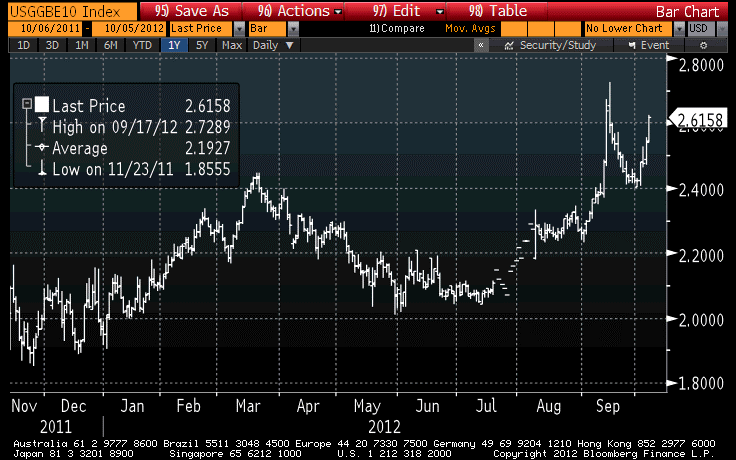
Note that this is the ten year breakeven, so it isn’t reacting here just to gasoline. And I am not aware that the outlook for growth has changed dramatically this week, nor any major money metric. What is going on? My only guess at the moment is: gamma. Small things, like a win for the Republican challenger in last night’s debate, can cause big changes in expectations, and this will become even more true as long as the race stays tight.
If we look at just that market, we could also mull the technical issues. A market that spikes to all-time highs is one thing. A market that spikes, retraces, and then rallies back to a new high would be quite another thing altogether, and might signal a new range for inflation expectations is being formed. And oh, my, would that be significant?
The equity market remains elevated, and rising inflation expectations will eventually take a toll on multiples. It always does. I don’t want to bet against equities while inflation is currently low and the Fed is trying to push the market higher, but I believe we have some volatility ahead. With implied volatilities so low on options right now, it may be worth buying puts.
[1] I am ignoring the important nuance that in this case, the forward price will be different than the spot price – it’s not important for my illustration, but you really want to compare the strike price to the forward price of AAPL, not the spot price. I make this footnote just so that readers familiar with option theory won’t think I don’t know what I’m talking about.
[2] Again, this isn’t quite true. An option trader knows that an option with a lot of gamma also has a lot of time decay, and vice versa. As a former options trader, I can tell you there is no more helpless feeling than being long gamma on expiration day and watching the market sit in a 2-tick range, knowing you’re going to lose all your time value with no delta-hedging gains, and nothing you can do about it.
Titanic Decisions
There is something very striking going on in the inflation markets, and among investors. It only recently struck me, after attending an inflation conference last week and then today participating in two discussions: one with the CIO of a large insurance company and one with a group of senior people at a large asset management firm.
If it were only that the senior people at the large asset management firm were reporting that “people are not concerned with inflation right now,” I would dismiss it. There are lots of things that investors and consumers are concerned about that the senior people at large asset management firms have no idea about. The anecdotal reports from the inflation dealers at the inflation conference carry more weight, because they’re at least focused on having that specific conversation with their clients. But the clincher was the discussion with an insurance company CIO, who reports they are definitely going to be putting on some small inflation hedges because they hedge possibilities, not probabilities, but that they actually think deflation is more of a threat here than inflation.
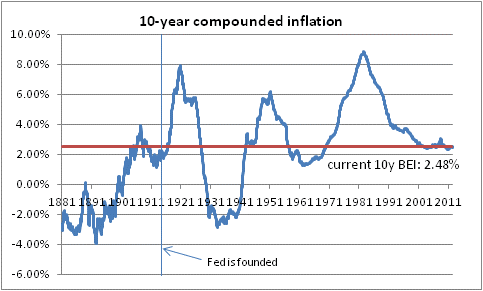
I want to first show a chart of rolling 10-year inflation in the Federal Reserve era (source: Enduring Investments), compared with the current level of 10-year inflation breakevens. With the exception of the Great Depression, when the Fed tightened policy as money velocity declined in a manifest error, inflation has almost never been below the current level on a compounded 10-year basis. And it has never, with that singular exception, been very far below the current level. Ergo, inflation insurance is very cheap, even though 10-year breakevens are not far from all-time highs (since TIPS began, in 1997).
The refrain is that “we might get inflation in a few years, and we’ll look to hedge then,” but I don’t see how that makes any sense if the cost to insure now is so all-fired low. It isn’t as if you’re giving up lots of high-yielding opportunities to buy this insurance. If the opportunities to increase return are very poor, shouldn’t one take advantage of cheap opportunities to reduce risk? It seems odd to me.
I am also flummoxed at this perspective in the context of both business risk and career risk. I alluded to this issue yesterday. Sure, maybe “we all know” that even though M2 has until recently been growing at rates that have only been associated with post-disaster Fed accommodations (after 9/11) or inflationary periods (1980s, 1970s), inflation won’t rise because Europe is a mess, but let’s briefly consider the alternative future history. Suppose that in five years, you are an investor or asset manager and sitting with a spouse or a client or a boss, and the price level has increased 50% from here. And the spouse/client/boss says “you know, Fred, we’re wondering why you didn’t load up on cheap inflation protection. I understand why you didn’t do it in 2009, but once the Fed started unlimited QE and every central bank in the world was doing similar things, didn’t you think it made sense to put on some protection? I mean, there’s always inflation when there’s too much money in the system.” What possible defense does Fred have? Is “our economists didn’t think that was going to happen” going to be a valid defense?
Now obviously, by no means is this sense universal, but it seems insanely widespread. It seems as if the intelligentsia has been persuaded that since all of the proletariat is concerned about inflation, but the smart people at the Fed are not, then they ought to bet with the Fed. I have news for these folks: the man on the street is far better at forecasting employment, and certainly no worse at forecasting inflation, than the bow-tied, blue-chip economist at a Wall Street firm or large insurance company – especially when that inflation view is adjusted for common perceptual errors that we can roughly quantify.
It’s generally true that today’s generation of investors thinks “bad inflation” is 3% and is frequently unconcerned. But in 2009 and 2010 and 2011, there were certainly investors who were beginning to get worried, which is why TIPS yields are way down here at -0.86% in the 10-year part of the curve. Nowadays, the refrain seems to be “we may need product for our retail clients,” but otherwise “remain calm, all is well.”
But I think that’s also what they told the people on board the Titanic. At some point, regardless of what the authorities are forecasting, investors need to grab for their life jackets or to head for the stairs anyway (and if I sound frustrated, it’s because we’re trying to hand people life preservers and they keep going back belowdecks). The worst thing that can happen if you’re wrong is that you’re feeling foolish, standing freezing on the deck of the ship and all really is well. The “Titanic Decision” matrix is below. I can tell you one thing: there is a single box there that I am pretty sure I want to avoid. What about you?

Model Abuse
A central bank is easing again! The only problem for U.S. market participants is that it isn’t the Fed that is easing, but the Bank of China, which last night dropped rates for the first time since 2008. This set markets up on a good tone heading into the day, and investors waited with breathless anticipation for Chairman Bernanke to echo his Jackson Hole speech and send us off to the races.
He didn’t. The Fed chief delivered what passes for moderation from the chief helicopter pilot, matching his comments somewhat obviously to ECB boss Mario Draghi’s comments from yesterday: the Fed is ready to act; long-term inflation expectations are well-anchored; but the U.S. budget trend is “clearly unsustainable” and must be put on a “sustainable path.” (Unremarked-upon was the fact that he contradicted himself when he called the so-called “fiscal cliff” at the beginning of next year “a significant threat.” Which is it? Are smaller deficits bad, or good? The answer is both – bad in the short run but really good in the long run – and the Chairman should say that. This just sounds intellectually sloppy. Then again, he is speaking to Congressmen, so using even using multisyllabic words is frowned upon.)
Any way you slice it, Bernanke did not deliver the promise of “more to come” that some investors anticipated.
Patience. Having played the stern paternal figure, Gentle Ben can now proceed to warm up the choppers. There is a growing chorus of other Fed voices in support of an ease, and in my opinion this is likely a somewhat intentional choreography in which the Chairman can appear to be persuaded by the others on the Committee to do what he wants to do. Chicago Fed President Evans today said bluntly on CNBC that “more accommodation would be good,” that he is very concerned about unemployment and doesn’t see evidence that inflation will rise (apparently he isn’t concerned with the lack of evidence that unemployment will fall due to monetary accommodation). San Francisco Fed President Yellen said yesterday at a speech in Boston that the Fed’s objective is a quick return to full employment (it seems like the Fed’s objective once contained something about price stability, didn’t it?), and that Fed action might be justified “to insure against adverse shocks,” or even if the Fed concludes that the recovery “is unlikely to proceed at a satisfactory pace.”
Really? That’s the bar now? The Fed eases if growth is merely “not satisfactory”? If that’s the answer, then get ready for an enormous amount of easing, because growth isn’t going to be “satisfactory” for quite a while even if the nation skirts a recession.
I always laugh at the assertion that “inflation expectations are well-anchored.” Yesterday I compared this phrase to the analysis that a house has “good auras” by ghost-hunters. (That’s probably not fair to ghost hunters, who may have some science to back up what they are doing as far as I know.) But the phrase also seems to mean whatever you want it to mean. We all know that short-term inflation expectations have plunged, but as I argued in a post this week that is mostly because of energy prices until quite recently. But for market-based measures of long-term inflation expectations, the measure that is popular among policymakers is the 5y, 5y forward inflation rate. Often they take this reading of “expectations” from the TIPS/Treasury breakeven curve, which is wrong, but if you’re using it to tell fortunes I guess it doesn’t matter if you use pigs’ knuckles or rat bones. However, I do think it’s worth tracking 5y, 5y forward inflation from the inflation swaps market, if only to look at what the policymakers are looking at. A chart of 5y, 5y forward inflation in the US, UK (both on the left axis) and Eurozone is shown below. (Source: Enduring Investments)
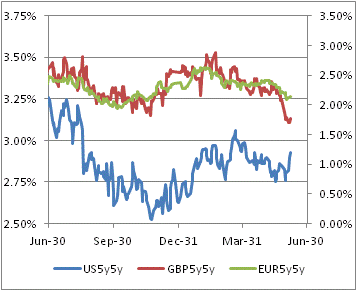
In case the point isn’t apparent, let me make it so. Euro “long-term inflation expectations” are near the lows over the last year. In the UK, that measure is plumbing new 12-month lows. But in the U.S., we’re stable if not rising. Since February 8th, 5y forward inflation is down 2bps in the U.S. but down 35bps in the UK and 49bps in Europe (which already had the lowest long-term measure of the three, near 2%, due to the prior credibility of the ECB as a Bundesbank-descended inflation fighter).
So which is “anchored?” Mario Draghi has the best argument, if this measure is useful for this purpose: Forward Euro inflation expectations are around 2% and have declined markedly recently. The UK has relatively high inflation expectations, but they’ve declined quite a bit, so that’s “anchored” to some extent…at least, there’s a drag on it. But in the U.S., forward inflation expectations are well above the Fed’s ~2.25% CPI target, and have been for quite some time. If anything, those expectations are actually rising but they’re certainly not declining. In any event, Draghi and Bernanke both call inflation expectations “anchored,” but market-based measures of this concept are showing totally different things.
.
Because I didn’t annoy enough equity bulls with my historical and quantitative observations about equity valuations and likely real returns[1] yesterday, I am going to use the tool I deployed yesterday in a manner for which it was absolutely not intended. I was reflecting on the fact that the method forecasts future 10-year returns, but it therefore takes ten years to get the scorecard back to see how things actually turned out. So why not, I thought, pretend that the future really did turn out so that the figures were perfectly accurate? What would the future history of the S&P look like in that case?
So what follows is a make-believe future price chart of the S&P 500. This is not a forecast. I am not even using rat bones.
What I did was take the 10-year real return forecast, (which as I’ve explained in the past takes the long-run real growth rate of the economy, adds dividends, and adds or subtracts most of the “pull to fair value” over the next ten years), and subtracted a 2% dividend to get the expected real index price appreciation. Then I assumed that the CPI index rose at the rate implied by the inflation swaps curve (I calculated the forward 1-month rates and accreted the CPI index by that rate each month, so roughly a 2.46% compounded rate over the whole period but around 1% in the beginning and more like 3% towards the end, as implied by the swaps curve). I took the real index price appreciation and added back inflation to get the nominal price appreciation, and voila! I have a hypothetical series which is the set of S&P index values that, if the projected real return forecast is realized and the inflation swaps curve is accurate, would occur in the future.
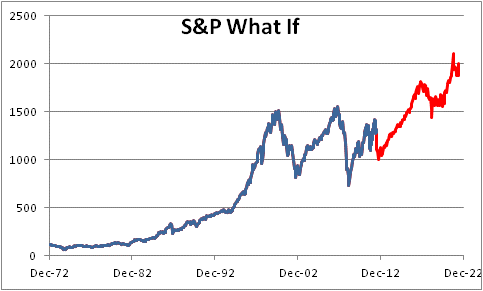
I am happy to report that based on this “method,” the S&P ought to break to new all-time highs sometime in 2016. (Please remember, this is not a forecast. It’s “for entertainment purposes only,” although the practical value of it is as a test to see if the 10-year-real-return-forecasting method produces predictions that aren’t necessarily ridiculous or overly morose. Frankly, it doesn’t seem so bad to me – the chart shows an initial 20% or so discontinuity since the current trailing 10-year return is about 2% higher than what the a priori forecast was in 2002, but then doubles over the next 10 years.
For investors that have been through a 15-year period in which the index went essentially nowhere, and actually fell appreciably in real terms, I would submit that’s not a horrible result. Yes, it’s slower than during the 1980s boom but the difference is we started that boom with stocks at very low valuations while we stand today at above-average valuations.
Let me repeat it one more time: this is not my forecast. I would certainly never forecast an actual path. It is simply the result of taking the forecasting model and essentially cranking it in reverse. And now everyone can tell me why this is stupid and implausible. Ready, go!
[1] Please do note the use of the term real return. To get the nominal return, add your expectations for inflation. But as investors, we don’t really care about the nominal return, but the returns in terms of how much additional stuff we get to consume, so I don’t normally worry about nominal returns, or look at them.
