Archive
Japanese Inflation is Rising – Of Course!
The Financial Times today carried an article entitled “Japan Inflation Rises to Highest in Nearly Five Years.” Core inflation in Japan reached -0.1%, which is actually the highest since early 2009, so not quite five years (see chart, source Enduring Investments, below). More importantly, however, the year-on-year figures are near the highest in the last decade-plus, with base effects likely to push core inflation above zero in the near future.
 This should be shocking to no one, since Japanese M2 growth recently reached the highest year-on-year growth level since … wait for it … 1999, and is now actually growing slightly faster than European money supply for the first time in a long, long time. Because, you see, money growth is intimately related to inflation. News flash!!
But the Japanese have only just begun to increase their money supply, and it is going to go a lot higher. As will inflation in Japan.
Now, here’s the conundrum of the day. If the Japanese pat themselves on the back because they are near to exorcising the deflation demon with quantitative easing, then how can Bernanke, Yellen, Summers, et. al. be so confident that our QE will not increase inflation? It can’t be the case that QE is effective at ending deflation (which was one benefit that Bernanke trumpeted in the past, too), but doesn’t tend to increase inflation. Well, I suppose it can be the case, but it would be quite weird.
The difference between the US and Japanese response to money growth over the last few years is that money velocity in the US has been declining with interest rates, while the Japanese already had rates so low that velocity had nowhere to go but up. As I have noted previously, even if velocity in the US merely levels out, 7% money growth will produce an uncomfortable rise in inflation.
So before settling into the belief, as Summers has expressed, that quantitative easing has “few harmful side effects,” it seems to me that we ought to reflect on the Japanese QE example.
Deflation Isn’t An Export; Crazy Talk Is
We are once again witnessing the market effects of a deficit of basic knowledge of economics. This is, of course, no news in itself: the list of economic conceptual errors, to say nothing of forecast errors, made by market participants over the last decade is long enough to constitute an entire course of study at an accredited college. But the current misunderstanding is somewhat bothersome because it requires only a rudimentary level of common sense to see that it cannot be so; therefore, the fact that this misunderstanding persists is a sign that people aren’t even bothering to think about whether the received wisdom is correct.
The question concerns Japan, as so many questions soon will. The statement is made that the aggressive quantitative easing by the Bank of Japan is “exporting deflation”, and is thus the profligate monetary policy of Japan creates the risk of declining inflation domestically.
To see how bankrupt (no pun intended) this thinking is, simply perform the following thought experiment. Suppose country A can cause deflation in country B by easing monetary policy aggressively. It must also be true, then, that country B can cause deflation in country A by easing their policy aggressively. Therefore, the best strategy must be for both country A and country B to ease aggressively, since that way they will both get the benefits of monetary policy easing but both will deflate.
Obviously, that’s lunacy! In this two-country case, there is much more money and yet much lower prices. This can only true if monetarist theory is completely wrong.
Let’s try a slightly-more-sophisticated version of the same confusion. Instead, we make the statement that country A can cause deflation in country B by easing policy relatively more aggressively than country A. But this still creates gains, because once country B starts to ease aggressively, country A can also ease aggressively as long as they ease less aggressively, and experience falling prices along with the other supposed rewards of monetary policy. Again, this is clearly nonsense (although a little less clearly).
This is another version of the confusion of the real/nominal confusion. In this case, people observe that the country which is more aggressive in easing will tend to see its currency decline. This is true, and it is also true (as a separate statement) that a declining currency tends to increase inflation and a rising currency tends to decrease inflation. This is where the confusion sets in: by easing aggressively, the BOJ is causing the dollar to rally – although it declined sharply today – and making investors think that will pressure our domestic inflation lower.
But where did the money go?
It is true that if the US dollar rallies then, all else equal, our domestic inflation will decline. But in this case, all else is assuredly not equal. In this case, there is much more liquidity in the system as a whole. And the effect of that liquidity swamps the effect of the FX change. I used to use a simple regression model of core inflation that included both year-on-year changes in FX and M2, lagged appropriately (along with rosemary, cumin, tarragon, and some other spices). The coefficient for the change in M2 was 0.36: that is, a 10% change in M2 would, all else equal, push core inflation up 3.6%. The coefficient for the change in the dollar index was 0.014: a 10% rise in the dollar would cause core inflation to decline 0.14%. Since these two effects typically offset each other to some degree, monetary policy is more effective in pushing prices higher if you’re the only central bank doing QE…but not much more effective.
Because historically the crazy monetary policies have been pursued by countries in isolation, which have seen their currencies crater while their inflation went to the moon, many investors have incorrectly conflated the two events. This is one reason that some traders have been expecting the dollar to collapse for some time now. But if everyone is pursuing QE, then the effect on the currency is indeterminate (not to mention unstable). The only reason we’re seeing the Yen depreciate is that they are significantly more aggressive, for now, than the rest of the world is in pursuing QE.
So in short, Japan is “a bug in search of a windshield”: yes. The Bank of Japan’s aggressive QE will cause inflation in Japan: yes. The depreciation of the Yen will “export deflation” to the rest of the world: no. In fact, the BOJ’s action will raise the price level in the rest of the world, although less than it will raise its own price level because the currency move will offset a small part of the liquidity effect.
Now, I am sure that someone will object that this violates Purchasing Power Parity, which suggests that the A-B currency pair should change exactly enough to offset the difference in price-level changes in countries A and B. My two quick observations are: (1) PPP is useful theory but doesn’t seem to describe the real world (see the Wikipedia entry on PPP for some evidence and objections), and (2) if PPP is right, then exporting deflation is also impossible. According to PPP, the BOJ QE would have no effect on our price level…so it’s not a very effective objection to my argument that “exporting deflation” is crazy talk.
Comparisons
With little economic data on the calendar, and the Fed speakers back-loaded at the Chicago Fed conference later in the week, there is time to reflect on other questions (unless, of course, the Israel/Syria back-and-forth turns into something more than the last couple of jabs have produced).
It is interesting to me that analysts and journalists truly enjoy finding comparisons between present situations and actors, except when the comparisons suggest unpleasant conclusions. This is at a time when there are really no comparable periods in history to compare to, at least with respect to major global policy initiatives!
I read comparisons between Shinzo Abe’s pressure on the Bank of Japan and Fed Chairman Bernanke’s campaign to resurrect the American economy with ever-greater monetary policy shocks. Somewhere, I saw an analyst ask “isn’t Abe taking note of the failure of U.S. monetary policy to goose the economy?” But the comparison is not apt because the two men, and the two economies, face very different challenges. Abe doesn’t need to increase consumer spending and reinvigorate the economy with monetary policy. While that might be nice, the main goal of Japanese monetary policy now is to raise the price level and the rate of inflation. They are using exactly the right tool to do so: lots of monetary easing. On the other hand, Bernanke is trying to kick-start the real economy with a monetary tool, while at least in principle avoiding an inflationary outcome. That’s like trying to hammer a nail with a fish. It might work, but it’s the wrong tool for the job. So the comparison doesn’t work: one man knows how to use his tools, the other does not.
Here is another useless comparison: “Bond Buyers See No 1994 as Bernanke Clarity Tops Greenspan.” The myth that transparency really helps markets in the long run is sort of silly: is there any sign that the crises caused by monetary policy have become less frequent since the Greenspan glasnost than they were before? I know that’s the belief, because the Fed has told us that’s the way it is. But my scorecard tells a sorry tale of bubbles and crashes since the early 1990s. It isn’t a lack of transparency that causes routs. It’s leverage, and negative gamma. Mortgage hedgers are more active now than they were in 1994, and they have larger books. Hedge funds are orders of magnitude larger. And Wall Street is smaller, and is able to provide less liquidity – partly because they are more levered (which they think is okay because of “Fed transparency”), and partly because the government doesn’t want them to take bets with the leverage they have (which, since they’re paying for failures under the current system, isn’t wholly absurd).
So will the next bond selloff not be as bad as in 1994, because the Fed will give more warning? Remember that no matter how transparent the Fed is, there is still a transition point. Somehow, the market goes from a state of thinking there will be no tightening of policy, to a state of thinking that there will be a tightening of policy. That requires a re-pricing, whether it occurs because the Fed signaled it in a speech or a statement, or because they signaled it by doing Matched Sales for the SOMA account with Fed funds already trading above target (as was the old way of telling us something had changed). There is no way to go from “not knowing” to “knowing” without a moment of realization. And when that phase change ultimately occurs, the greater leverage inherent in the market and the diminished role of market makers will cause the selloff (in my view) to very likely be more dramatic than in 1994.
One place where we cannot prevent comparisons – nor should we want to – is in the asset markets. Stocks are doing well, despite absurd valuations, because most other markets are either more-absurdly valued (e.g., Treasury bonds) or have horrible momentum that means they’re not popular right now (e.g., commodities). I have no doubt that equity performance over the next 10 years will be very uninspiring, because equity markets that start from this level of valuation never produce inspiring returns. But when people ask me what the trigger will be for a selloff, I have to shrug. There have been plenty of “reasons” for that to happen. But I think the ultimate reason is probably this: equities are perceived as the “only game in town.” I have read several articles recently that echo this one: “Bond Fund Managers are Loading Up on Stocks.” When there is some other asset class, or some other world market, that starts doing appreciably better, perhaps investors will decide to allocate away. Unfortunately, the candidates for that market are pretty few, given the general level of valuations. Could it be commodities, which is one of the few genuinely cheap markets? Or perhaps real estate, which is still only fair value but has some pretty striking momentum? I don’t know – but I am also not sitting around waiting for a “trigger event.” There may well be a selloff without such a trigger.
Droopy
For a change, fixed-income is where all of the excitement is. For more than a month (since March 5th, the S&P has closed no lower than 1540 and no higher than 1570, plus or minus a couple of nickels: a month-long range of less than 2%. What’s really amazing about that is that on seven of those twenty-three trading days, the range of the day was more than half of the month’s entire closing range. In two of the last four trading days, the intraday range was two-thirds of that for the entire month!
Meanwhile, the 10-year Treasury rate has gone from 1.90% to 2.06%, down to 1.71%, and ending today at 1.75%. The closing range in point terms of the current 10-year note was 99-16 to 102-19, or a bit more than 3% (and it was obviously more than that for the long bond). It has been a long time since bonds were more volatile than stocks over a period as long as a month.
Most of that volatility in nominal rates has been on the real interest rate side. The range in closing 10-year TIPS yields is -0.52% to -0.76%, or 24bps, compared to 35bps for the nominal yield. That’s more volatility than the real yield should be displaying at this level of rates, and it has moved TIPS from being slightly cheap a month ago to somewhat rich. Our Fisher yield decomposition model, which had been neutral on TIPS and breakevens since mid-February, is now modestly short TIPS (and still flat breakevens). Moreover, the leverage applied by our long-inflation-biased “smart beta” model is only 2/3 of the neutral leverage, so conservatism is the watchword at the moment.
The rally in TIPS and nominal yields owes much, I am sure, to the somewhat feeble data we have seen over the last week. The Employment data, in particular, were very disappointing, especially to that group of people who expected profligate monetary policy easing to create economic growth. It will surprise no regular reader of this column that I am not shocked to see a lack of growth response to aggressive monetary policy easing – as I take pains to remind readers, monetary policy is not supposed to affect growth, except in the presence of money illusion. It is therefore something less than a news flash that growth is responding more to tiny changes in government spending (albeit temporarily) than to massive changes in monetary aggregates.
To be sure, even monetary aggregates have been drooping lately…at least, the ones that matter. M2 has been lurching along in the mid-6% growth rate year-on-year, and flat over the last quarter (see chart, source Federal Reserve). That’s only slightly above the average growth rate in M2 since 1981 – although, to be fair, the average core inflation over the same time period has been about 3.1%, so core inflation is still well below where we would expect it to get to if this rate of monetary growth continues.

Growth in commercial bank credit growth, also, has retreated to only 4.1% year-over-year after spending most of the past year above 5%. It too is still right around the long-term average real growth in commercial bank credit (see chart, source Federal Reserve, Enduring Investments), but last year it had been edging towards the mid-2000s standard.

So these are positive developments from the standpoint of future inflation, but it is far too early to call victory on that front. I expect the rise in M2 to re-accelerate in fairly short order; but in any event it is important to remember that the Fed is not the only game in town and not the only central bank that is pursuing easy-money policies. Indeed, last week the biggest news was that the Bank of Japan pledged to double its monetary base, its holdings of JGBs, and its holdings of ETFs and JREITs over a period of only two years.
This policy will almost surely produce the result the Japanese policymakers have been shamelessly vocal about seeking: higher inflation, in a short period of time. At the end of the day, the inflation that Japan gets in the near-term will depend on what their domestic money velocities and multipliers do, but they will surely get higher inflation eventually just as the Fed’s policies have produced inflation even with declining multipliers and velocity. To my mind, the Japanese inflation swaps market – which according to Bloomberg is at 1.26% for 5 years and 1.01% for 10 years – seems to be cheap!
But the Japanese policy will certainly not stop at the water’s edge. Around 2/3 of our domestic inflation is sourced from global factors, and the monetary policy of a major trading partner is a significant global factor. The behavior of the Yen and industry response to changing competitive pressures from Japan will determine how much of the BOJ’s inflation remains domestic and how much is exported, but it would be surprising indeed if the result was entirely contained within the borders of Japan. The Yen has responded sharply to the policy changes at the BOJ (see chart, source Bloomberg), but in my opinion it has very much further to go. In fact, the only reason we may not get back to mid-1980s levels is that the Fed’s policy is similarly aggressive – the only difference at the moment is that the Fed is giving lip service to the notion that they intend to hold down inflation in the long run. (I don’t believe them.)

None of the above has much, if anything, to do with North Korea, or Cyprus, or Slovenia, or Portugal. All of those countries still are potential wild cards, and all of them (it needs hardly be said) constitute downside risk. The White House is seemingly satisfied to wait to see if North Korea really will launch a nuclear-tipped missile; this means that the entire distribution of potential outcomes is compressed so that there is a very high likelihood of nothing bad happening, and a very small chance of something really, really bad happening. How do you trade that? The answer is that you use options. Implied volatilities are under pressure again because the recent tight range makes it difficult to eat the time decay of long-vol positions. But as for me, I’m delighted to pay insurance premiums for insurance that turns out to be unnecessary, especially when that premium is low. I don’t have any long equity positions, but if I did then I’d be protecting them with cheap put options.
Wrapping Up – And Some Portfolio Projections
Whether it’s with a bang or with a whimper, the year is drawing to a close. So too is this author’s year; I expect that this will be my last post for 2012. Let me take a quick moment to thank all of you who have taken the time to read my articles, recommend them, and re-tweet them. Thanks, too, for your generous and insightful comments and reactions to my writing. One of the key reasons for writing this column (other than for the greater glory of Enduring Investments and to evangelize for the thoughtful use of inflation products by individual and institutional investors alike) is to force me to crystallize my thinking, and to test that thinking in the marketplace of ideas to find obvious flaws and blind spots. Those weaknesses are legion, and it’s only by knowing where they are that I can avoid being hurt by them.
In my writing, I try to propose the ‘right questions,’ and I don’t claim to have all the right answers. I am especially flattered by those readers who frequently disagree with my conclusions, but keep reading anyway – that suggests to me that I am at least asking good questions.
So thank you all, and I hope you have a blessed holiday season and a happy new year. And now, back to our regularly-scheduled article.
.
It seems likely, although not a sure thing, that 2013 will be a better year in terms of economic growth. Certainly, we are ending 2012 in better shape than we entered it. One way or the other, the budget deficit will come down – at least partly because the prospective rise in tax rates has moved forward some realization of taxable gains – and, although that is a negative from a classical C+I+G+(X-M) perspective, I believe a smaller deficit will help assuage some business and consumer fears and be no worse than neutral … if, in fact, we get a smaller deficit! A bigger point is that while Europe is far from out of the woods, a near-term exit of Greece from the Euro finally seems unlikely. Stay tuned for Italian and Spanish dramas in 2013, and plenty of other pressures on the continent, but the worst case that we feared a year ago has been at least kicked down the road a piece.
Domestic growth to end 2012 is looking better, too. Today the Philly Fed index showed its highest print since March (8.1 versus -10.7 last month and expectations for -3.0). Existing Home Sales came in at 5.04mm, the first time above 5mm (without a government program, such as got Existing Home Sales up there briefly at the end of 2009) since 2007. The inventory of existing homes fell to the lowest level since 2002 (see chart, source Bloomberg).
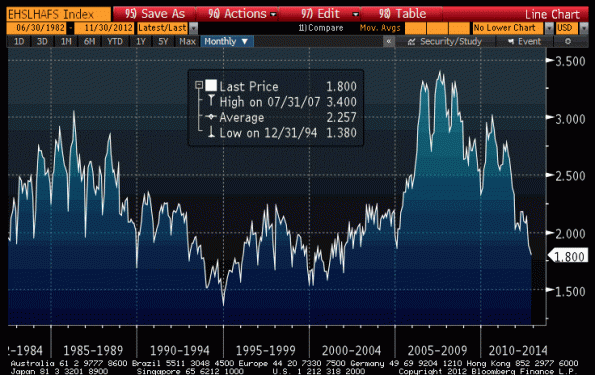
Yes, there is additional “shadow inventory,” and so this isn’t the “true” inventory once you include bank REO property and other wannabe sellers who are waiting for the market to pick up, but that shadow inventory will clear a lot faster now that prices are rising. The monthly Home Price Index from the FHFA was released today, showing that nominal home prices in October rose 5.5% over last October (see chart, source Bloomberg).

Even in real terms, home prices are rising. Over time, residential real estate has roughly appreciated at the rate of inflation plus 0.5% (so that in real terms, home prices tend to just tread water). Between 1997 and 2007, however, real home prices rose some 50% before collapsing 28% between 2007 and 2011. But this latest bounce is real (see chart, source Bloomberg; I’ve merely divided the HPI by the NSA CPI price level and multiplied by 100), and it comes thanks to profligate monetary policy. To the extent that tax rates rise but the mortgage deduction persists, fiscal policy too will probably support home prices going forward. It isn’t a sustainable rise in real prices, but if it is merely sustainable in nominal prices it will heal a lot of upside-down borrowers.

On the topic of profligate monetary policy, I ought to note that M2 growth has been reaccelerating, and has grown at a 9.8% pace over the last 13 weeks. Over the last 52 weeks, M2 is +7.6%. Assuredly, it isn’t the sustained 10% pace we saw at the beginning of 2012, but it is still far more than is needed to keep prices stable with a 2-3% real growth rate…as long as velocity stabilizes or heads higher. So, while the unemployment part of the “misery index” has been improving, the inflation part of the index is likely to continue to worsen. That will be the story in 2013, I suspect, as quantitative easing continues by central banks around the globe (and continues to accelerate in places: the Bank of Japan last night increased its purchasing program by another ¥10trln) and prices or real assets are not only no longer falling, but rather starting to rise.
Where to invest in this environment? Nominal bonds are the worst of all worlds; Treasuries are priced for a -1% real return over the next 10 years, and corporate bonds are even worse with a -2.1% expected real return. (Incidentally, you can compare these estimates to those I produced in 2010 and 2011 via these links. They’re mostly worse, following a better year from asset markets than we had a right to expect!) TIPS produce a -0.74% real return for the next 10 years. Stocks are at +2.44%, which looks good by comparison but is only fair given the risk, and low compared to historical norms – and also more expensive than they were at the end of 2011 (2.57% expected 10 year real return) and 2010 (2.58%). Commodities are cheaper: by my metric, diversified commodity indices are now expected to return 5.43% per year, after inflation, over the next decade (2010: 4.30%, 2011: 4.78%, so you can see this is not an exercise in forecasting the next year’s returns!). Residential real estate has richened slightly but is priced roughly at the long-run average, so I expect returns to be around 0.2% per year for the next decade. The chart below summarizes these estimates (source: Enduring Investments).

Our Fisher model is flat inflation expectations and short real rates; our four-asset model remains heavily weighted towards commodity indices; and our new metals and miners model is skewed heavily towards industrial metals (53%, e.g. DBB) and precious metals (43%, e.g. GLD) with negligible weights in gold miners (2%, e.g. GDX) and industrial miners (2%, e.g. PICK). (Disclosure: We have long positions in each of the ETFs mentioned.)
Feel free to send me a message (best through the Enduring website) or tweet (@inflation_guy) to ask about any of these models and strategies. And otherwise, have a happy holiday season and a merry new year! I look forward to a great 2013, a robust inflation market that continues to grow (the CME is likely to list both TIPS and CPI futures in the coming year), and no small amount of volatility to navigate. This column will return circa January 3rd or 4th.
Honest, Abe?
Today was CPI day, which after Christmas and Thanksgiving is one of my most favorite of days. Here is what I tweeted earlier today (and there’s lots more commentary below):
- unrounded core CPI at +0.18%, a bit higher than what dropped off. Not exactly alarming, but higher than Street expectations.
- y/y core to almost exactly +2.000%. Apparel rose again after the recent rise had slowed in the last couple of months.
- Subindices: ACCEL: Housing, Apparel, Transp, Food/Bev (75.2% of basket). DECEL: Med Care (6.9% of basket). UNCH: Recreation, Comm/Ed, Other
- OER was unch…rise in Housing came from primary rents (that is, you actually pay rent) and lodging away from home.
- Core goods inflation stayed stable at +0.7% y/y; core services stable at +2.5%. I think the former number is going to rise.
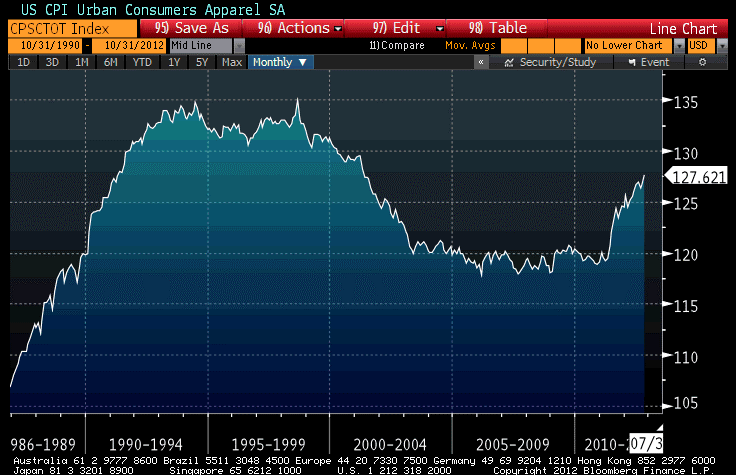
This was actually something less than the most exciting CPI report in history. It was better than the Street expected, and although the year/year figure barely nudged higher the components of the number were strong. The rise came from Housing, which ought to continue to accelerate for a while given rental tightness and other forward-looking indicators, and Apparel resumed its rise as well. See the chart below (source: Bloomberg) for the update to what is rapidly becoming one of my favorite inflation-related charts.
The Cleveland Fed’s Median CPI dropped just enough to round down to +2.2% on a y/y basis, and the Atlanta Fed’s “Sticky” CPI is also at 2.2%. These measures are other ways to look at the central tendency of the inflation figures, and suggest that the current 2.0% from the traditional Core CPI is likely to converge higher rather than vice-versa.
But today didn’t change any inflation paradigms.
There was other news, however, that struck me as inflation-related and worth commenting on.
One was a story in the UK Daily Mail citing the case of a Denny’s franchisee (he owns a few dozen Denny’s restaurants) who is planning to add a 5% “Obamacare surcharge” to customer dining checks.
Now, the sum of all of the sales of this man’s Denny’s restaurants is a tiny part of the CPI category “Food away from home,” which is itself a small part of CPI, so it won’t have any impact on the numbers. Even if lots of restaurants followed suit, it wouldn’t have much of an impact since “Food away from home” is only 5.6% of the consumption basket (so a 5% surcharge on all checks would cause a rise in CPI of 0.28%), but it serves as a good reminder of one important point.
The higher taxes and other costs of doing business that are going to be targeted at business is going to show itself to individuals one way or the other. The higher cost of Obamacare compliance, and any other increased business taxes, will not be paid by businesses for the simple reason that businesses are pass-through entities. That is, businesses don’t make money; people who own businesses (partners or shareholders) make money. So whether the higher costs show up as higher prices to the consumer (in which case the government’s attempt to raise revenue from business will result in higher inflation prints, as the transition takes place) or as lower profits to the businesses themselves, the cost will end up being borne by real humans.
At the end of the day, how much of these costs is absorbed by the owners and how much is paid by the consumers is determined by the elasticity of supply and demand for the product. For example, if the elasticity of demand is infinite, then the owners will bear the entire cost; if the elasticity is zero, then consumers will pay it all. My personal guess is that given the current level of gross margins, more of these taxes and higher costs will be paid by owners – implying lower equity earnings – than by consumers, but we will see. But notice that either way, you get lower real earnings. Either nominal earnings fall, or prices rise. Not good for stocks in either case; bad for bonds in the latter case, too.
Then there are the actions of several central banks in the other hemisphere. A story in the Wall Street Journal, and echoed elsewhere such as in this Australian news outlet, suggests that the Reserve Bank of Australia has adopted a form of QE by allowing its foreign currency reserves to rise in order to push down the currency. The RBA has been one of the bastions, at least relatively, of ‘hard money’ in a world of central banks that have gone wild, so this isn’t a positive development unless you’re long inflation-related assets.
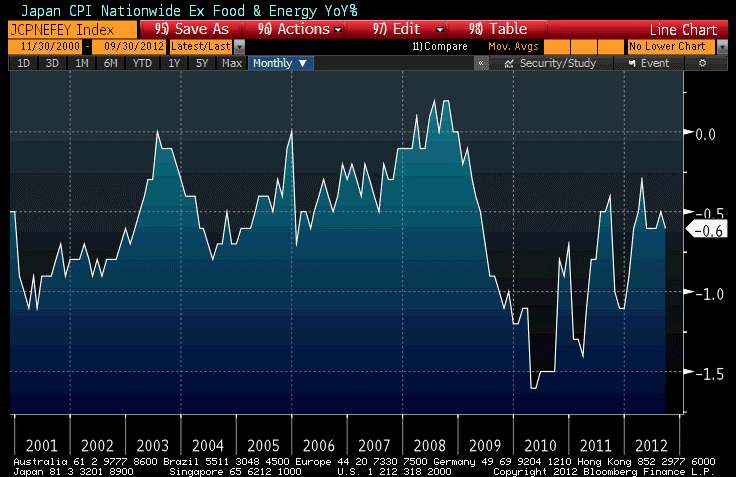
And also hard to miss were the comments by the leader of Japan’s main opposition party, Shinzo Abe, who may become the next prime minister quite soon. Abe suggested that the Bank of Japan should target 3% inflation, rather than 1% inflation, and threatened to revise the law that (supposedly) insulates the BOJ from politics. Note that 5-year Japanese inflation swaps are near all-time highs, but still only at 0.77%, and 10-year inflation swaps are at only 0.48%. Under Abe’s pressure, we would likely see a substantial acceleration in QE by the BOJ, which has already succeeded in pushing core inflation in Japan from -1.6% to -0.6% over the last two years (see chart, source Bloomberg).
We are increasingly moving into a one-way street for central bank policy. Central bankers are essentially engaging in a sophisticated version of competitive devaluations. The Fed does QE, the BOE does QE, the ECB does QE (but claims it doesn’t), the SNB and BOJ and now the RBA does QE. It is a one-way street because whoever stops printing first will see his currency shoot higher as investors flock to the harder currency. The chart below shows what has happened to the Aussie dollar over the last decade versus the USD. While the strengthening trend was interrupted by the 2008 flight-to-quality, it quickly resumed. Since that time, it has risen roughly 50% (and 100% overall since 2001).
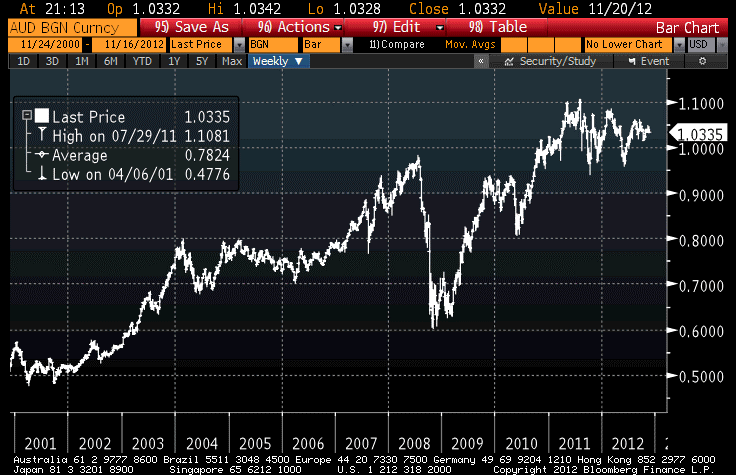
Now, a strong currency is good. It makes foreign goods cheaper and raises the standard of living overall. However, it also hurts exports, which slows the economy and results in visible layoffs while the economy adjusts. There’s only so much of this a country’s politicians are willing to take, and it seems Australia may have reached its limit.
If everyone is printing, exchange rates may not move at all. It has frustrated many dollar bears that the greenback hasn’t declined under the profligate printer Bernanke; printing money is supposed to destroy a currency. It has done so repeatedly over the course of history, and it happens for obvious reasons: when you get a bumper crop of something, its price tends to fall. More supply induces lower prices. In this case, it induces a lower price of a currency unit in terms of other currency units.
But that only happens if the relative supply of a currency is changing. If everyone is printing at roughly the same pace, there is no reason that currencies should move at all relative to each other. They should all fall relative to non-printers, or to hard assets. And that’s why it’s even more incredible that commodities are not shooting higher. Yet.
Those effects, in my view, absolutely swamp in importance the weak growth news we’re getting these days. Today, the Philly Fed report and Initial Claims were both quite weak, but the data is going to be polluted by hurricane Sandy for a while and hard to interpret. I don’t think the hurricane had anything to do with this story, or its timing for that matter:
FHA Needs Bailout From Treasury to Plug Budget, Bachus Says
“Nov. 15 (Bloomberg) — The Federal Housing Administration will need billions of dollars in aid from the U.S. Treasury before the end of the year to fill a financial hole caused by defaults on mortgages it insures, House Financial Services Committee Chairman Spencer Bachus said today.
“… The agency is “burning through” its last $600 million and FHA officials have briefed him that they will need a financial backstop within a month, the Alabama Republican said during a press conference in Washington.”
So, we are trying to figure out how to raise a trillion dollars over ten years to start closing the budget gap, but it helps to remember that there are other groups who are going to be bellying up to the bar for a hit of government help. The FHA, the postal service (-$15.9bln this year, although they expect to lose only $7bln next year), probably California before long. We’d better get our act together quickly…but as yet, there is no sign of it. Nice of Bachus to wait until less than a month before the FHA runs out of money to mention this, by the way.
And I haven’t even mentioned the sudden explosion of violence in Israel, which doesn’t give the impression of a fire that will quickly burn out. It may not spin out of control, either, but it bears watching very closely since our influence in the region has significantly ebbed since the change of control in Egypt, our exit from Iraq, and our distancing from Israel.
I don’t think 2013 is shaping up to be a very fun year. But we’re not there yet!
The Cool Kids Don’t Like Bonds Any More
Global stock markets were the boring markets for a change, as today global bond markets took a potentially meaningful step back. In the U.S., 10-year yields rose 15bps (with no economic data to point to), reaching 2.28%. Yesterday I noted that most of the last week’s rise in yields had come from an increase in inflation expectations; that trend corrected today, as TIPS were also hammered. Ten-year TIPS yields rose 12bps, to -0.10%, implying that the 10-year breakeven rose a mere 3bps.
This was not just a U.S. story. The 10-year UK Gilt rose to the highest yield since December, +17bps today. Germany was +13bps today although still in the range; JGBs up to the highest level since December although that’s also only 9bps above the low yield from the last quarter since JGB yields have been effectively ‘pinned’ for a long time.
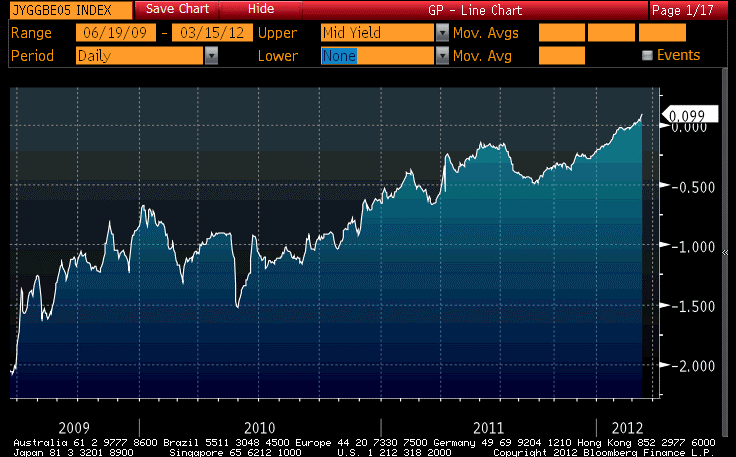
Although in the U.S. our selloff was largely in real yields today, the underlying pressure here is from prices. I have previously illustrated the fact that core inflation globally has been rising for two years; this is starting slowly to be reflected in yields. The chart below is an eye-opening one of Japanese 5-year breakevens (there is no 10-year breakeven because Japan stopped issuing inflation-linked bonds a few years ago although they may soon resume). It has been rising almost non-stop since mid-2010, from -1.5% in five-year inflation expectations to…a positive number. That’s right, the poster child for deflation now has investors expecting prices to rise (albeit a small amount) over the next five years.
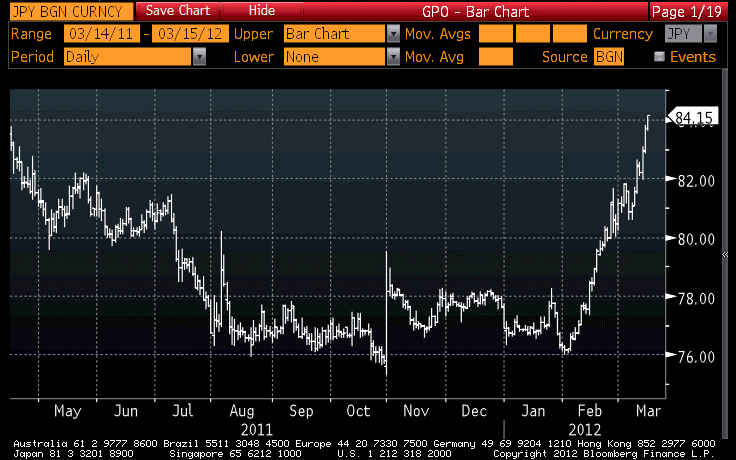
And with that small change, the yen has fallen 8 big figures against the dollar in about a month (see Chart, shown in terms of the number of yen per dollar). Higher inflation in Japan means the Yen is finally losing real purchasing power too, and is no longer essentially a one-way bet versus the dollar.
Here is another chart you don’t see much. This is 10-year Australian breakevens:

Euro 10-year inflation swap rates, despite the tremendous recent troubles, are closer to the highs than the lows of inflation expectations over the last several years:

Twenty basis points, or forty basis points, is nothing to get all in a lather about, yet. But I believe it is significant that global bond markets are all pricing in more inflation over the last few months, and nominal yields today all rose. This is not a global growth story – it’s mostly a global inflation story.
In that context, it was especially odd to see precious metals get battered again today (-3.3%), although the reasoning is easy enough to understand. Precious metals may hedge against a growth Armageddon, or they may hedge against inflation – but it is hard for them to hedge both outcomes at the same time. Betting on Armageddon has never been a good bet, so far (since we’ve had zero Armageddons as of this writing), and being long precious metals in anticipation of that event is never a good idea. That said, there are other reasons to be long precious metals as part of a diversified commodity index, and I continue to be amused and confused by the fact that inflation indications are sprouting up all over, in many markets…but not yet in commodities, which historically produces the highest inflation “beta” in the early stages of an inflation episode. I think the adjustment will eventually come, and it may be swift when it does.
To repeat, a one-day or one-week selloff in bonds, even global in nature, is nothing to get panicky about. But higher inflation, higher interest rates, and higher gasoline prices each singly poses a challenge for increasingly-lofty equity valuations. Collectively, they pose a dangerous threat. Right now, the stock market doesn’t seem to know what is good for it. It reminds me a bit of a rebellious teenager, like James Dean in “Rebel Without A Cause.” No good can come of the drag racing being done in equities right now. That being said, I covered some of my short (through equity options) on Tuesday before the Fed, because this feels like a pom-pom rally and everything is going to feel great until the morning.
So far, I can’t figure out how far away dawn is. The rapid movements in the dollar/yen, the abrupt drop in bonds, the rise in energy prices – these are all bad, but they’re still fairly insignificant moves. It will take more to derail stocks.
It won’t likely come tomorrow from the surveys (Empire Manufacturing, Consensus: 17.5 vs 19.53 last, and the Philly Fed Survey, Consensus: 12.0 vs 10.2 last) or Initial Claims (Consensus: 357k from 362k). But those are also not likely to be very bullish figures for bonds, either. I suspect the crack in stocks will come if investors notice that conditions in rates markets are getting less accommodative (or more attractive as a competing investment!). At 15bps per day, that may not take long but it’s probably not going to be on Thursday!
What Have You Done For Us Lately?
So the EU laid down the law last week: Greece had to prove that it was serious about austerity measures. It had to get all political parties who might win in elections this year to agree to maintain the austerity measures, and they did. It had to pass a bill detailing the austerity measures through parliament, and it did. The government and the major political parties went further, and sacked anyone who voted against the measure – displaying a fairly hair-raising resolve to ditch democracy if that was necessary to make a buck. And it had to find a few more hundred million in austerity measures, which it was working on.
Then a group of Euro finance ministers was to meet on Wednesday, sign off on the deal, and move the process forward so that the March bond payment would be covered (assuming a few other things, like the IIF agreement, moved forward as well).
Well, that meeting has been canceled. It is being replaced with a conference call. Jean-Claude Juncker said that they had not received “assurances” from Greek leaders about the cuts. You may read between the lines here with some ease: it is hard to imagine how greater assurances could have been given than sacking all of the dissenters and passing a law despite protestors outside threatening to burn the ancient city down.
The Euro ministers may have been surprised by the report that Greece’s economy contracted by 7% (annualized) in the latest quarter, but although that was larger-than-expected it wasn’t so different that it should completely change the EU’s perspective. To me, Juncker’s downgrading of the meeting looks like a fairly clear indication that the EU is not at all united about whether Greece should be saved, allowed to default while remaining in the EZ, or kicked summarily out of the EZ (or even the EU). It sounds like an excuse. It is hard to see how Greece could have done more than they did this weekend. I don’t believe Greece can be prevented from defaulting, and I have said that now for a very long time. I think that enough in the EU have come to the same conclusion that the default is going to happen, probably in March – and the way the EU has gone about it, frankly, is going to cause bad blood in Athens for a generation.
.
Meanwhile, in Japan the Bank of Japan overnight added ¥10 trillion (about $130bln) to their version of QE, and declared that it now has an inflation target of 1%. The BoJ didn’t state over what period inflation is to return to 1%. I will say that it’s about time – the country that has had the most need of QE, the most reason to weaken its currency, has for the last couple of decades refused to apply meaningful monetary stimulus to its deflation problem. I’m fond of saying that the BoJ correctly diagnosed the disease (deflation) and correctly prescribed the treatment (more money) but completely blew the dosage. “The body economic has cancer: radiation is prescribed. Here is a prescription for one hour in a tanning bed.” With this action, they are finally starting to increase the dosage.
I showed a couple weeks ago that core inflation in Japan, just as in Europe, the UK, and the US, has been rising (in Japan’s case, rather fitfully) for several years. But that is mainly from global factors – the rising money tide raises all prices, no matter its source. The quickest way for Japan to increase its own inflation is for it to intentionally weaken its currency. That they’ve never done this is hard to understand, and must be tied to a sense of national honor and pride in the currency. A weaker Yen would help growth and raise inflation. It boggles why a more-aggressive monetary policy hasn’t been pursued before now.
If Japan is serious, then currency-hedged Nikkei is going to finally be an interesting investment. Since 1989, the only way you wouldn’t get smoked being long the Nikkei was because you were usually buying Japanese stocks with cheaper yen than when you went to sell. While the Nikkei in Yen terms has lost about 77% over the last quarter-century, in dollar terms it has only lost about 57%, thanks to the ever-appreciating currency. If the BoJ is really going to print, and has the guts to outprint the U.S., then the Nikkei may appreciate while the currency actually weakens.
.
The economic news in the U.S. continues to be okay, but not great. Today’s Retail Sales report was better-than-expected as core Retail Sales was +0.7% versus expectations for +0.5%, but December’s numbers were revised lower and essentially offset the weakness. These are not depression numbers, but they aren’t also robust expansion numbers. We continue to stumble forward economically…but at least we’re stumbling forward.
On Wednesday, the pace picks up a little further. In addition to finding out what comes out of the conference call of the EU ministers, the February Empire Manufacturing report (Consensus: 15.00 from 13.48), January Industrial Production (Consensus: +0.7%) and Capacity Utilization (Consensus: 78.6% vs 78.1%), and the minutes of the latest FOMC meeting will be released. This last will be carefully scrutinized for details about how to interpret the new communications from the Fed, but I actually don’t expect we will learn much new: the FOMC went out of its way to tell us exactly what they wanted us to understand from the new approach.
Any Fireman Will Do
Thursday’s spotlight turned out not to be on the European summit but on the ECB. As expected, the central bank cut rates 25bps (although some expected 50bps) and loosened collateral criteria so that banks can pledge dicier assets at the ECB.
By the way, although this is a bad idea it becomes necessary because the best-quality collateral – sovereign bonds – are the securities causing all of the problems, so if a bank wants to rid itself of toxic sovereign bonds it also rids itself of a lot of collateral. So banks were doing “collateral swaps” (a good explanation is given by the Financial Times here) in increasing amounts, which in turn has the effect of creating a great contagion possibility if banks falter.
The Danish Central Bank also cut rates, to 0.80% from 1.20%, in case you’re keeping score.
But the real fireworks came when new ECB President Draghi declared that the ECB wouldn’t lend to the IMF to re-lend to sovereigns in need of aid, noting that the capital-T Treaty prohibits the ECB from financing member countries (and cute optics aside, that’s plainly what the plan was). Equity investors were shocked. The Gordian Knot of treaty obligations and limitations was supposed to be subordinate to “whatever needs to be done,” wasn’t it? After all, in the U.S. the Federal Reserve in 2008 was, um ‘flexible’ about its interpretation of its legal limitations.
If EU ministers were unified, that Gordian Knot could be cut. But the knot was tied that way on purpose; it was supposed to be problematic to circumvent because smaller countries needed assurances that their will would not be circumvented. For example, Finland’s Grand Committee of parliament today rejected the notion put forward by Merkel and Sarkozy that financial rescues conducted by the ESM needed to be fast-tracked and approved by a “qualified majority” rather than requiring unanimity. Finland pointed out that the treaty requires unanimity, and they (quite reasonably) intend to resist weakening that protection of their sovereign prerogative.
So the probability of having something awe-inspiring emerging from the European summit…something which would save the ratings of many of the Eurozone members…is very obviously decreasing. The rules are constraining the options, as they were meant to.
Stocks dropped 2.1% on this dawning realization, as well as the notion that the ECB isn’t ready to pull the “Quantitative Easing” lever as rapidly as investors were expecting them to. Inflation-linked bonds were very weak, with inflation swaps down 6-10bps despite a rallying bond market (the 10y nominal yield fell to 1.98%). Commodities were somewhat weak (DJ-UBS -0.8%), but not too bad compared to what happened in inflation markets.
This was probably partly due to some investors getting cold feet when the ECB didn’t come forth with a fountain of cash. I don’t think Draghi was as intransigent on this point as he was made out to be, and I think the ECB will continue to buy bonds until they simply can’t sterilize them all and they back into QE. But let’s suppose that the ECB really was immovable on this point, and central bankers determined that more was needed. In that case, I think it increases the chances of the Fed doing QE3. Liquidity is liquidity, as last week’s example with the coordinated action on swap lines reminds us. It’s more awkward to print dollars if Euros are needed, but there is a way to change dollars into Euros!
This is why inflation is substantially a global phenomenon, with something like 2/3 of the inflation in developed nations coming from a common global factor. You can’t just watch the Fed, although the Fed moves the needle the most. You have to watch the global tide of money, which (it hardly needs to be said) continues to rise.
While all eyes are turned on Europe, few cared about the somewhat stronger-than-expected Initial Claims (381k) today. And in the U.S., it seemed that few noticed that Japanese data has taken a serious turn for the worse. Japanese data last night (Our Wednesday night) was awful. October Machine Orders were -6.9% versus expectations of +0.5%, and that follows -8.2% in September. Don’t look now, but that’s the worst consecutive months of orders since Nov/Dec ’08. Somehow Japan’s fiscal situation has escaped notice, even though this AA-rated nation has a debt-to-GDP ratio of 200% (as of 2010 according to the CIA Factbook), which is substantially higher than Greece’s (143% in 2010) and Italy’s (119% in 2010). But let’s not think about that right now…
Choppy trading will continue on Friday and it will probably stay that way even after the summit ends, at least until the end of the year. It seems to me that stocks are more vulnerable to the downside due to optimistic positioning, especially with a weekend looming and every indication that big solutions are unlikely to come out of this summit. But I am happy to keep my hands off the trigger.
