Archive
Battle Lines Drawn
The data has started to arrive.
Tuesday’s Employment report (gosh, it seems strange to write that) was weaker-than-expected with Payrolls +148k versus expectations for +180k. As I wrote back at the beginning of August, something in the realm of 200k is about as good as you’re going to get, so we’re not very short of that…we’re just very far short of what the consensus seems to expect we’re eventually going to get. No doubt, 148k isn’t 200k, and the six-month average of 163k is the lowest of the year. But it is also not a calamity, on the growth front.
And yet, 10-year interest rates are 50bps below the highs of early September. (Real yields are actually down 60bps, which means inflation expectations have risen slightly during that period). Interest rates are down because everyone knows that the trajectory of policy, with Yellen as likely to be the next Chairman of the Fed, is going to be “lower for longer.” But why? This goes back to the observation that growth is not far short of the best that it is likely to get. The only point of “lower for longer” is to support asset markets – housing, equity, and the bond market whence our nation’s interest burden is determined – and it seems to be doing this quite well. The alternate theory is that the Fed still fears deflation, despite all evidence (and copious theory) that the risk arrow is pointing in the other direction. In neither case does the Federal Reserve come out looking particularly on top of things, but more and more we are expecting that from Washington whether the officials are elected or appointed.
I really thought at one point that the bond market was going to be where the profligate monetary policy was going to first come unglued, but I am now wondering if it isn’t that denizen of hair-trigger shooters, the foreign exchange markets. The dollar index is plumbing the lows of the last two years, although it remains considerably above the lows of 2008 and 2011. As the chart below shows, the dollar has actually left behind the commodity markets where, as we know, investors suffer from the delusion that growth is more important for the nominal price of commodities than is the overall price level. Weak-ish growth means that commodities are only weakly above its August lows, although the buck is quite a bit lower since then.
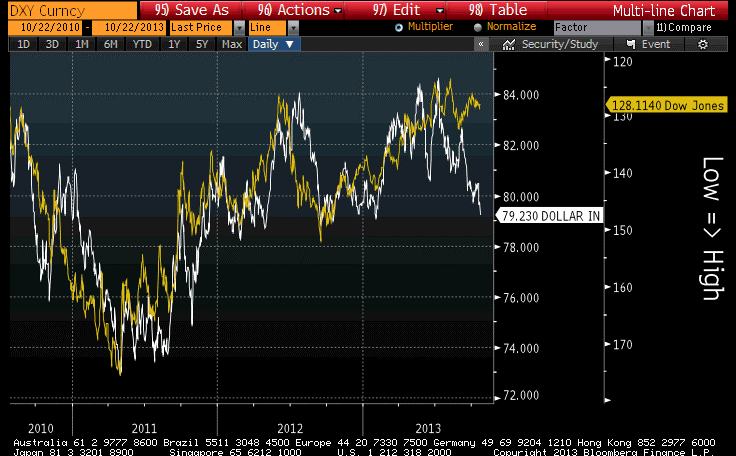
I don’t think we can learn much right now watching stocks, where investors are simply playing Icarus. We all know where it leads, but any words of warning are laughed off as they soar with Fed-induced wings. Of course they’ll turn away in time!
I think housing is interesting. Having gotten back barely to fair, or maybe just a smidge cheap, compared to incomes, housing is expensive once again. But it isn’t in bubble territory yet, at least in the sense that when it cracks it could cause the carnage it did once before.
Bonds are on tenuous footing. With the consensus currently in place that the Fed might keep QE in place more or less forever, there are a lot of ways to disappoint the status quo: Fed speakers might suddenly try to start sounding stern again and imply that QE might not last forever; inflation might continue to tick higher and make obvious the unsustainability of the current course; or growth numbers might surprise to the high side.
The barbarians are already overrunning the dollar, and I suspect only the fact that Japanese monetary policy is far worse is keeping the descent slow. But people plugged into the supply and demand for currency are probably most likely to understand what happens when too much is supplied (hint: it’s the same thing that happens to the price of corn when too much corn is supplied). For a while, monetary authorities have been chasing each other to see which could be the least respectable, but it now seems that Japan wins that race and the US is likely to place.
As the chart above shows, reasons for increasing exposure to broad-based commodity indices (especially those that do not overweight energy, as the GSCI does) continue to accumulate.
There is much more data to come, of course, but to me it seems the battle lines have been more or less drawn in this fashion.
The Longest Journey Begins With Delaying the First Step
Everyone expected markets to provide a lot of late-day volatility today, and so they did. The Fed apparently doesn’t mind surprising the market with a non-consensus outcome when that surprise gooses stocks and bonds higher. Here are some (fairly unstructured) thoughts about today’s declaration from the Fed that there will be no “taper” in its QE program yet:
- This has nothing to do with the fact that there was a minor wiggle in the Employment data, some weakness in Retail Sales, and some other disappointments this month. If that is now the standard…that the Fed plans to expand its balance sheet without bound as long as growth is not smashing the cover off the ball, then we are truly lost for QE will never, ever end. This month’s numbers were all within the normal variation for economic data, which do in fact vary even when the underlying economy is not. The old standard was “ameliorate a deep recession.” Then Greenspan turned that to “resist even a mild recession.” And now, is the standard “robust growth no matter what the long-term cost?” I don’t think so, and so I reject the notion that the failure to begin the taper has anything to do with the growth numbers.
- Similarly, the inflation numbers cannot be the reason. Core inflation is now rising, and the Fed has previously recognized that some of the decline in inflation has been due to transient effects of the sequester. Median inflation has remained steady at 2.1%, which is basically the Fed’s long-term target. The cost of 10-year deflation floors in the market are at the lowest level since they began to trade in 2009 (see chart, source Bloomberg and BGC Partners – the price is in up-front basis points). So it isn’t a lingering fear of deflation that has the Fed concerned.

- The Fed speakers over the last month have had ample opportunity to shoot down the idea that taper would start at this meeting, which has been the consensus for a long time. None of them did so, implying that the Fed was comfortable with that consensus. But something changed in the last few days, and that is that the odds-on next Fed Chairman went from being Larry Summers to being Janet Yellen, who happened to be in the meeting today.[1] Does this change the dynamic? Absolutely, since one reason Bernanke has started thinking and talking about tapering is so as to leave as clean a slate as possible so that the next Chairman wouldn’t have to start his term by tightening (sorry, I mean “reducing accommodation”) and scaring asset markets. Once Summers withdrew his name, Yellen’s vote got automatically much more important and the urgency to start the taper much less (since Yellen doesn’t believe there are any important costs to QE). Indeed, in his post-meeting presser Bernanke noted that the “first step” on a taper is “possible this year.” That is far to the dovish side of what the Street was expecting, but consistent with the notion that Yellen’s opinion will carry a heavy weight unless someone else is appointed to the post.
- Yellen said last June that the Fed’s objective is a quick return to full employment, and that Fed action might be justified “to insure against adverse shocks [emphasis mine],” or even if the Fed concludes that the recovery “is unlikely to proceed at a satisfactory pace.” So, perhaps I need to reconsider my point #1 above. Maybe that is the standard now.
- If in fact QE has no cost, then there is no reason to ever stop it. In fact, it should be accelerated. Most Fed officials seem recently to be coming to the realization that there is highly unlikely to be a costless economic remedy, even if they are not sure what the costs are or think they can be contained. Those people clearly have no voice any more, even though it appeared that those views in the last few months were gaining currency (no pun intended, since the dollar dropped to the lowest level since February after the announcement today – a Fed that was edging however slowly to being more-hawkish than average was good for the dollar; a weak, more-dovish than average central bank will be worse for the dollar all else equal). This is pedal-to-the-metal time.
- TIPS got a lot more expensive today, with the 10-year rallying 20bps to 0.475% and breakevens up 4.5bps one day before the Treasury auctions another slug of them. The auction ought still to go well, because caution has been thrown to the wind by our beloved central bankers. This is also good for commodities, and they rose today led by precious and industrial metals. Is it good for equities? Well…
- Equity analysts are like puppies. They completely forget what happened 5 minutes ago and every experience is brand new. There is never any context. So stocks shot higher today, with the S&P gaining 1.2%, because of the dovish Fed and lower interest rates. But over the last few months, as the taper grew closer and interest rates shot higher, all equities did was move to new highs. So, higher interest rates and a (relatively) hawkish Fed doesn’t hurt stock prices, but lower interest rates and a dovish Fed helps them? This may be why the Fed thinks that buying bonds keeps interest rates low and selling bonds doesn’t raise them. It’s a strange market-based notion of a perpetual motion machine. For goodness’ sake, let’s crank interest rates down 200bps, back up 200bps, down 200bps, and keep doing that and the stock market will be at 1,000,000 before you know it. Prosperity! But in fact it is probably more like a bicycle pump. Pushing down inflates the tire, pulling up doesn’t deflate it. It seems costless. However, if you keep doing that, eventually the tire will pop.
- Speaking of the perpetual motion machine, I enjoyed this little gem from the FOMC statement:
The Committee is maintaining its existing policy of reinvesting principal payments from its holdings of agency debt and agency mortgage-backed securities in agency mortgage-backed securities and of rolling over maturing Treasury securities at auction. Taken together, these actions should maintain downward pressure on longer-term interest rates, support mortgage markets, and help to make broader financial conditions more accommodative…
Really? It hasn’t worked recently. Lest they forget: the taper hadn’t started yet, but until today it was busy being discounted in the bond market. I don’t expect that merely continuing to buy bonds into the SOMA will push rates much lower again. We all know that this game ends, and we know how it ends. With 10-year notes at 2.70% I wouldn’t be selling them, but I also wouldn’t expect a massive rally to unfold. I would hold long positions in September and October, because those are the right months in which to hold bonds (especially with debt ceiling fight #2, Syria, Italy’s government disintegrating, and Germany’s election), but if the market gave me 2.45% to sell, I would sell.
[1] Note, though, that no person who has ever held the office of Fed Vice-Chairman has later been appointed to be Chairman…although Donald Kohn, since he was Vice-Chairman from 2006-2010, would also represent a departure from this same tradition. However, he was not in the room.
Verizon and Velocity
What is the significance of the fact that Verizon on Wednesday managed to sell $49bln in bonds without any kind of hiccup?
Obviously, it means that the corporate market is doing okay, that investors who are starved for good spreads like the attractive spread the bonds were priced at, and that there is reasonable confidence in the marketplace that Verizon can succeed even as a much more-leveraged company. All are good things.
But here is another thing to think about. My friend Peter Tchir, who writes the excellent T-Report, noted this morning that “Investors weren’t selling other bonds to buy Verizon.” That is, a fair amount of the money may well have been coming out of cash to go into the Verizon bonds.
Why does this matter? Remember that the velocity of money is the inverse of the demand for real cash balances. That is, when everyone is holding cash, the velocity of money is low; when no one wants to hold cash, the velocity of money is high. I have shown the chart below (source: Enduring Investments) before and argued that higher interest rates will tend to increase velocity by decreasing the demand for real cash balances. At least, that usually is what happens.

What would a turn higher in velocity look like? Well, I think it may well look something like this. “I no longer have to reach as much for yield and take all the risk I had to in March to get a 3% yield. So it’s time to invest some of this cash.”
Now, the ultimate flows get a little confusing, because cash is neither created nor destroyed in this transaction. Cash is transferred to Verizon from investors; Verizon then transfers that to Vodafone investors, who perhaps put it back in the bank for no net change. But if those investors in turn say “I don’t want those cash balances, either,” and then go invest or lend it or spend it, then you’re starting to see how money velocity is increasing. The money essentially becomes a kind of financial “hot potato” now, moving more rapidly from investor to investor, from consumer to vendor, and so on. The volume of transactions rises, which increases prices and output as explained by the MV≡PQ monetarist credo.
And that is how higher rates can produce more inflation.
We are seeing other strange things, too, that could be consistent with this explanation. Another great blog, “Sober Look,” observed last week that 30-year jumbo mortgage loan rates have fallen below conforming mortgage loan rates. Their explanation of the phenomenon is worth reading, but note this part: “Flush with deposits, banks have access to extraordinarily cheap capital and are seeking to earn more interest income.” Yet this has been true for some time. What has changed is that interest rates are now higher, increasing the opportunity cost of cash in both nominal and real terms.
This doesn’t automatically mean that money velocity is increasing; it may just be an interesting bond sale and unusual market activity in jumbo mortgages. But it is worth thinking about, because as I note in that article linked to above, even a modest rise in money velocity could produce an aggressive response from inflation.
Summary of My Post-Employment Tweets
Here are my post-Employment tweets. You can follow me @inflation_guy.
- Pretty weak NFP number since the payrolls figure (169k) plus revisions (-74k) is way worse than forecast. Decline in rate irrelevant.
- Actually think Fed spent so much time talking about starting taper that they may do it anyway, but have an excuse now to delay.
- Nothing like a weak NFP number to help the beleaguered bond market. Bounce may temporary but in Sep you don’t wanna fade rallies.
- I don’t watch it much, but avg hrly earns at 2.2% is highest since brief pop to 2.3% in mid-2011. Y do people hate TIPS here?
So 10-year note yields broke above 3% overnight, the highest level since 2011. More importantly, 10-year real yields had been approaching 1% (reaching 0.93% overnight) as fear-of-taper has investors quite reasonably fleeing fixed-income.
I said above that I don’t look much at average hourly earnings. This is because the evidence is that wages follow prices, rather than prices following wages in a mythical “wage-push” inflation. Moreover, we can intuit that this is the case because if wages led inflation, we would really like inflation since we would tend to see our wages increase before inflation did…we would be doing better all the time, rather than worse. In fact, we know intuitively that is wrong.
With that giant caveat, it is worth pointing out that average hourly earnings are above median CPI (which right now is a better measure of the central tendency of inflation because of the large one-off effects in medical care) by the most they have been since 2011 (see chart below, source Bloomberg).

The unemployment rate declined, but only because the Participation Rate plumbed a new post-Carter low at 63.2%. You have to go back to July 1978 to find participation rates this low, and back then there were a lot fewer women in the workforce.
All in all, this is a pretty ugly employment report, but the FOMC has carefully lined up its doves and even gotten a few hawks to say that tapering ought to begin this month. I suspect it is still likely that they start down that path, but probably the first steps are fairly small. Still, given how far rates have risen and the possibility that this will lead to some “taper: off” talk, and given the strong seasonal tendency for rates to decline in September and early October, I would not want to fade a bond market rally.
Guarding Your Tail
It didn’t seem when dawn broke in New York today as if the stock market would spend some time during this first post-summer session fighting to record a positive mark on the close. The S&P opened up 1% higher, partly because Chinese economic data was modestly stronger-than-expected, but mostly because hot money types sought to use the thin overnight session to try and create the impression that returning investors were flocking to buy “these cheap levels.”
But whatever the proximate cause of the overnight rally, it was met immediately with selling and three hours later the indices were flirting with unchanged on the day before a late charge produced a +0.4% finish for the S&P. I don’t think the turnaround had anything to do with the fact that Israel fired ballistic missiles into the Mediterranean as a test of anti-ballistic-missile technology last night – that information was known when we walked in, although there was some confusion about whether the U.S. was involved or not and whether it was supposed to be secret or not.
Indeed, the whole U.S. market seems far more interested in whether the Employment number this Friday is 160k or 180k than whether the U.S. or Israel attacks Syria, prompting a response from Iran and/or Syria on Israel and generally provoking the situation in the Middle East like a Mentos candy dropped into Diet Coke. This is why 10-year notes were down on the day, despite the fact that the terribly low float outside the Fed means any flight to quality could be explosive.
The odds of a flight to quality may be low, but the expected payoff is (probability of event) * (value given that event happens), the latter of which is quite high. This is one reason I would be more comfortable being cautiously long bonds at this point. I guess the counterargument is that any taper will have a disproportionate effect on the sectors with less float, but I would think that should be mostly priced in by now. Well, perhaps the Syrian conflict is priced in as well…after all, little is likely to happen very soon, unless Congress acts quickly to validate the President’s request for authorization of military action. The President doesn’t seem to be looking for a quick answer and would probably like the whole issue to just go away, so probably the most likely event is still that nothing happens in Syria that impacts U.S. interests very much.
But do keep in mind that the part of the value of a particular strategy that comes from a particular state of the world is, as I said above, (probability of the state of the world) * (value given that state of the world happens).[1] For many financial options, the value of the option is determined not by the likely or median outcome, or even the distribution of likelihood of outcomes around the strike price of the option, but rather the outcomes in the tail, where there is very low likelihood and very high value. These are all “unlikely” events, in the sense that their independent probabilities are less than 50% and in most cases markedly less:
- a hot war in the Middle East,
- an abrupt taper from the Fed, or a decision from the Fed to increase purchases,
- Merkel’s party loses the vote and is unable to form a pro-Euro coalition,
- the Yen suddenly collapses,
- the US borrowing ceiling isn’t extended without fierce brinkmanship (in mid-October, the US won’t be able to pay for everything it wants to pay for, although it will still have plenty to make debt service and entitlement payments and so is not in even remote danger of an actual default unless the Treasury simply refuses to direct its ample revenues to debt service),
- …and others.
How does your asset allocation perform under each of these scenarios? Are there tails you have unhedged? If so, then you are doing what hedge funds have been doing for the last couple of decades: selling implicit options, earning a better return today as long as a bad event doesn’t hit. In hedge fund land, we talk about being short implied credit or liquidity options, but even retail investors have this sort of position on. What happens to your portfolio if oil goes to $200, or the US suddenly drops into recession, or the Euro breaks up over the weekend? What about if inflation goes from 2% to 6%? (Interesting fact: over the last 100 years, inflation accelerated by at least 4% from one year to the next fully 10% of the time. And the probability that inflation is over 10%, given that it is over 4.5%, is 37%…so in other words, the inflation tails are very long).
Don’t ask me for answers about what you should do in these cases – my purpose in these articles is not to distribute free answers to intricate questions that depend on your personal situation. My purpose is to present the question, and the question is, have you thought about how your portfolio will perform in the case of unlikely events?
If not, spend some time doing so. My fundamental belief is that a 70% or 80% equity position is almost never the right answer for any investor. If you are sufficiently wealthy that you could lose that 80% and have it not affect your lifestyle, either now or in the future, then you truly can plan for the long haul and ignore such risks (although even then I would not ignore valuations because you can add to your long-term returns by paying attention to them). For everyone else, “long term” is probably 10 years or less, and severe impairment of the portfolio does not admit to a certain 10-year cure. Just ask the people who had most of their retirement assets in Enron, or for that matter in the NASDAQ circa March 2000.
Watch your tail. The next month or two will be interesting.
[1] Technically, this is only true if all of the enumerated states of the world are distinct. To the extent that they are not, a covariance structure comes into play…for our purposes you can think of each separate event as creating option value, but you can’t simply sum those values.
Not Broken, Just Bent?
Equity market bulls are a tenacious bunch. In August, with increasing tensions in the Middle East – Egypt and, this time, Syria – along with uncertainty over the future course of monetary policy and steadily rising interest rates, the S&P 500 has lost all of 2.8% after hitting a new all-time high early in the month. Investors who focus purely on the price charts and on the behavior of the indices should be delighted in how stocks have performed with this bad news and fairly weak earnings.
Of course, it should be noted that stocks have still not reached the 2007 highs, much less the 2000 highs, in real terms (see chart, source Bloomberg: this is just the S&P 500 divided by the CPI index). This isn’t to belittle the rally, which has roughly doubled the value of equity investments, in real terms, since the bottom. But it should remind us that this is not a secular bull market, yet, even though we have reached new nominal highs.

As we step away from the pure equity focus, though, the picture grows progressively uglier. After a period of stability in late June through early August, interest rates have begun to rise again. The 10-year note is at 2.76% (but last week approached 2.90%). The 10-year TIPS is at 0.65% after challenging 0.80%. The further selloff makes the consolidation in July look like just a pause in the middle of an otherwise-steady uptrend in yields. We were at 1.60% as recently as May! This selloff has been unusual, but then we all know that it’s because yields shouldn’t have been that low in the first place. Some of this selloff is merely returning from a ridiculously expensive position. (With all that being said, I must admit that after this kind of selloff, I would want to be taking a shot from the long side as we move into September).
Commodities are higher, with the DJ-UBS index comfortably above the 100-day moving average for the first time this year (see chart, source Bloomberg). And this isn’t merely a reflection of energy prices moving higher, because spot crude oil at $108.80 is actually back within the range it has held since early July: $104-$109. Over the last month, grains are 4% higher, livestock 2.5% higher, precious metals 10% higher, industrial metals 5% higher. So this movement in commodities has been fairly broad-based (the softs are down), even with the dollar treading water over that period.

So, while stocks are merely bent, not broken, at this stage, I’d prefer to own bonds – even nominal bonds – to them at these levels, and of course I still like commodities. I do think there is a halfway decent chance that the stock market could transition from bent to broken in the next month.
Both commodities and inflation-linked bonds did poorly today, though, at least partly because an article in the Wall Street Journal today (by Jon Hilsenrath) suggested that Yellen is “playing down her chances of getting the job,” and that therefore Summers is the front-runner.
It is probably safe to say that Summers is less-dovish than is Yellen, although we don’t know much about his monetary policy views since he seems to have few of them. We do know that he sees “few harmful side effects” from QE, which should be automatically disqualifying (almost as automatically disqualifying as being a super-intelligent academic economist should be). With either of these candidates – and it seems as if these really are the only two, since no one else has been mooted in the press – we are going to get a very dovish central banker by almost any historical standard. Central bankers have known for decades about the perils of quantitative easing…that’s why they didn’t do it in the recession of the early 1980s, or the recession of the early 1990s, or the recession of the early 2000s. Each of those recessions was plenty deep enough to warrant quantitative easing if there are few harmful side effects. But we know there are harmful side effects. So if Summers thinks there aren’t any, this just means that he is very current with the “new” wave of monetary thinking and too dismissive of the old, time-tested views (which is, after all, one of the weaknesses you can expect from a ‘brilliant academic’ who has already proven himself unable to manage one institution filled with other brilliant academics).
Now, I find it personally distressing that the market is so concerned with who the Fed Chairman will be. It shouldn’t matter that much, and here is something to reflect on: it wouldn’t matter so much if monetary policy were as straightforward and as much of a science as central bankers are trying to convince us that it is. The fact that the market thinks it matters (as do I) is all the evidence you need that it does matter, and that central banking is more art than science. And you can guess what I think about most modern art too, by the way.
In the context of the fact that the Fed itself appears to be pretty much broken, not bent, I guess I take solace in another thought: given the quantity of “excess reserves” in the system, the Fed can’t do much, positive or negative, for a while. The die has been cast, and it won’t really matter who takes the Chairman’s crown from Bernanke unless that person has a brilliant way to hit the delete key and make those reserves vanish. Otherwise, those reserves are going to press on the transactional money supply, and continue to push inflation higher over the medium term.
It’s Risk Parity, Not Risk Party
I am disinclined to take victory laps when most people are losing money, but the recovery in commodities prices over the last week at the same time that bond and equity prices are both declining is a taste of success for my view that has been rare enough lately. That is, of course, the burden that a contrarian investor bears: to be wrong when everyone else is having fun, and to be right when no one wants to go out and celebrate. In fact, if you find yourself sharing your successes too often with other people who are having the same successes, I would submit you should be wary.
It is worth noting that the commodities rally has not been led by energy, despite the terrible violence in Egypt which threatens, again, to ignite a spark in the region. Today, the rise in commodities was led by gold and grains; yesterday by cows and copper (well, livestock and industrials).
I don’t think that this is because of a sudden epiphany about inflation. In fact, although breakevens have been recovering from the oversold condition in June (more on that in a moment), the inflation data today did nothing to persuade inflation investors that more protection is needed. I gave some thoughts about the CPI report earlier today in this post, but suffice it to say that it was not an upside surprise. (And yet, there are starting to appear more-frequent smart articles on inflation risks. I commend this article by Allan Meltzer to you as being unusually clear-eyed.)
And commodities are not moving higher because of renewed enthusiasm about growth, I don’t think. Today economic bell cow Wal-Mart cut its profit forecast because higher taxes are causing shoppers to be more conservative (perhaps in more ways that one). And, while today’s Initial Claims figure was good news (320k versus expectations for 335k), weakness was seen in Industrial Production (flat, with downward revisions, versus expectations for +0.3%) and both Empire Manufacturing and Philly Fed came in slightly weaker than expectations. None of this is apocalyptic, but neither is it cause for elation about domestic or global growth prospects.
While the nascent commodity rally makes me personally feel warm and fuzzy, the more-momentous move is in what is happening to interest rates. And here I need to recognize that until very recently, I thought that bonds would follow the typical pattern of a convexity-exacerbated selloff: after a rapid decline, the market would consolidate for a few weeks and then recover once the overhang had cleared. I’ve seen it aplenty in the past, and that was the model I was operating on.
But I believe rates are heading higher. Although the overhang from the prior convexity selloff has probably been distributed, there is a new problem as illustrated by the news today about Bridgewater’s “All Weather” fund. The All-Weather Fund is an example of a “risk parity” strategy in which, in simplified form, “low-volatility” strategies are levered up to have the same natural volatility as “high volatility” strategies. The problem is that levering up an asset class with a poor risk-adjusted return, as fixed-income is now, doesn’t improve returns or risks of the portfolio at large. The -8% return of the AWF in Q2 illustrates that point, and makes clear to anyone who bought the great marketing of “risk parity” strategies that they probably have much more rate risk than they want (although according to the Bloomberg article linked to above, Bridgewater “hadn’t fully grasped the interest-rate sensitivity” of being long 70% of net assets in inflation-linked bonds and another 48% in nominal bonds. I do hope that’s a mis-quote).
The unwinding of some of that rate risk (Bloomberg called the panicky dumping of a relatively cheap asset class, TIPS, into the teeth of a retail and convexity-led selloff “patching” the risk) helped TIPS bellyflop in May and June, and to the extent that institutional investors wake up and reduce their levered long bets on fixed income we might see lower prices much sooner than I expected across the entire spectrum of fixed-income. Indeed, without the Fed or highly levered buyers, it’s not entirely clear what the fair clearing price might be for the Treasury’s debt. I was at one time optimistic that we would get a bounce to lower yields after a period of consolidation, but this news is potentially a game-changer. Although the seasonal patterns favor buying bonds in August and early September, the potential downside is much worse than the potential upside.
The Disturbing Evolution of Central Banking
One of the more disturbing meta-trends in markets these days is the direction the evolution of central banking seems to be taking.
I have written before (and pointed to others, including within the Fed, who have written before[1] ) about the disturbing lack of attention being paid in the discussion and execution of monetary policy to anything that remotely resembles money. Whether we have to be concerned about money growth in the short- and medium-terms, ultimately, will depend on what happens to the velocity of money, and on how rapidly the central bank responds to any increase in money velocity. But there are trends that could be much more deleterious in the long run as the fundamental nature of central banking seems to be changing.
Today the Bank of England released its Quarterly Inflation Report, in which it introduced an “Evans Rule” construction to guide its monetary policy looking forward. Specifically, the BoE pledged not to reduce asset purchases until unemployment dropped below 7% (although Mark Carney in the news conference verbally confused reducing asset purchases with raising interest rates), unless:
“in the MPC’s view, CPI inflation 18 to 24 months ahead is more likely than not to be below 2.5 percent; secondly, if medium-term inflation expectations remain sufficiently well anchored; and, thirdly, the Financial Policy Committee has not judged the stance of monetary policy — has not judged — pardon me — the Financial Policy Committee has not judged that the stance of monetary policy poses a significant threat to financial stability, a threat that cannot otherwise be contained through the considerable supervisory and regulatory policy tools of various authorities.”
This is quite considerably parallel to the FOMC’s own rule, and seems to be the “current thinking” among central bankers. But in this particular case, the emperor’s nakedness is revealed: not only is inflation in the UK already above the 2.5% target, at 2.9% and rising from the lows around 2.2% last year, but the inflation swaps market doesn’t contemplate any decline in that inflation rate for the full length of the curve. Not that the swaps market is necessarily correct…but I’ll take a market-based forecast over an economist consensus, any day of the week.
So, for all intents and purposes, while the BOE is saying that inflation remains their primary target, Carney is saying (as my friend Andy the fxpoet put it today) “…the BOE’s inflation mandate was really quite flexible. In other words, he doesn’t really care about it at all.”
Along with this, consider that the candidates which have so far been mooted as possible replacements for Bernanke at the US Fed are all various shades of dovish.
Here, then, we see the possible long-term repercussions of the 2008 crisis and the weak recovery on the whole landscape of monetary policy going forward for many years. In some sense, perhaps it is a natural response to the failure or monetary policy to “get growth going,” although as I never tire of pointing out monetary policy isn’t supposed to have a big impact on growth. So, the institutions are evolving to be even more dovish.
At one time, I thought it would happen the other way. I figured that, since the ultimate outcome of this monetary policy experiment is clearly going to be higher inflation, the reaction would be to put hawkish central bankers in charge for many years. But as it turns out, the economic cycle actually exceeded the institutional cycle in duration. In other words, institutions usually evolve so slowly that they tend not to evolve in ways that truly hurt them, since the implications of their evolution become apparent more quickly than further evolution can kick in and compound the problem. In this case, the monetary response to the crisis, and the aftermath, has taken so long – it’s only half over, since rates have gone down but not returned to normal – that the institutions in question are evolving with only half of the episode complete. That’s pretty unusual!
And it is pretty bad. Not only are central banks evolving to become ever-more-dovish right exactly at the time when they need to be guarding ever-more-diligently against rising inflation as rates and hence money velocity turn higher, but they are also becoming less independent at the same time. A reader sent me a link to an article by Philadelphia Fed President Plosser, who points out that the boundaries between fiscal and monetary policy are becoming dangerously blurred. It is somewhat comforting that some policymakers perceive this and are on guard against it, but so far they seem ineffectual in preventing the disturbing evolution of central banking.
[1] Consider reading almost anything by Daniel L. Thornton at the St. Louis Fed; his perspective is summed up in the opening sentence of his 2012 paper entitled “Why Money Matters, and Interest Rates Don’t,” which reads “Today ‘monetary policy’ should be more aptly named ‘interest rate policy’ because policymakers pay virtually no attention to money.”
Sweet And Sour
Yes, I understand that it is an absolute blast to be long stocks when they are ripping higher. Everyone has fun, everyone feels wealthy, and all it took was for the Fed to defer a statement on the taper plan for at least a couple of months. For equity folks, that was equivalent to sounding the “all clear” signal to keep the party going for another couple of months. Add to that great news the fact that the ISM manufacturing index unexpectedly leapt today to two-year highs (see chart, source Bloomberg, below), and you have the possibility of good growth, with a supportive Fed. It isn’t that surprising that in the short term the equity folks are happy and the bond folks are a bit concerned.
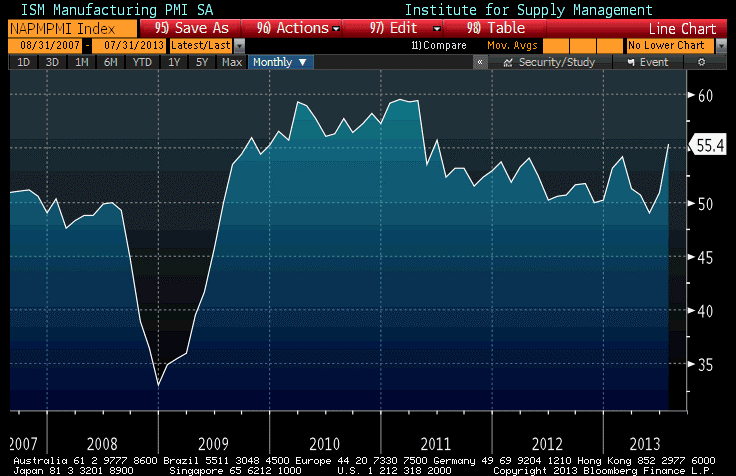
But the worst threat to stocks isn’t the taper, it isn’t an incipient slowdown in China, and it isn’t the fact that margins appear to be compressing. It’s that they will, some day, face competition for investment dollars from interest rates, commodities, real estate, and all of those other things that haven’t been exciting to invest in for a while.
Ten-year interest rates at 2.70% are not an exciting investment, but they are definitely more exciting than 1.60% rates were. However, you don’t really need to think about whether marginal investment dollars will flow to bonds since rates are 110bps higher now. You know that, no matter what the yield, more investment dollars are going to be flowing to fixed income going forward.
How do we know this? We know it because the Fed isn’t going to be buying $85bln per month, at some point in the not-too-distant future. So we know that, even if the Fed doesn’t sell, the bond market will be soaking up another $85bln of investment dollars compared to what it has been doing during QE3. And those dollars will need to come from somewhere. After all, this is just the ‘portfolio balance channel’ in reverse. The Fed pushed risky markets higher by buying all the safe stuff, so as to force investors to move out the risk spectrum. By taking away the “safe” alternatives, in other words, the Fed substituted for “animal spirits” in the market. (I discussed and illustrated this back in January.)
The opposite also occurs, though. When the Fed steps out, some investors will buy those “safer” investments at the higher yields where those markets clear. Those investors will be coming out of stocks, mainly. By substituting for animal spirits, the Fed pushed the stock market higher when investors didn’t feel much like pushing it there. And, once they start to taper that policy, they need investors with real animal spirits to step in and take risky positions in stocks because they want to.
The head-scratcher for me is, why would I want to take a risky position in stocks now, when interest rates and in particular real interest rates, are higher…if I didn’t want to take that position before? Does growth suddenly look that much better?
I ought to reiterate here that I still think a bond rally is due, despite today’s shellacking in a fairly illiquid-seeming market. I will change that view if 10-year yields rise another 5-10bps, however. I frankly think that while Bernanke likely wants to take the first step towards tapering while he is still Chairman – since it’s the polite thing to do to take the riskiest step of unwinding his policy before the next Chairman is forced to do it – I doubt he wants to get so far down the tapering road that the next Chairman feels locked in to a certain course of policy. So I suspect we will not see as much tapering this year as the market expects. Investors clearly thought we would get some indication about tapering at this meeting, and we didn’t. Bond folks know we will, eventually. Equity folks also know we will, but they all think they can get out as soon as the Fed gives the signal.
The problem, of course, is that some investors won’t wait for the explicit signal. To be fair, it has been a losing trade to be early on the Fed taper story, but that just means the ultimate comeuppance is going to be worse.
There is a ton of data due out on Friday, but my attention will not be on the Payrolls figure (Consensus: 185k). It is perhaps frightening to think about this, but Payrolls in the neighborhood of 200k is about all that we can expect. The chart below (Source: Bloomberg) shows the BLS Nonfarm Payrolls statistics along with a 24-month moving average. Ignore the swings from month to month. Instead, notice that in the expansion in the mid-2000s the 2-year average never got above 200k, and even in the robust expansion of the late 1990s the average was only about 250k (and we’re not about to have a robust expansion any time soon!). So, whether you like it or not, 200k per month is about all you’re going to get.
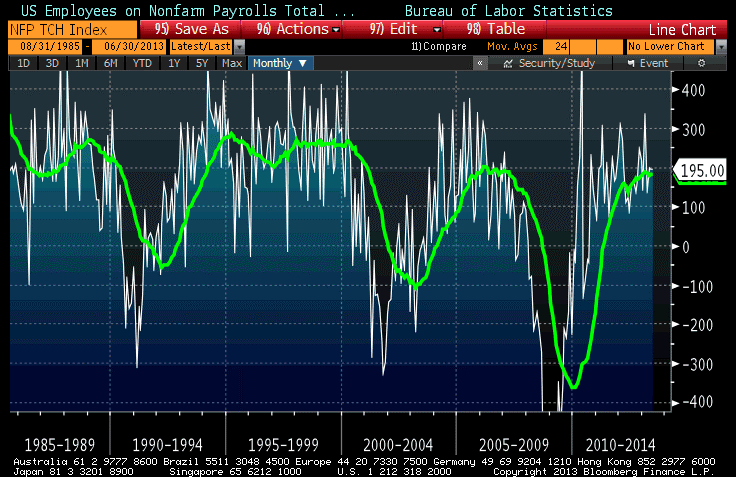
The Unemployment Rate is expected to decline back to 7.5% after rising to 7.6% last month. And again, here, the rate of decline in the Unemployment Rate is about as fast as you’re going to get it (see chart below, source Bloomberg). In fact, if anything the decline in the ‘Rate is slightly faster than in recoveries past, although as has been well documented the unemployment rate is much higher if you discount the increased prevalence in this recovery of part-time work.
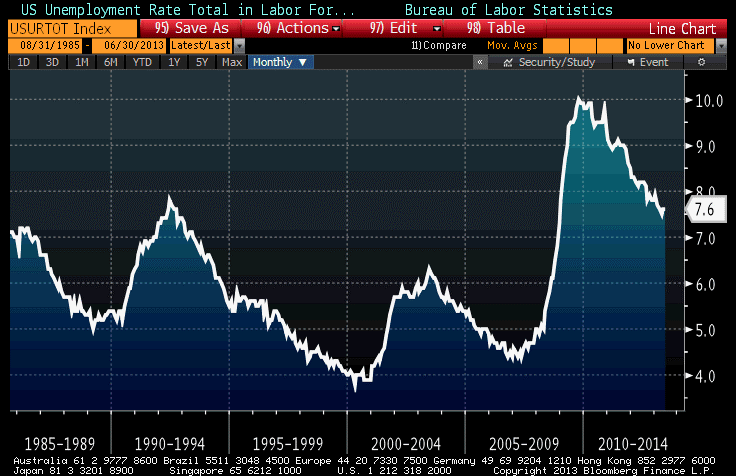 So, on growth the sad truth is that we have been waiting for economic improvement, but none is coming. This is about as good as it is likely to get, economically speaking (at least, in terms of the pace of improvement, though with time this will pull the Unemployment Rate gradually lower).
Indeed, much faster growth would likely incline the Fed to taper faster, and even to consider additional tightening measures. And much slower growth would probably dampen the rather ebullient earnings estimates of the sell-side analysts. The dividend yield is less than 2% with inflation-linked bonds paying around 0.5%. So I won’t be looking at the numbers very closely. We are already in the sweet spot. What I am going to be looking for, tomorrow and going forward, is any sign that investors are getting a sour taste.
